

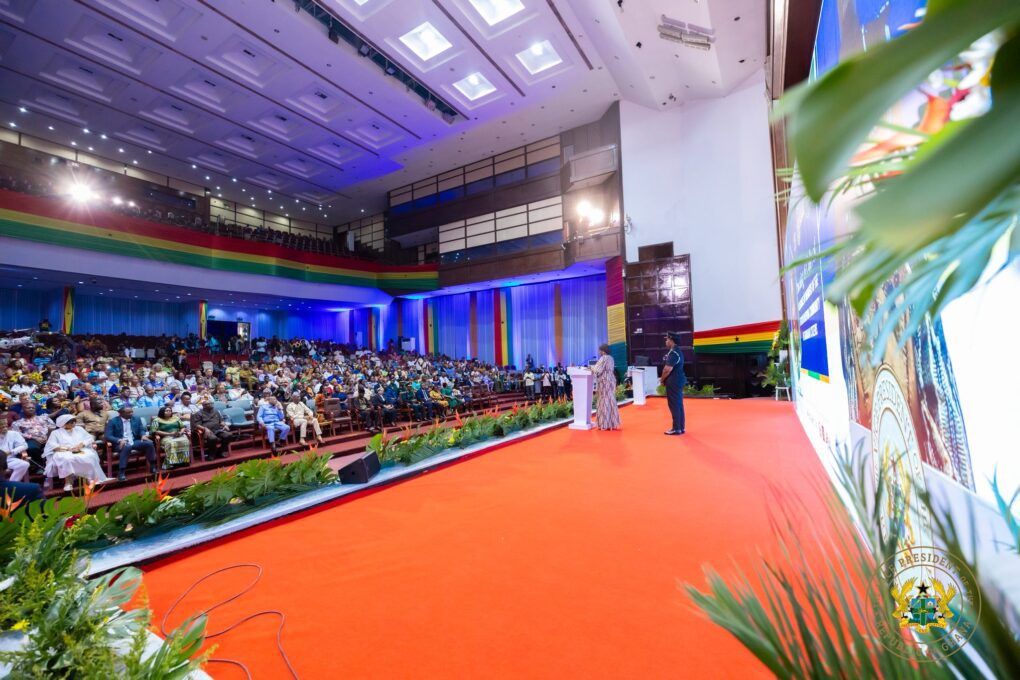
After completing the necessary application and verification process, the government granted Ghanaian citizenship to 155 individuals of the African diaspora at a lively event in Accra yesterday.
The new citizens, waving small Ghana flags and dressed in a mix of traditional and formal apparel, smiled with delight as they took the Oath of Allegiance administered by Circuit Court Judge Annette Sophia Essel, legally vowing loyalty to the country.
The event, held at the Accra International Conference Centre, also included the Vice-President, Professor Naana Jane Opoku-Agyemang, assisting some government officials and attended by ministers of state, members of the diplomatic corps, and diaspora community representatives.
It was a further step in the nation’s efforts to improve relations with the African diaspora worldwide and increase engagement with individuals of African origin.
The granting of Ghanaian citizenship to individuals of the diaspora, according to Vice-President Opoku-Agyemang, is more than just a standard legal procedure; it is a potent statement of identity, history, and belonging.
She added that although history may disperse a people across continents, it cannot erase their identity or break their ties to their ancestors. The event, she said, symbolised the ongoing connection between Africa and its descendants worldwide.

“The history of the transatlantic slave trade remains one of the darkest chapters in human civilisation.”
“Ghana has, therefore, taken a principled position that the Transatlantic Slave Trade must be formally recognised by the international community as one of the gravest crimes against humanity,” Prof. Opoku-Agyemang said.
“Our government is leading efforts at the United Nations to secure that recognition, not as an act of symbolism, but as a commitment to truth, remembrance, justice and restoration for peoples of African descent everywhere,” she added.
Professor Opoku-Agyemang further stressed that granting citizenship to diaspora members was a declaration that the nation acknowledged and embraced the descendants of Africans whose lives had been upended by the transatlantic slave trade.
It was an act of moral reconciliation and historical restoration, she continued.
According to her, the ceremony reaffirmed the nation’s status as a home for the global African family and emphasised that granting citizenship was about more than just nationality; it was also about recognising a common heritage and confirming the enduring and significant ties between Africa and its diaspora.
According to the vice president, the African diaspora is one of the continent’s most valuable sources of talent, knowledge, creativity, and economic power.
She said that through investments, philanthropy, entrepreneurship, and remittances, diaspora people support African economies with billions of dollars each year.
According to Prof. Opoku-Agyemang, their contributions created communities, supported families, and increased development chances.
However, she emphasised that economic factors were not the only factors influencing the nation’s interactions with the diaspora.

She stated that the administration believed that the link between Africa and its diaspora must be based on identity, belonging, and a common destiny.
Prof. Opoku-Agyemang explained that the administration was strengthening a comprehensive Diaspora Engagement Policy aimed at transforming historical connections into practical partnerships, stating that it would create pathways for diaspora investment, support entrepreneurship, and encourage collaboration in education, innovation, tourism, and national development for mutual benefit.
Muntaka Mohammed-Mubarak, Minister of the Interior, said the ceremony marked the end of a legal and administrative procedure in which persons with strong ties to the country were formally granted citizenship.

He stated that the Ministry of the Interior and its partner institutions are dedicated to ensuring that citizenship acquisition remains transparent, credible, and in accordance with Ghanaian laws.
The minister added that the conferment provided new citizens with the rights and protections promised by Ghanaian law while also entrusting them with the obligations that come with citizenship.
He referred to the diaspora as the country’s 17th and Africa’s sixth region, emphasising that its knowledge, investments, creativity, and cultural links were critical to national progress and international participation.
Mr Mohammed-Mubarak also mentioned projects like PANAFEST, the Joseph Project, Year of Return, and Beyond the Return, and stated that the country was building organised connections with the diaspora through policies like the Diaspora Birthright Certificate Framework.
“The global community acknowledges slavery as a crime against humanity. Ghana is, therefore, proud to play a leading role in reconnecting Africa with its global family, demonstrating that citizenship can serve not only as a legal status but also as a bridge linking history, identity and a shared future,” he added.

Source: newsthemegh.com