

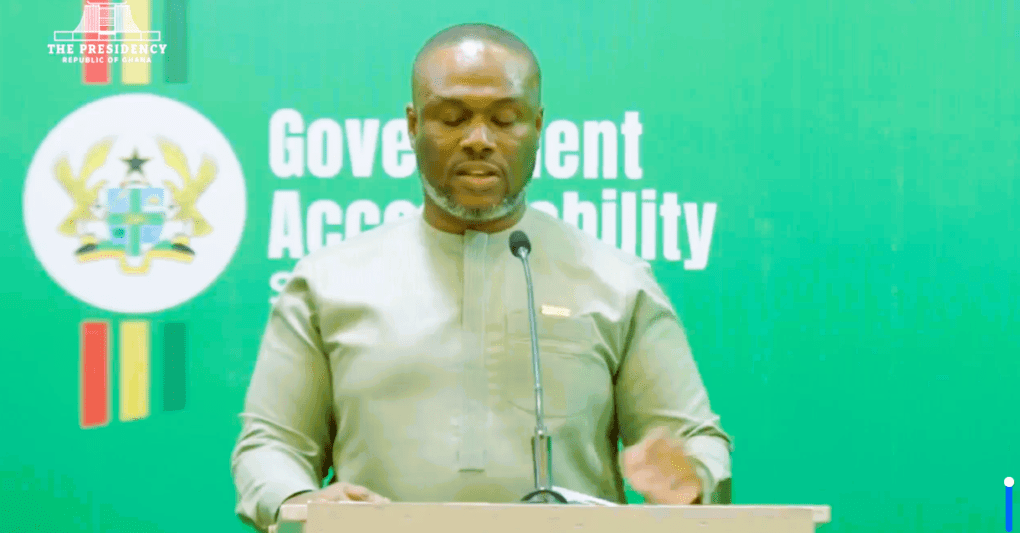
Kenneth Gilbert Adjei, Minister of Works and Housing, has revealed that, while the majority of Ghanaians have access to basic water services, less than half of the population benefits from safely managed water sources.
According to the minister, figures from the Ghana Statistical Service (GSS) and WHO/UNICEF Joint Monitoring Programme (JMP) show that about 88% of Ghana’s population has access to basic water services. However, fewer than half of people have access to safe drinking water.
“Only 44% of the population benefits from safely managed water services, defined as an improved water source that is on-premises, available when needed, and free of contamination,” Mr. Adjei declared during the Government Accountability Series in Accra on Wednesday, January 28, 2026.
Mr Adjei pointed out that, while overall access figures appear to be positive, major discrepancies continue between urban and rural regions.
He added that urban water access is over 96%, compared to an average of 74% in rural areas.
“Certain regions are experiencing access rates as low as 42%. It is important to note that these figures include communities where service is often intermittent and unreliable,” he explained.
The minister emphasised the issues of urban water distribution, citing high levels of non-revenue water, estimated at 50%—double the worldwide guideline of 25%.
“One of the critical challenges facing urban water supply is non-revenue water, which stands at an estimated 50%,” he stated, cautioning that the situation continues to jeopardise the sector’s financial viability and efficiency.
Mr. Adjei further disclosed that about four million Ghanaians continue to rely on surface, limited, or unimproved water sources, putting their health and the environment at grave risk.
He blamed a number of structural and environmental concerns, such as ageing infrastructure, insufficient maintenance expenditure, inadequate cost recovery mechanisms, high operating expenses, water body pollution, and climate-induced variability, for the problems facing the water sector.
The minister reaffirmed the government’s commitment to addressing these concerns through targeted investments, sector reforms, and improved coordination with development partners to increase access to safe, dependable, and sustainable water services throughout the country.
Source: newsthemegh.com