
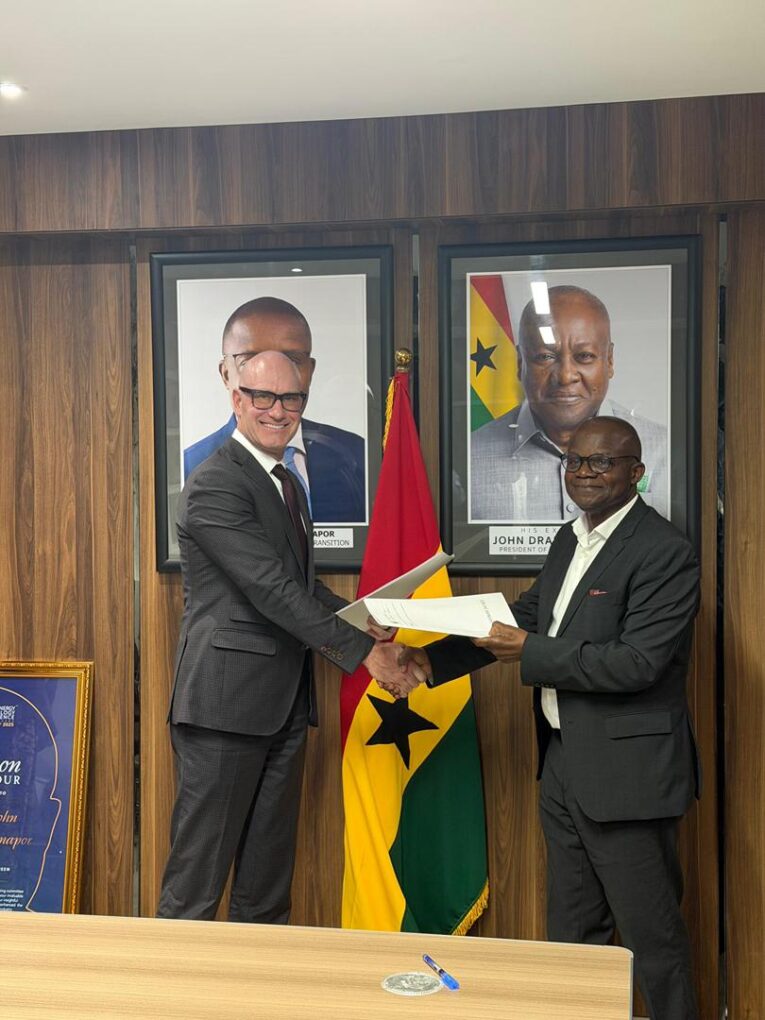
The Government of the Republic of Ghana, through the Ministry of Energy and Green Transition, has signed a historic Memorandum of Understanding (MOU) with Canadian clean energy company Portage Energy Group Inc. to create a transformative national waste-to-energy and waste-to-value initiative.
The project intends to improve Ghana’s capability for renewable energy while addressing the nation’s expanding municipal garbage problems.
The proposed project, which aims to turn municipal solid waste (MSW) into bio-organic pellets, produce clean electricity, and then refine those pellets into Sustainable Aviation Fuel (SAF), names Portage Energy Group Inc. as a Preferred Development Partner. The Memorandum of Understanding was signed on May 19, 2026.
The Tema Metropolitan Area will see the start of preliminary technical and environmental engineering investigations, with an emphasis on the Kpone Landfill site.

The Ministry of Energy and Green Transition and Portage Energy Group Inc. collaborate to provide integrated facilities that generate three primary outputs: clean power, sustainable aviation fuel, and bio-organic pellets (fuel obtained from waste).
Up to 25 megawatts (MW) of energy are anticipated to be produced by each facility, of which about 5 MW would be used for operational needs and the remaining capacity will be used to supply Ghana’s national grid.
With no financial commitment to the Ghanaian government, the project will be fully funded by the private sector via Portage Energy.
Ghana’s efforts to the circular economy and climate resilience are directly aligned with this national strategy.
The facilities are expected to lower methane emissions, prolong the useful life of the current waste infrastructure, and create jobs locally by diverting organic waste from landfills.
Additionally, the project is anticipated to facilitate Ghana’s shift to renewable energy and establish the nation as a future hub for the production of Sustainable Aviation Fuel in Africa, with substantial potential for future SAF exports to generate foreign revenue.
The alliance marks a significant turning point in Ghana’s green transition strategy, according to a statement released in conjunction with the signing by Hon. Dr. John Abdulai Jinapor, Minister for Energy and Green Transition:
“This partnership aligns seamlessly with Ghana’s strategic commitment to sustainable waste management and our green transition. By turning municipal solid waste into reliable, clean electricity, we are not only addressing sanitation challenges but also strengthening our national energy security and driving local economic growth without drawing on public funds.” – Hon. Dr. John Abdulai Jinapor, Minister of Energy and Green Transition
“Portage Energy is honored to be designated as a Preferred Development Partner for this transformative project. Our proven waste-to-value solutions will reduce landfill dependence, generate up to 25 megawatts of clean power, and lay the essential groundwork for future Sustainable Aviation Fuel production in West Africa.” – Craig Latimer, Chief Executive Officer, Portage Energy Group Inc.
“The signing of this Memorandum of Understanding marks another proud milestone in the strong bilateral relationship between Canada and Ghana. We are thrilled to see Canadian innovation and expertise supporting Ghana’s ambitious climate resilience and circular economy goals.” – H.E. Myriam Montrat, Canadian High Commissioner to Ghana
Portage Energy will start technical evaluations and stakeholder involvement right away in accordance with the parameters of the MOU.
The parties plan to negotiate final operating and power purchase agreements for execution after these procedures are finished.
In addition to establishing Ghana as a future leader in the manufacture of sustainable aviation fuel in Africa, this initiative is a component of the nation’s larger efforts to advance renewable energy, climate resilience, sustainable urban management, and the development of the circular economy.
Source: newsthemegh.com