
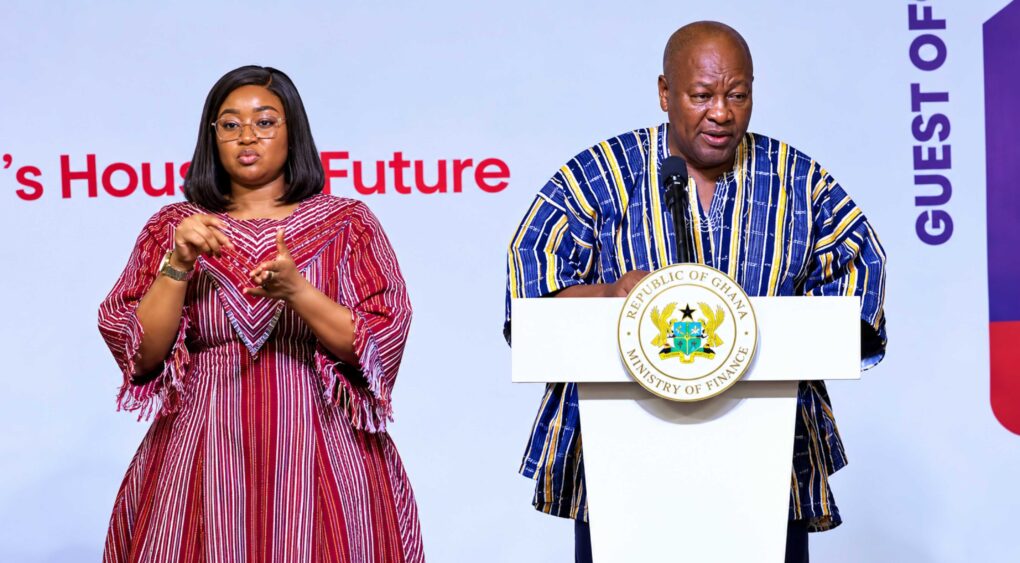
President John Dramani Mahama has proposed a new housing finance scheme to help Ghanaians who own unfinished houses access affordable loans to complete construction and move into their properties instead of continuing to pay rent.
Under the proposed initiative, the National Housing Fund (NHF), in collaboration with financial institutions, would introduce a specialised financing product that enables homeowners to borrow money to complete partially constructed buildings and repay the loans after occupying their homes.
President Mahama announced the proposal on Wednesday, October 7, 2026, during the maiden National Conference on Housing Finance in Accra. He said the initiative could unlock significant amounts of money trapped in unfinished buildings across the country while helping homeowners overcome the financial challenges preventing them from completing their properties.
Mahama Targets Unfinished Houses Across Ghana
The President expressed concern about the growing number of unfinished buildings across Ghana, noting that many property owners have invested substantial resources in construction but remain unable to complete their homes.
According to President Mahama, a dedicated housing finance product could help address the problem by identifying communities with large numbers of incomplete houses and providing targeted financial support to their owners.
He proposed that engineers and architects assess the properties and prepare bills of quantities to determine the additional costs required to complete each building. The income levels and financial circumstances of the owners would also be evaluated to establish their ability to repay the loans.
Mahama explained that some houses have already reached the roofing stage and could be completed relatively quickly if their owners receive the necessary funding.
He believes the proposed financing arrangement could help homeowners move into their properties sooner while putting their existing investments to productive use.
Rent-to-Own Housing Scheme Could Support Homeowners
President Mahama also suggested linking the proposed financing facility to rent-to-own housing arrangements.
Under such a model, eligible homeowners could occupy their completed properties and redirect money previously spent on rent towards repaying their housing loans.
The proposal is expected to offer potential relief to Ghanaians who are simultaneously paying rent and struggling to raise funds to finish houses they have already started building.
The President called for innovative housing finance solutions that go beyond conventional mortgage arrangements to address the specific challenges facing Ghanaian households.
Census Reveals Millions of Incomplete Structures
Data from Ghana’s 2021 Population and Housing Census highlights the scale of the country’s unfinished building problem.
The census recorded 1,065,387 structures that had been completely roofed but remained unfinished. An additional 825,367 structures were incomplete and had not yet been roofed.
However, these figures cover structures generally and do not establish how many were privately owned residential houses whose owners were also paying rent elsewhere.
The census further indicated that 65.8 per cent of not-fully-completed structures with some form of roofing were being used for residential purposes. In urban areas, the proportion stood at 71.3 per cent.
The figures have renewed attention on the need for affordable housing loans, construction financing and policies that can help property owners complete existing projects rather than leaving buildings unused for extended periods.
Mahama Ayariga Describes Unfinished Houses as Dead Capital
The Minister for Local Government, Chieftaincy and Religious Affairs, Mahama Ayariga, described the money invested in unfinished houses as “dead capital”.
He noted that many Ghanaians have committed considerable financial resources to building homes but continue to live in rented accommodation because they lack the additional funding required to complete construction.
Mr Ayariga called for measures to unlock the value of these properties while improving housing delivery and urban planning.
He also raised concerns about the rapid horizontal expansion of Ghanaian cities, explaining that buildings are frequently developed in areas without adequate roads, electricity, water supply and other essential infrastructure.
According to the Minister, this pattern increases the eventual cost of providing public services and supporting residential communities.
He urged Metropolitan, Municipal and District Assemblies (MMDAs) to consider greater vertical development and improved spatial planning to coordinate housing construction with infrastructure provision.
Government Calls for Affordable Housing Finance for All
Deputy Minister for Works, Housing and Water Resources, Gizella Tetteh-Agbotui, said Ghana’s housing crisis was not simply a matter of insufficient housing units but also a challenge of accessing appropriate financing.
She called for housing finance products tailored to the needs of different categories of workers, particularly people employed in the informal sector who may struggle to qualify for traditional mortgages.
Among the proposed solutions are:
- Long-term mortgage loans for formal-sector workers.
- Housing microfinance for informal-sector workers.
- Incremental construction loans for households building their homes in stages.
- Rent-to-own housing arrangements for people seeking alternatives to conventional homeownership.
- Shared-equity financing to expand opportunities for young people and first-time homebuyers.
Ms Tetteh-Agbotui also identified high land prices, expensive building materials, infrastructure costs, limited access to long-term construction loans and difficulties with land administration as major factors driving up housing costs in Ghana.
She stressed the importance of developing innovative financing arrangements that reflect the financial realities of ordinary Ghanaians.
National Housing Fund Reduces Mortgage Interest Rate
The National Housing Fund resumed lending under the National Mortgage Scheme in September 2026, offering mortgage financing at an interest rate of 8.4 per cent, down from the previous rate of 13.5 per cent.
Financing for property developers under the scheme currently stands at an interest rate of 10.4 per cent.
The lower mortgage rate is expected to improve access to housing finance for eligible applicants, while developer financing is intended to support housing construction.
Chairman of the National Housing Fund Board, Okoamankra Kwame Akwonu X, disclosed that the Fund had also piloted a Rent-to-Own Scheme and was seeking to increase investment in its housing finance programmes to accommodate more applicants.
Expanding these initiatives could provide additional options for households that cannot afford the upfront costs associated with buying or completing a home.
Mahama Wants Informal-Sector Workers Included in Housing Loans
President Mahama stressed that conventional mortgage products alone would not solve Ghana’s housing affordability challenges.
He called for the inclusion of traders, artisans, farmers, transport operators and other workers in the informal economy who may have regular earnings but lack the documentation traditionally required by banks.
The President proposed using alternative methods to assess applicants’ ability to repay housing loans, including their savings history and verifiable business cash flows.
Such an approach could help financial institutions evaluate borrowers whose incomes may not be reflected in formal payslips but who generate revenue through businesses and other economic activities.
If developed and implemented, the proposed financing scheme could provide a new pathway for eligible homeowners to complete unfinished properties, reduce their dependence on rented accommodation and improve access to affordable housing in Ghana.
The proposal forms part of wider discussions on housing finance reform, mortgage affordability and innovative ways to address the country’s housing deficit.
Source: newsthemegh.com