
By Al Jazeera Staff and Reuters
Police lock down New Delhi to foil protest demanding resignation of the country’s election chief.
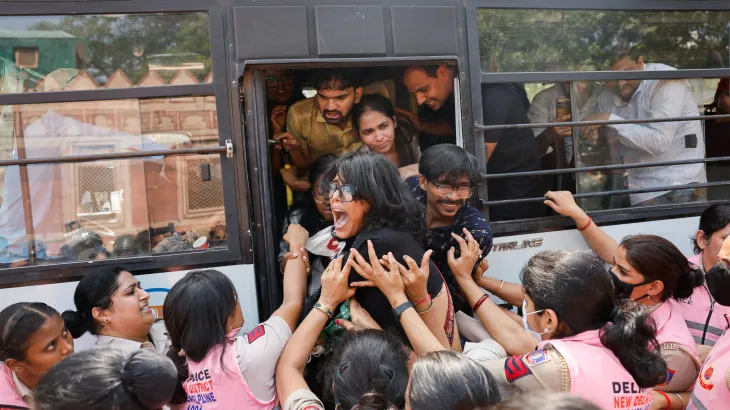
Police in India’s capital, New Delhi, have detained more than 2,000 protesters, opposition politicians, journalists, lawyers and the founders of the “Cockroach” youth movement in a bid to quash a rally demanding the resignation of the country’s election chief.
Thousands of police and paramilitary personnel were deployed across the city on Saturday, while mobile internet services were suspended in the central business district as authorities moved to stop a demonstration organised by the satirically-named Cockroach Janta Party (CJP) and other youth groups.
Dozens of metro stations and markets were also shut.
The Hindhu newspaper, citing New Delhi police sources, said nearly 2,500 protesters were detained across the capital. The Reuters news agency, meanwhile, citing a Ministry of Home Affairs official, put the figure at about 2,000.
Some 600 people were also arrested in the city of Mumbai, India’s financial hub, over the protests, according to the ANI news agency.
The protesters were demanding that Chief Election Commissioner Gyanesh Kumar resign over a revision of voter lists they say disproportionately benefits Prime Minister Narendra Modi’s governing Bharatiya Janata Party (BJP).
Protesters accuse the BJP of using the Special Intensive Revision (SIR) of voter lists to sway results, and opposition parties say the revisions affected several recent state elections the party won, casting a shadow over polls in the world’s largest democracy.
Kumar has not commented, but the Election Commission and the BJP have denied allegations of wrongdoing.
The CJP had planned to gather thousands of people at Jantar Mantar, a designated protest site in central New Delhi. But on Saturday, the area was sealed off by security forces before the demonstration began.
Security forces also set up checkpoints on major roads and entry points across the city of 20 million people, boarded buses searching for protesters, and inspected vehicles.
Barricades and concrete blocks disrupted traffic, while anti-riot vehicles equipped with tear-gas launchers guarded key routes.

CJP leaders detained
Police detained the CJP’s founder, Abhijeet Dipke, as well as his associates, Saurav Das and Ashutosh Ranka, in an aeroplane upon arrival in New Delhi from Mumbai.
Dipke shared a video on his Instagram channel, showing a team of police officers entering the Air India plane after it landed. As they came closer, he said: “I have come to get arrested. I am not afraid of you guys.”
In another video shared by Ranka, Dipke was seen addressing the flight’s passengers.
“It was nice to know you all. We can see where the nation is heading,” he said. “This is dictatorship, where Delhi police has entered in the flight and trying to arrest us.”
Delhi police also detained other CJP members: YouTuber and Modi critic Dhruv Rathee; Neha Bora, the national president of the All India Students’ Association (AISA), a leftist group affiliated with the Communist Party of India (Marxist-Leninist); Dipankar Bhattacharya, the general secretary of the party; and Prashant Bhushan, a senior lawyer at the Supreme Court.
Some opposition lawmakers, as well as former chief ministers – Mamata Banerjee of West Bengal, Arvind Kejriwal of Delhi, and Pinarayi Vijayan of Kerala – were also detained, television channels showed.
Despite the detentions of the founders of the youth movement, small protests took place elsewhere in the city, including at the popular crafts market “Dilli Haat”.
Shranaya, a state committee member of the left-wing Students’ Federation of India (SFI), who goes by her first name, told Al Jazeera that the SFI’s office in New Delhi had been under surveillance for hours, but members inside had managed to escape and protest.
“This is dictatorship, live and in front of us, just to protect a bureaucrat who steals elections for the BJP on Modi’s behest. They are murdering democracy in the daylight in the Indian capital,” she said.
“This government is unaware of the power of the people, and that is our upper hand. We do not have weapons, but we have zeal. We will be again on the streets, and we will keep returning,” she added. “We are students. We are unemployed. We are ‘cockroaches’ – and we will return.”
She then climbed a barricade but was dragged away by police and taken away in a bus.
Representatives of two digital news outlets said police briefly detained four of their reporters while they were covering the demonstrations. A Reuters journalist was also detained briefly before being released.
Challenge to Modi
The protests represent one of the most serious tests yet for Modi and intensified after the Indian Express reported last week that two election commissioners had questioned Kumar’s revisions that removed roughly 130 million names from voter lists.
The BJP says its electoral success reflects Modi’s popularity and India’s economic growth, and accuses opposition parties of spreading misinformation.
BJP spokesman Sambit Patra dismissed the demonstrators as “anarchic elements” and said that “their flop show has been completely demolished”.
“What is happening at Jantar Mantar, what you can see on TV and a few social media handles, is not India’s story. India is calm and going ahead under good governance,” he told reporters.
The opposition Congress party’s president, Mallikarjun Kharge, slammed Modi’s government after the detentions.
“Modi government has turned the ‘Mother of Democracy’ into a ‘Muzzled Democracy’!” he posted on X. “Detentions, arrests, jails, lathis [batons] and pellets cannot deter the people of India. Since the days of our freedom struggle, the youth have been at the forefront of shaping the nation’s destiny.”

Global condemnation
The United Nations Human Rights Office expressed concerns over mass detentions before and during the protests.
“We call on the authorities to ensure that the right to peaceful assembly is fully respected and fulfilled,” UN Human Rights spokesperson Thameen Al-Kheetan said in a statement.
He also urged authorities to engage in “meaningful dialogue” to address the “broadly held” concerns expressed.
Amnesty International warned that the detentions signal the Indian government’s desperate attempts to “suppress critical voices”, while the Committee to Protect Journalists urged Indian police to “respect journalists”.
The Indian mission to the UN in Geneva, however, called the global concerns “misplaced” and said they constitute “an unwarranted interference in the internal affairs of India”.
It stressed that the right to peaceful assembly was guaranteed by India’s Constitution. “As in every democracy, Indian citizens exercise this right subject to reasonable restrictions in the interest of public order,” the statement added.
The unrest comes before a series of important state elections beginning in early 2027.
Sanjay Kapoor, editor of Hard News Magazine and a political analyst, told Al Jazeera that it is “very strange” to see Modi’s government “so panic-driven and fearful of what the protesters might do”.
“The truth is that the BJP and the centre have been very, very scared of how it will all play out,” he said.
Kapoor noted that most people coming to the protests do not want Modi’s BJP to continue to govern.
“Modi’s government has begun to lose a lot of credibility at the moment,” he said. “BJP is afraid that the ground has shifted dramatically against them and they would find it very difficult to come back to power.”
Source: aljazeera.com