

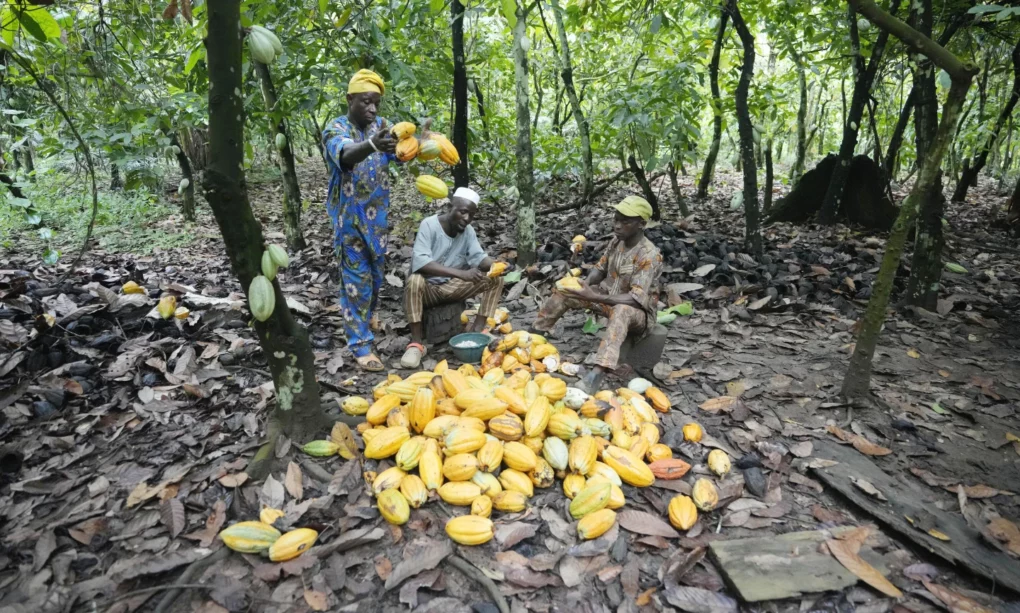
As market dynamics and regulatory forces come together this year, the local cocoa business is preparing for major changes.
Analysts predicted at the start of the last quarter of 2024 that due to limited global supply, cocoa prices might reach US$9,600 per metric tonne (pmt) in 2025.
In December 2024, it surpassed this amount, reaching US$11,925.
The closing price of March ICE NY cocoa futures on January 8, 2025, was US$10,984.81 per metric tonne, a 1.68 percent drop from the day before.
The price of cocoa rose 30.73 percent from November 2024 and 145.2 percent from December 2023 to reach US$10.32 per kilogramme in December 2024.
The aforementioned limitations are made worse by unfavorable weather patterns and illicit gold mining operations, which have impacted the supply of cropland.
This prediction follows a sharp price spike in 2024, when cocoa prices almost doubled year-to-date by mid-November, rising from US$4,916 to US$8,523.
Supply shortages in Ghana and Côte d’Ivoire, exacerbated by El Niño’s effect on yields and rising worldwide demand for cocoa, were the main causes of this 73.4 percent increase.
“The European Union Deforestation Regulation (EUDR), which goes into effect in early 2025, will further restrict supply availability; likely keeping prices elevated amid strong global demand for chocolate,” according to Databank’s 2025 estimates.
One of the main causes of the finance problems plaguing the domestic market is the Ghana Cocoa Board’s (COCOBOD) incompetence as an industry regulator.
It had trouble getting its regular partners to provide the yearly syndicated loan last year.
Due to these and associated factors, local farmers have been unable to take advantage of the windfall brought about by rising prices.
Cocobod declared in September 2024 that the price of cocoa would rise significantly for the 2024–2025 season, setting the price at GH¢48,000 per tonne. The price of a 64-kilogram bag of cocoa was GH¢3,000, which was 129.36% more than the previous season.
However, civil society contended that the price, which at the time was about US$185, was insufficient to compensate the farmers.
Strict regulations for cocoa growers are brought about by the upcoming EUDR, which mandates that goods entering the EU market be traceable and demonstrate to be deforestation-free after December 2020.
Although the rule aims to stop environmental damage, the local cocoa industry faces significant obstacles as a result.
Traceability is still a major obstacle.
According to an analysis in a Tropical Forest Alliance (TFA) paper on the EUDR, in 2023, only a “mere 9 percent of exports” had enough data to trace them back to the district where they were produced, even though 80 percent of the nation’s cocoa exports could be traced to a company that publicly discloses some supply chain information.
Systems of tree tenure and land ownership make compliance even more difficult. Naturally existing trees on private property are vested in the state under Ghana’s Concessions Act, which frequently deters farmers from protecting them.
“Government has recently established a Tree Tenure and Benefit Sharing mechanism that should ensure farmers and communities benefit from the trees growing on their farms, but it will take time to be effectively implemented”. stated Abraham Baffoe, Executive Director-Proforest, as cited in the TFA paper titled “How To Make Europe’s Deforestation Regulation Work.”
Under the new legislation, smallholders, who produce almost all of the nation’s cocoa, face the biggest obstacles.
Cocoa farming supports more than 800,000 farmers, and it employs 3.2 million people, or 17% of the working population. Many people are not familiar with the complexities of traceability or EUDR requirements.
Mr. Baffoe stated,“The message is simple: if you want to sell to Europe, you must stop cutting trees,” Misconceptions still exist, nevertheless, such as the idea that “sun cocoa” is better than “shade cocoa,” even though the International Cocoa Organization has shown that shaded conditions are necessary for the best yields.
Farmer education initiatives are accelerating. Training on sustainable techniques is being offered by organizations such as Proforest in partnership with the Ghana Cocoa Board (COCOBOD). In order to promote compliance, platforms like the Africa Sustainable Commodities Initiative (ASCI) are also holding workshops with producers.
To comply with EUDR regulations, the government has launched a National Cocoa Management System (NCMS), which includes a Cocoa Traceability System.
Mapping cocoa farms and ensuring adherence to deforestation-free criteria are the goals of this method. Although encouraging, implementation still requires a lot of resources.
“To implement traceability on the ground, we need a digital ID for every farmer, tags for every bag of EUDR-compliant cocoa, dedicated centres in all cocoa districts… and we need this all in one go, now!” Mr. Baffoe went on to say.
One major obstacle is financial limitations. Stakeholders are requesting more extensive financial support, even though the European Forest Institute and charitable organizations like the Walmart Foundation have offered aid.
“Proforest’s work with the Ghana government is being supported by Walmart Foundation. They are offering fantastic support to smallholder farmers,” he further stated.
Stakeholders stress that cooperation is necessary for compliance. One example of cooperative attempts to match agricultural productivity with forest conservation is the Asunafo-Asutifi landscape initiative, which is a component of the Ghana Cocoa Forest REDD+ Program.
“If we had allowed things to simply go the way as designed by the EU, it would only have resulted in companies working within their own supply chains, but that does not solve the issue,” Mr. Baffoe insisted, arguing for landscape-level initiatives aimed at tackling deforestation across entire jurisdictions.
Source: newsthemegh.com