

Yirenkyi Yahaya | Email: [email protected] | The writer is an electrical engineer and author based in Accra.
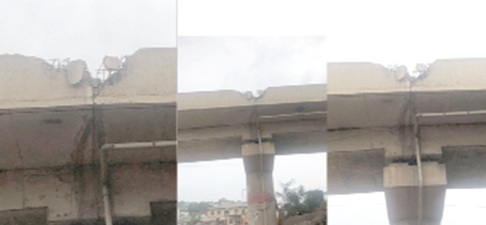
Photographs taken at the Mallam Interchange in Accra last week reveal alarming structural deterioration at one of the capital’s busiest and most critical road infrastructure assets — raising urgent questions about public safety and the state of bridge maintenance in Ghana.
The images, captured at the beam-column junction beneath the flyover, show severe concrete spalling, large sections of the concrete deck broken away, and steel reinforcement bars visibly exposed and unsupported.
A deep structural crack runs vertically from the damaged beam section down through the supporting column — a combination of defects that structural engineers would classify as a serious integrity concern requiring immediate professional assessment.
The Mallam Interchange is a dual carriageway flyover forming part of the George Walker Bush Highway — a six-lane, 14-kilometre corridor funded by the United States Millennium Challenge Corporation.
Since its completion in 2012, maintenance of the interchange has been handled by the Ghana Highway Authority, transitioning from MCC funding to domestic government allocations.
In recent years, structural vulnerabilities including exposed expansion joints and missing nuts have prompted calls for reinforcement and rehabilitation by the GHA and Ministry of Roads and Highways.
The damage now visible at the beam-column junction represents a significantly more serious condition than previously reported surface-level defects.
From a structural engineering standpoint, the exposed reinforcement steel visible in the photographs is particularly concerning.
Once the concrete cover protecting the steel is lost, the bars are directly exposed to moisture, carbonation, and the salt-laden coastal air of Accra — conditions that accelerate corrosion rapidly.
Corroding steel expands within the concrete, driving further cracking and spalling in a self-reinforcing cycle of deterioration.
A beam-column junction — the point where the spanning deck transfers its load to the vertical support column — is one of the most structurally critical and highly stressed points in any bridge or flyover structure.
Damage concentrated at this location is not cosmetic. It is structural.
Residents near the interchange have previously raised safety concerns, with accounts of vehicles falling from the structure on multiple occasions.
The structural damage now documented adds a new and more fundamental dimension to those concerns.
The Ghana Highway Authority and the Ministry of Roads and Highways must treat this as a matter of urgent public safety — not a routine maintenance schedule item.
An independent structural engineering assessment of the interchange should be commissioned immediately, the findings made public, and remediation works undertaken without delay.
Every day that passes without intervention is a day that thousands of commuters, traders, and motorists pass over and under a structure whose integrity is visibly compromised. Ghana cannot afford to wait for a collapse before it acts.
Source: graphic.com.gh