

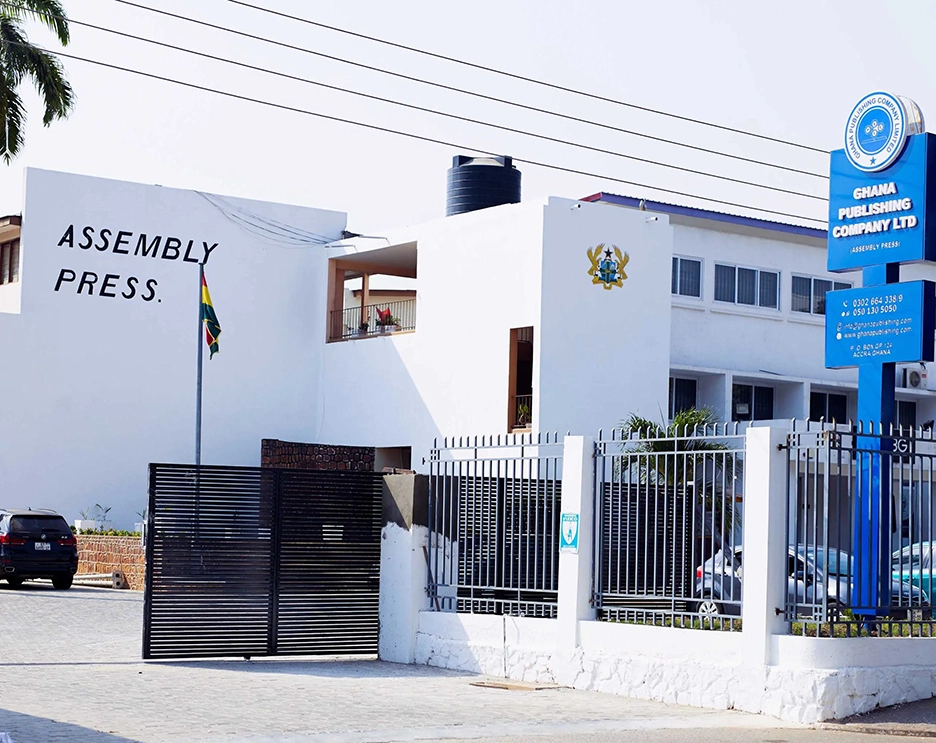
The Ghana Publishing Company Ltd. has accelerated its services by implementing a 24-hour policy in an effort to boost output and improve public service delivery.
The government’s goal of increasing output around-the-clock is in line with the policy’s introduction by the corporation that prints and publishes important national documents, including Acts of Parliament, Constitutional Instruments, and Legislative documents, among others.
The company’s employees are expected to work three shifts.
To increase accessibility to government publications, the business has also announced plans to fully operationalize the use of its Electronic-Gazette technology.
Additionally, an Electronic-Shop system is anticipated to be launched, enabling clients to make online orders for publishing and printing services.
Felix Kwakye Ofosu, the Minister of State in charge of Government Communications, who yesterday introduced the 24-hour service, praised the company’s leadership for assuming the initiative before the government formally did.
He noted that in competitive settings, State-Owned Enterprises (SOEs) frequently fell behind private businesses.
Mr. Ofosu pushed the company to use the initiative to strengthen its position in the Ghanaian market by promoting innovation and efficient management, especially because the 24-hour service had just been launched and it had been operating for ten years.
“I see no reason why state-owned enterprises, with all the support they can get and the entire government machinery behind the roof, cannot do better than private entities.
“It is my belief that with the launch of this 24-hour service by the GPCL, you will lift your colleagues in the sector and position yourself as the go-to place for printing and publishing within the Ghanaian economy, and this is something that you should be able to achieve,” the minister said.
Additionally, Mr. Ofosu promised his assistance in urging the government to award the GPCL additional printing contracts.
However, he cautioned against complacency based solely on the corporation’s status as a state-owned enterprise (SOE) and emphasized the necessity for the company to exhibit capacity and competitiveness.
“The mere ownership of the business by the government does not mean that business principles should be undermined or compromised. We cannot also say that simply because you are owned by government, everything should be given to you on a silver platter, you must show the capacity to deliver,” he reiterated.
The minister advised the industry once more to seek business from private organizations in addition to relying on government contracts.
Nana Kwasi Boatey, the GPCL’s acting managing director, clarified that the implementation of the 24-hour service demonstrated the organization’s dedication to innovation, expansion, and quality while establishing the GPCL as the nation’s and the world’s foremost printing and publishing enterprise.
According to the MD, despite the company’s lengthy history and vital role in the nation, GPCL faced numerous difficulties, most notably high taxes on imported paper and other printing supplies that raised manufacturing costs.
He therefore urged the sector minister to think about eliminating import duties on paper and other necessary supplies for the printing business.
He claimed that by eliminating these levies, the government would support Ghana Publishing Company and lower the cost of printing domestically for local companies, educational institutions, and government agencies, thus retaining domestic money.
He also urged the government to issue an order requiring all Ministries, Departments, and Agencies (MDAs) to give Ghana Publishing Company top priority for all of their publishing and printing requirements.
Source: newsthemegh.com