

By Rabbi Adu Agyei | By Nene Afadzinu
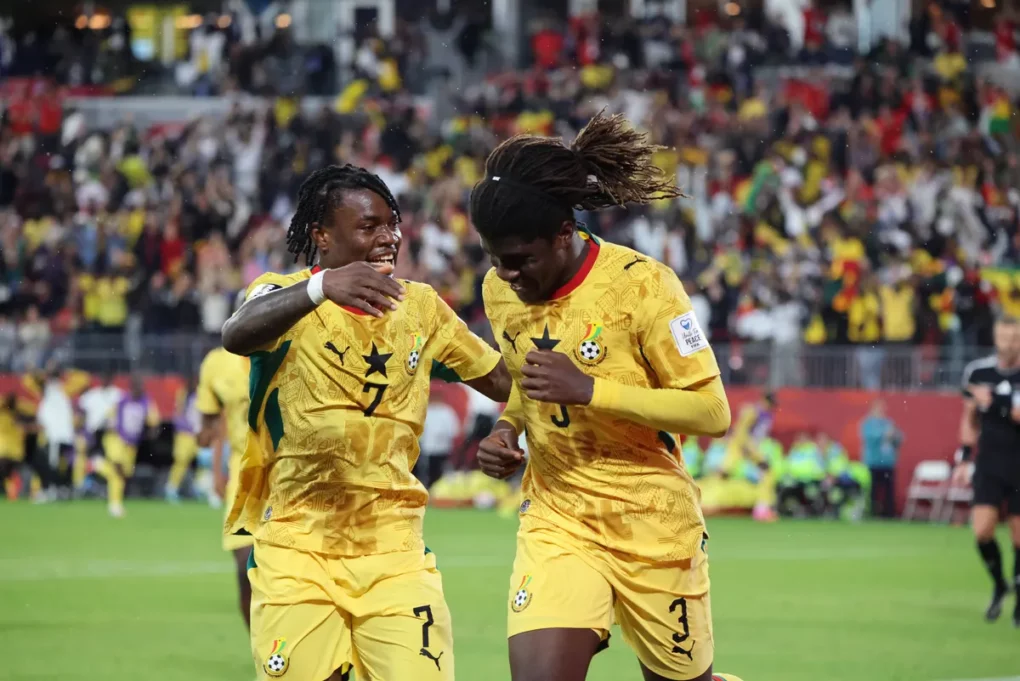
Ghana began their 2026 FIFA World Cup campaign with a dramatic 1-0 victory over Panama thanks to a stoppage-time winner from Caleb Yirenkyi in their Group L opener.
With England having beaten Croatia 4-2 earlier in the day, the Black Stars knew a positive result was needed to keep pace at the top of the group. Carlos Queiroz’s side delivered, although they had to waituntil the closing moments to find the breakthrough.
Here are five things we learned from the encounter.
1. Impressive display from the inexperienced centre-back pairing
It is easy to understand why Ghanaians would have been worried about the Black Stars’ centre-back options heading into this World Cup, after the tried-and-tested duo of Mohammed Salisu and Alexander Djiku both had to pull out of the tournament due to injury. And Jonas Adjetey giving away penalties in consecutive shaky performances against Austria and Germany would have done nothing to assuage those concerns. But Adjetey and Jerome Opoku, playing in just their second start together, put in a rock-solid display that set the foundation for Ghana’s late win against Panama. The pair combined for 21 defensivecontributions and dealt expertly with wave after wave of Panamanian attacks, particularly in the first half. Adjetey won 100% of his aerial duels and ground duels, while Opoku had a 91% pass completion rate in what was a truly complete performance by the duo.
2. Ghana have game changers on their bench
In Ghana’s only World Cup preparatory friendly against Wales, the Black Stars started slowly before growing into the game after the introduction ofsecond half substitutes such as Ernest Nuamah and Brandon Thomas-Asante. Not much was made of the impact of the subs as it was only a friendly and there was an unlimited number of subs available to choose from, but history repeated itself tonight. This time, it was Fatawu Issahaku, coming on to replace Ernest Nuamah in a reverse of the Wales sub, who provided the much-needed impetus on the right wing to help open the game and create chances for the Black Stars. Kwasi Sibo also made an impact with a cultured display off the bench highlighted by a 94% passing accuracy. But the biggest difference maker yet again was Brandon Thomas-Asante, who injected life into Ghana’s attack with his excellent ball control and energy. It was Thomas-Asante who had the pace to skip past his man and the composure to tee up Yirenkyi for the 95th minute winner. With players like Inaki Williams, Christopher Bonsu Baah, and Augustine Boakye not featuring at all from the bench, there is cause to be excited about Ghana’s depth.
3. Panama are a well-drilled side
Gone is the Panama side that joyously celebrated a consolation goal after conceding 6 against England at the 2018 World Cup. If there is one thing the Panamanians proved today, it is that they are no pushovers. They controlled possession for large spells of the game and ended the match with 62% possession and 11 shots to Ghana’s 8, failing to convert two big chances. In the first half they beat Ghana everywhere but on the scoreboard, dominating physically, technically, and tactically. They had 64% possession with 316 passes to Ghana’s 172 and reduced the African outfit to 0.00 xG. Their passing was crisp, their movement was sharp, and their defence was tight, but they did not create enough themselves and when they ran out of steam in the second half, a Ghanaian winner seemed inevitable. Regardless of the result, Thomas Christiansen has done a fine job with the Central American outfit and they may even wonder what could have been had Adalberto Carrasquilla been fit for the game.
4. The Kamaldeen experiment should be ended
Kamaldeen Sulemana broke through at FC Nordsjaelland as one of the brightest African prospects in the Danish Superliga. Such was the earlypromise that he drew comparisons to Sadio Mane and then to Jeremy Doku after replacing the latter at Rennes. To the hair-tearing frustration of many a Ghanaian, Kamaldeen Sulemana appears to be the same player at the age of 24 that he was at 18: electric but painfully raw. His decision-making in the final third continues to be abysmal, making head coach Carlos Queiroz’s decision to play him as the central attacking midfielder behind the striker discombobulating. Queiroz trialled that tactic in the friendly against Wales and had no success, with Ghana creating little until Kamaldeen was replaced. Tonight, Ghana created little until Kamaldeen was replaced. If his potential pace in transition is the reason for the tactic, Ghana have players like Semenyo, Nuamah, Fatawu, Thomas-Asante, and Boakye who all possess pace in transition but are importantly more comfortable operating in central areas. Let this game be the end of the experiment,please.
5. It might be time to look beyond Jordan Ayew
Jordan Ayew has been the most unpopular Black Stars player among Ghanaians since his poor decision to take a weak shot instead of squaring the ball to a better-placed Asamoah Gyan against Germany at the 2014 World Cup. The Black Stars captain has actually had a decent career for the national team since then, entering into the top 5 list for all-time top scorers and tonight becoming the record appearance holder for Ghana. The nation even has him to thank for his 14 goal contributions in the World Cup qualifiers that got Ghana to North America this summer. But Jordan is 34 and half as fast as he once was. Coupled with his preference for holding the ball up to draw a foul or bring others into play instead of quickly laying the ball off in transition, it cannot be denied that Jordan slows the team down. Ghana are currently set up to attack on the counter, as Yirenkyi’s well-executed goal showed. With Jordan’s pace and playstyle slowing the team down and a plethora of pacy attacking options to choose from, it might be time to reduce the captain’s minutes to strategic appearances off the bench.
Source: 3news.com