

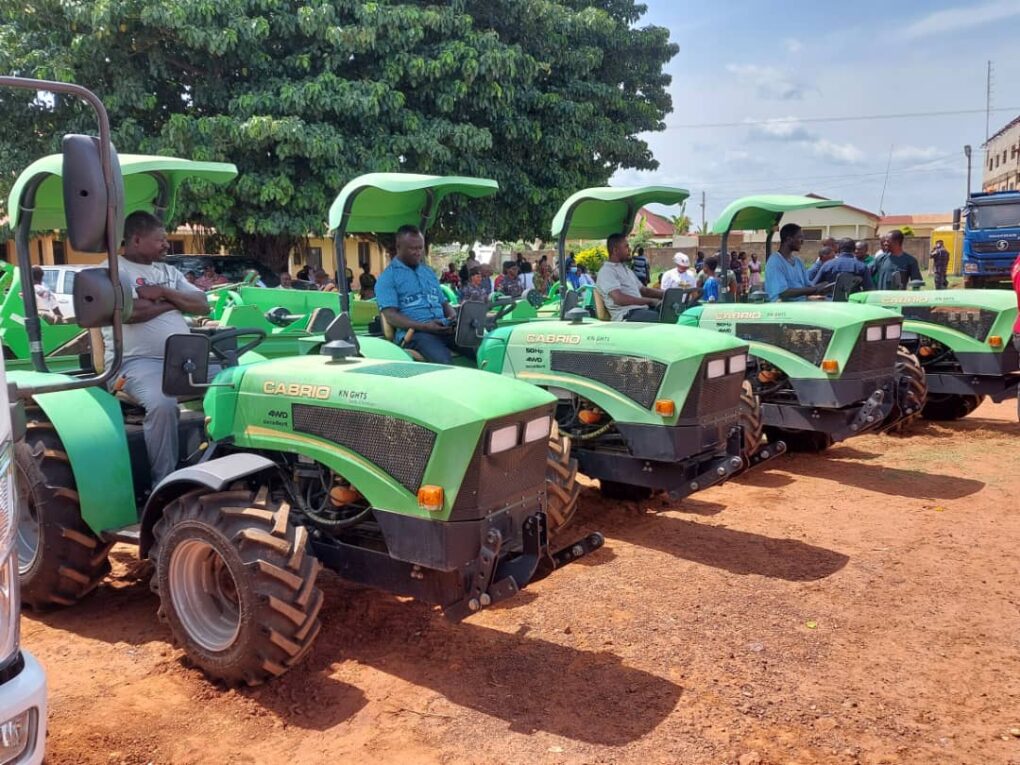
Over the weekend, President John Dramani Mahama unveiled agrochemicals and equipment for the Feed Ghana Program, a government initiative to increase food production in the country.
To lead the program’s execution, the President gave the Ghana Prisons Service and the National Service Authority large amounts of maize seeds, fertilizer, a Kia vehicle, and tractors.
The presentation was given by President Mahama on Saturday as he officially opened the Feed Ghana Program’s implementation in Techiman, Bono East Region.
He said that the Feed Ghana Program offered a proactive approach rather than merely a policy and urged unity and shared commitment in transforming the country’s agriculture as a driver of growth and wealth.
The President acknowledged that there were difficulties in the agriculture sector, but he also expressed great optimism that the program would be implemented successfully.
In order for the country to reap the greatest benefits from the initiative, he urged farmers, agribusinesses, financial institutions, development partners, and everyone else to support its execution.
The program’s objectives are to create agro-industrial zones throughout Ghana, encourage the use of contemporary farming methods, enhance infrastructure, and undertake strategic steps to boost food production.
One of its main initiatives is smart agriculture, which entails setting up farmers’ service centers all around the country.
Essential services like mechanization, high-quality inputs, financial assistance, market access, primary processing, and farmer training will be offered by the centers.
In order to assist young agri-entrepreneurs and improve the country’s food production, the program will also establish farm banks or land banks in specific irrigable zones.
In order to boost the production of maize, rice, soybeans, and sorghum for export, agroprocessing, and consumption, it will also concentrate on grains and legumes.
By encouraging the production of vegetables domestically, “Yeredua,” the program’s vegetable component, is anticipated to lower the importation of vegetables from nearby nations.
Investments would be made under the initiative in urban and peri-urban agriculture, greenhouse technology, controlled environmental farming, and encouraging schools to grow their own vegetables in backyard gardens.
In order to increase self-sufficiency, it will also encourage institutional farming, enabling households and communities to grow vegetables like tomatoes, peppers, and garden eggs. Additionally, it will provide assistance to organizations like Senior High Schools so they can obtain land for crop and livestock production.
Another important element of the Feed Ghana Program is the execution of the government’s much-discussed “Nkoko Nketenkete” project, which aims to revive the poultry sector.
Source: newsthemegh.com