
The Bank of Ghana (BoG) has received a GH¢5 billion recapitalisation bond from the government to start rebuilding its equity after the 2023 Domestic Debt Exchange Programme (DDEP) sent it into negative territory.
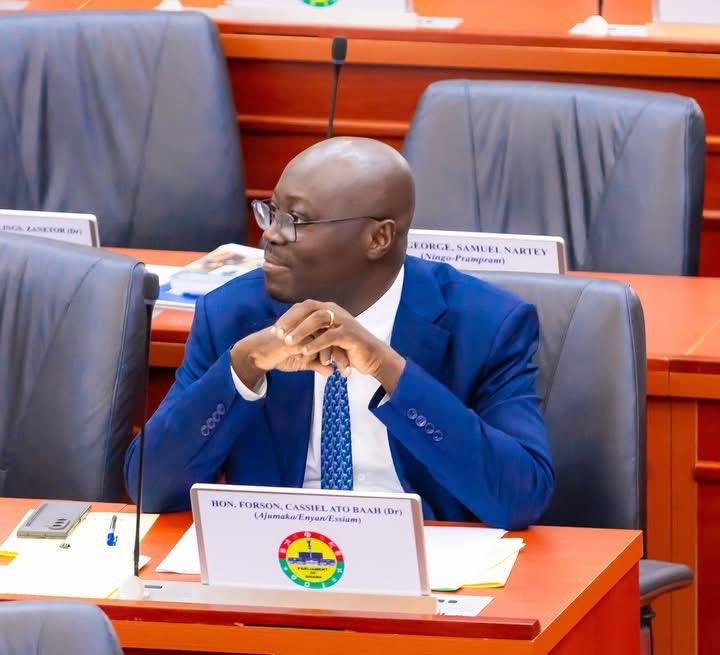
In the 2026 Mid-Year Fiscal Policy Review that was presented to Parliament on July 23, Finance Minister Dr. Cassiel Ato Forson revealed the revelation.
The DDEP “had a significant adverse impact on the Bank of Ghana’s balance sheet, substantially weakening its capital and resulting in a negative net equity position,” according to the Minister.
In response, on January 6, 2025, the Bank and the government signed a Memorandum of Understanding (MoU) to gradually recapitalise the organization.
The central bank’s own accounts detailed the extent of the harm.
According to the BoG’s 2025 financial statements, it had a negative equity position of GH¢96.28 billion and a net loss of GH¢15.63 billion for the year. This was mostly due to the haircuts it took when it took part in the DDEP and a more extensive reorganisation of government holdings on its books.
Because it may generate domestic liquidity, a central bank working with negative equity is not bankrupt in the same sense as a commercial bank.
However, a persistent negative position might limit monetary policy operations and cast doubt on the bank’s independence and credibility.
The goal of returning the Bank to a positive equity position is to eliminate that restriction and strengthen trust in its capacity to implement policy, which is the justification for the ongoing progressive recapitalisation and the yearly requirements outlined in Act 1158.
The first installment under that deal is the GH¢5 billion bond, which was issued in March 2026.
According to Dr. Forson, the government will “make annual provision to recapitalise the Bank of Ghana until the Bank’s equity is fully restored, in accordance with the Bank of Ghana (Amendment) Act, 2025 (Act 1158).”
He continued by saying that the apex bank would conduct a thorough operational efficiency review to cut expenses, improve financial management, and rebuild its long-term financial sustainability while the government works to restore the central bank’s capital.
The one quantitative performance requirement Ghana did not satisfy under its recently concluded IMF Extended Credit Facility (ECF) program was centred on recapitalisation.
Subject to confirmation at the anticipated IMF Executive Board meeting later this month, the Minister said Ghana finished the three-year program with all but one performance condition met.
The cap on modifications to the BoG’s claims on public organisations and the central government was an exception.
Dr. Forson claims that rather than any policy action, the breach resulted from the way the recapitalisation was documented.
He told the House that the transaction “was recorded in Bank of Ghana’s books as a receivable from the government instead of recapitalisation, resulting in a technical deviation from the program definition of the indicator rather than a policy-related breach” and that corrective action had since been taken.
The BoG recapitalisation is one of the reform objectives under the replacement Policy Coordination Instrument (PCI), which necessitates the signing of a Memorandum of Understanding between the central bank and the Ministry of Finance.
The recapitalisation of the central bank is a component of a larger series of actions aimed at bringing stability back to the financial industry.
The Minister stated that the administration had fully recapitalised the Consolidated Bank Ghana (CBG), the National Investment Bank (NIB), and the Agricultural Development Bank (ADB). It had also enabled the full recapitalisation of Prudential Bank Limited through a private sector-led approach and the recapitalisation of UMB Bank through the Ghana Amalgamated Trust (GAT).
Similar capital erosion and legacy losses necessitated action for the state-owned banks.
In May 2025, the government recapitalised the National Investment Bank with GH¢1.9 billion, completing the previous steps related to the US$367 million fifth tranche of the IMF program. The 2026 Budget states that NIB has since attained complete compliance with capital requirements.
In addition to the banks that have already been addressed, the government has stated that a system-wide Overall Reform Strategy will strengthen and recapitalise the remaining troubled state-owned banks through 2026 in order to eliminate recurrent losses and solvency risks and put the institutions back in a net-positive position.
In the end, qualifying banks will be positioned for listing on the Ghana Stock Exchange (GSE), a possibility that, if realised, would expand the exchange’s financial-sector offering.
The framework for returning the central bank to a positive equity position over the medium term is also supported by the Bank of Ghana (Amendment) Act, 2025, which is where the yearly recapitalisation provisions would be established.
Source: newsthemegh.com