
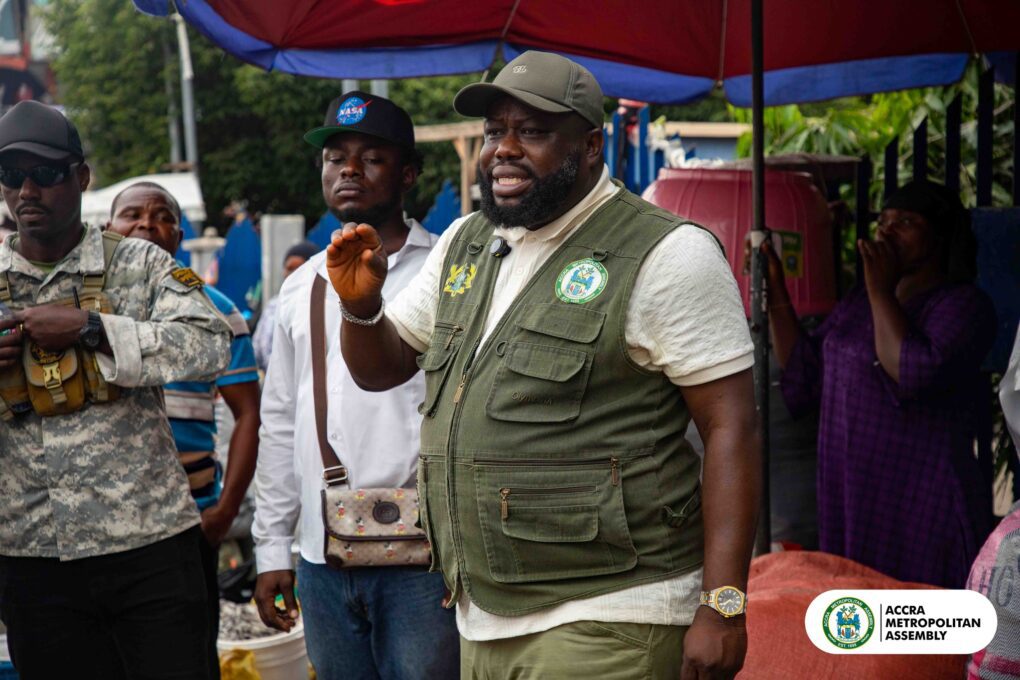
A task force has been established by the Accra Metropolitan Assembly (AMA) to clear trading and other activities from limited road sides and sidewalks marked with the “red line” policy as part of the AMA’s decongestion efforts in the CBD.
The team moved through important corridors from the AMA premises at Kinbu to the CMB area near the Central Police, through UTC, Rawlings Park, and the Law School enclave, before concluding around the Cocoa Board median towards the Farisco traffic light. The enforcement exercise, which was part of the larger decongestion program announced to take effect on February 1, began around 7 a.m. and ended around 5 p.m.
The operation was led by Hon. Michael Kpakpo Allotey, the mayor of Accra, who emphasised that government land and specified trading places were not for sale and warned traders not to provide money to city guards, construction inspectors or any middlemen.

He cautioned that items discovered beyond the red line might be seized, and violators could be prosecuted in the sanitation court and subject to statutory fines.
“The Assembly’s priority was to stop trading on roads and pavements, prevent refuse accumulation in busy commercial stretches, and ensure public spaces were used for their intended purpose,” the Mayor insisted, adding that the operation was not meant to “sack” traders but rather to restore order, improve safety, and improve the city’s appearance.
He underlined that the regulations extended to all traders operating along restricted lanes and warned against using vulnerability as a means of evading compliance.
Speaking to the media, the Mayor emphasised that the festive window had closed and that enforcement would now be applied consistently, with limited allowances only during official holidays. He added that the Assembly had purposefully permitted extended selling during the Christmas period, including an extra month after the festive season, to help traders take advantage of peak sales.
Speaking to the public’s worries about intimidation and extortion, the mayor reaffirmed that no one has the right to demand money from vendors in the name of defending public areas.
He stated that only official daily collections, such as the Assembly’s Two Ghana Cedis (GH¢2) ticketing system, were permitted in marketplaces and threatened to take action against anyone found accepting unapproved fees.
Citing recent economic conditions, such as currency pressures and fuel price fluctuations, the mayor connected the decongestion drive to larger government initiatives to stabilise the economy and enhance urban management, arguing that citizens also had a responsibility to support the national recovery by adhering to local regulations.
He clarified that the Assembly was pursuing market redevelopment as a long-term solution to traffic congestion, noting that additional markets were planned throughout the city and that construction was now underway in a number of locations, including Salaga and the Tuesday Market.


Source: newsthemegh.com