
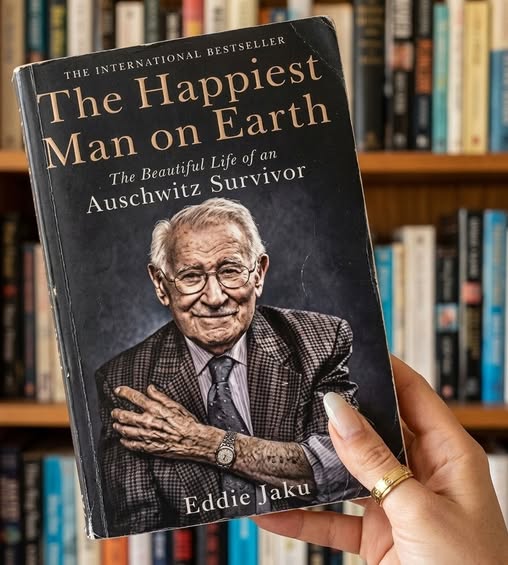
By Eddie Jaku
“Life can be beautiful if you make it beautiful.” That simple sentence stayed with me long after I finished listening to The Happiest Man on Earth.
Coming from a man who survived the horrors of Auschwitz, lost family, endured hatred beyond imagination, and still chose gratitude over bitterness, those words carry a weight that is difficult to describe.
Listening to Eddie Jaku tell his story through the warm and heartfelt narration of Raphael Corkhill felt less like an audiobook and more like sitting across from a beloved grandfather who has seen the worst of humanity and yet refuses to stop believing in its goodness.
The book is emotional, heartbreaking, inspiring, and deeply human. It is one of those rare books that does not merely inform you, it changes the way you look at life.
No wonder it has touched so many readers around the world and continues to be celebrated for its message of hope, resilience, kindness, and gratitude.
1. Happiness is a choice, not a circumstance.
Eddie Jaku lost almost everything that could be taken from a person. His freedom, his family, his home, his security, and his youth were all shattered by the Holocaust. Yet the most astonishing lesson from the book is that happiness is not something that happens to us, it is something we choose. Eddie repeatedly reminds us that the Nazis could take his possessions and dignity, but they could not take control of his mind. Listening to his reflections made me realize how often we postpone happiness until life becomes perfect. Eddie’s life challenges that thinking completely. His story whispers a powerful truth into a noisy world obsessed with chasing the next big thing, happiness begins the moment we decide to appreciate what remains rather than mourn endlessly over what is missing. That lesson hit me deeply. It is the kind of truth that deserves to be shared, saved, and remembered.
2. Kindness is the greatest wealth a human being can possess.
Throughout the audiobook, Eddie returns again and again to the value of kindness. Some of the people who helped him survive had very little themselves, yet they chose compassion when cruelty would have been easier. He learned from his father that friends, family, and kindness are worth far more than money. In today’s world where people often celebrate status, followers, influence, and material success, Eddie’s message feels refreshingly powerful. The people we remember most are not always the richest or the smartest, but often the kindest. Listening to his story made me reflect on how a simple act of kindness can become a lifeline for someone fighting a battle we know nothing about. If there is one message from this book that should trend everywhere, it is this, kindness never goes out of style.
3. Hatred destroys the person who carries it.
One of the most moving aspects of this memoir is that Eddie refused to spend his life consumed by hatred. He had every reason to be bitter, angry, and resentful. Yet he chose a different path. He understood that carrying hatred would allow his oppressors to continue hurting him long after the war ended. His refusal to let hatred define him is one of the most extraordinary examples of emotional courage I have ever encountered in a book. Listening to those sections was both convicting and liberating. We often think forgiveness benefits the person who wronged us, but Eddie shows that forgiveness also frees the wounded heart. In a generation where outrage spreads faster than understanding, his wisdom feels more relevant than ever.
4. Human connection can keep a person alive during the darkest seasons.
Eddie’s survival was not only a story of personal strength. It was also a story of friendship, loyalty, and human connection. Again and again, people appeared in his life whose encouragement, sacrifice, or companionship helped him endure impossible circumstances. The audiobook beautifully highlights how relationships became anchors in a storm of suffering. It reminded me that nobody is meant to walk through life alone. During our lowest moments, a friend, a spouse, a family member, or even a stranger can become the reason we keep moving forward. In a world where many people quietly battle loneliness behind smiling photos and polished posts, this lesson felt incredibly timely. Real connection remains one of life’s greatest treasures.
5. The greatest act of defiance is to build a beautiful life after pain.
Perhaps the lesson that moved me most was Eddie’s determination not merely to survive but to truly live. After everything he endured, he built a family, nurtured friendships, served his community, shared his story, and devoted himself to helping others. He refused to let tragedy write the final chapter of his life. That is what makes this book so unforgettable. It is not simply a Holocaust memoir. It is a testimony to the resilience of the human spirit. Listening to Eddie speak about gratitude, family, love, and purpose felt like watching light break through heavy clouds. His life declares that our wounds do not have to become our identity. Our scars can become evidence that we survived and continued forward. In a world hungry for hope, that message is pure gold.
Source: newsthemegh.com