
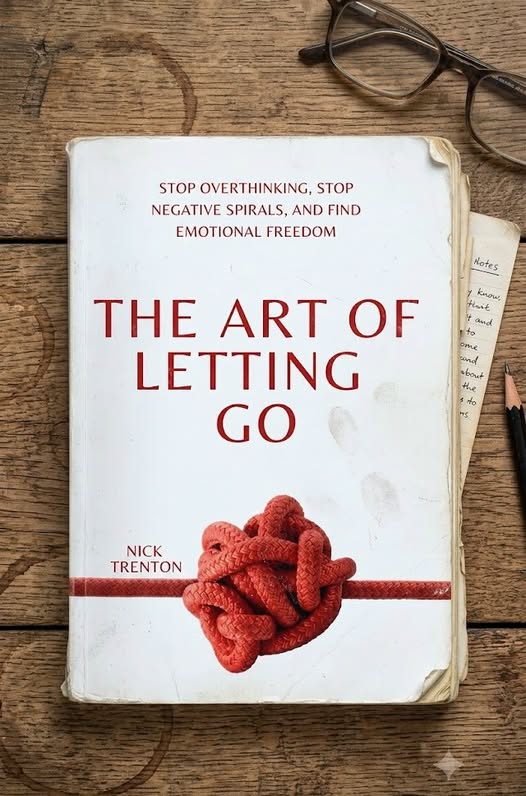
By Nick Trenton
Let me be real with you for a second, because this is not a review, this is a conversation I genuinely wish someone had started with me sooner.
Nick Trenton opens “The Art of Letting Go” with a truth so raw it almost stings: your mind was designed for 10,000 BC, built to detect predators and survive disaster, and yet here you are in 2026, lying awake replaying a conversation from three years ago like it still has fangs.
That line, delivered in Russell Newton’s calm, unhurried voice, the kind of voice that feels like a steady hand on your shoulder, hit me somewhere deep. Newton does not narrate this book so much as he breathes it into you, and by the time he is done, something in your chest actually feels lighter.
If you have been living in your own head like it is a haunted house you cannot escape, if the overthinking is eating your peace alive, if you have been main-charactering your own suffering and cannot seem to pop off into joy the way you deserve, then beloved, this book was written for you and for me and for all of us who have been carrying weight we were never supposed to hold.
1. Your Brain Is Running Ancient Software, and You Can Update It
Trenton makes a profound point that sits with you long after the chapter ends: our brains were essentially built for 10,000 BC, wired for survival in a world of physical threats, and yet we are using that same ancient machinery to navigate modern heartbreak, social media pressure, and daily uncertainty. He does not say this to excuse your anxiety, he says it to liberate you from the shame of it. You are not broken, you are just running outdated software on very modern hardware, and the book’s first and perhaps most merciful gift is the permission to stop blaming yourself for a brain that is simply doing what brains were designed to do. Trenton draws on his background in behavioral psychology to give readers practical tools for cognitive restructuring, helping you rewire your thought patterns rather than simply white-knuckling your way through them. When Newton narrates this section, his voice carries a gentleness that makes the science feel human, like a trusted friend who happens to have a master’s degree and genuinely wants you free. This is where the healing begins, not with hustle, not with toxic positivity, but with understanding.
2. Overthinking Is Not Intelligence, It Is a Trap
So real: most of us have spent years confusing overthinking with being thoughtful, as if replaying every worst case scenario in our heads is somehow productive preparation for life. Trenton teaches that the inner critic, that relentless voice that catastrophizes and second-guesses, is not your true self but a construct formed from past pain, internalized criticism, and unrealistic expectations, and the first step to freedom is recognizing that voice as separate from who you actually are. He gives you the language to identify it, to catch it mid-spiral, and to say, firmly and with self-compassion, “That is not me, that is just the noise.” Each chapter includes practical exercises that make the book not merely a guide but a workbook, and this particular chapter challenged me to write down my recurring spiral thoughts and examine them the way you would examine evidence in a courtroom, not to judge them, but to question whether they are actually based on reality. Russell Newton’s pacing here is everything, slow enough that the weight of each insight actually lands, unhurried enough that you feel held rather than lectured.
3. The Present Moment Is the Only Place You Have Any Power
This one, beloved, is the lesson that broke something open in me. Trenton argues that overfocusing on the unchangeable past or the unpredictable future robs you of agency, and he offers tools to refocus your energy on actionable steps that only exist in the present. He is not selling you toxic positivity or telling you to simply “be grateful,” he is making a behavioral and psychological case that the past is over and the future may never arrive in the shape you fear, so the only place where you can actually do anything, choose anything, feel anything real, is right now, in this breath, in this moment. Trenton emphasizes that letting go is a conscious choice, not a passive surrender, and one that significantly impacts overall well-being. There is something so grounding about hearing Newton read this, because his voice itself is anchored, present, and deliberate, modeling in sound what the chapter is teaching in words. It is the kind of lesson that makes you put down the audiobook, exhale slowly, and look around the room you are sitting in with fresh, quieter eyes.
4. Perfectionism Is Stealing Your Life, and Excellentism Is the Antidote
This lesson genuinely changed how I move. Trenton draws a sharp line between perfectionism, which paralyzes, and what he calls “excellentism,” a drive focused on growth rather than flawlessness, and he makes the case that perfectionism is not a high standard but a fear dressed up in ambition. The perfectionist does not actually want to do things well, the perfectionist wants to never be wrong, never be criticized, never be seen failing, and so they either spiral into overworking or they freeze completely, neither of which produces the life they actually want. Trenton’s approach is based and deeply freeing: excellence is achievable, sustainable, and human, while perfection is a moving goalpost designed to keep you forever dissatisfied. His economics background adds a nuance here that feels fresh, reframing urgency and perfectionism as cognitive distortions that cost you more than they ever deliver. Newton narrates this section with a quiet confidence that feels like a living demonstration of the principle, unhurried, assured, and more than enough.
5. Letting Go Is Not Giving Up, It Is Choosing Yourself
At its heart, this book is a beautiful reminder that the act of letting go is not about loss or sacrifice but about making space for what truly matters, and Trenton delivers this truth not as a motivational slogan but as a deeply argued, emotionally resonant case built across every chapter. Letting go of a grudge is not excusing the person who hurt you, it is refusing to let their actions continue renting space in your mind. Letting go of a past version of yourself is not betrayal, it is growth. The book guides you on a transformative journey toward self-discovery, and its wisdom resonates precisely because it is so deeply relatable, the kind of wisdom that makes you feel seen in your struggle and hopeful about your healing. By the time Russell Newton reads the final chapters, his voice has become something close to companionship, and you realize that what you have just experienced is not merely an audiobook but an intervention in the most loving sense of the word.
This book will not fix your life in an afternoon, but it will give you something far more valuable: a new way of being with yourself, quieter, kinder, and finally, finally free.
Source: newsthemegh.com