

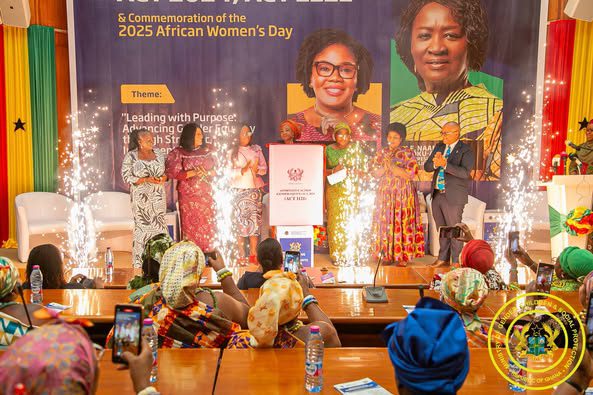
Ghana’s dedication to advancing gender equality, inclusive governance, and social transformation began anew on Thursday, July 31, 2025, when the Ministry of Gender, Children, and Social Protection (MoGCSP) hosted a high-level national launch of the Affirmative Action (Gender Equity) Act, 2024 (Act 1121).
A wide range of stakeholders, including members of parliament, civil society organizations, and academic institutions, were present at the event, which was hosted at the Accra International Conference Centre.
Additionally, the unveiling took place on Africa Women’s Day, which made it a particularly important and symbolic event.
The event, with the theme “Leading with Purpose: Advancing Gender Equity through Strategic Implementation of the Affirmative Action Act, 2024 (Act 1121),” showcased 20 years of continuous policy discussion and lobbying spearheaded by the Ministry with assistance from important players in Ghana’s development landscape.

Hon. Dr. Agnes Naa Momo Lartey, Minister for Gender, Children, and Social Protection, characterized the Affirmative Action Act’s approval as a significant legislative step toward inclusive national development and a historic win for Ghanaian women in her welcome remarks.
She urged all sectors to help ensure the law’s smooth implementation and stated that it will address the historical underrepresentation of women in leadership roles.
“The Affirmative Action Act is more than a legal instrument; it is a declaration of our collective will to build a just and equitable Ghana. Its implementation cannot rest solely on government. It demands the active participation of Queen Mothers, civil society, Parliamentarians, the media, and community actors,” she reiterated.
She also took the opportunity to announce another significant development: Parliament recently passed the Social Protection Bill into law.
According to her, this is an important turning point that advances the nation’s social inclusion strategy and supports the Affirmative Action Act.
In her keynote speech, Dr. Miriam Iddrisu, Deputy Policy Advisor at the Office of the Vice President, underlined the government’s steadfast commitment to gender justice on behalf of Vice President H.E. Prof. Naana Jane Opoku Agyemang.
She pointed out that decades of tenacity, fortitude, and solidarity among Ghanaian women, civil society organizations, and political players from all sides of the divide led to the passing of the Affirmative Action Act.
Through her spokesperson, the vice president underlined that gender parity is essential to the Reset Ghana objective and closely relates to the government’s 24-hour economy program.
She reaffirmed that in order to fully realize the Act’s promise, institutional strengthening, legal knowledge, and broad engagement are necessary.
Mr. Zia Choudhry, the UN Resident Coordinator, praised the Ministry for its audacious leadership and called the event “poignant and symbolic.” He pointed out that because the Act fosters justice, equity, and collective advancement, it benefits not just women but the entire country.
He promised the UN’s ongoing assistance in accomplishing the Act’s objectives.

Key resource persons from academia, development agencies, and civil society participated in a panel debate on the Act’s importance and implementation tactics.
The necessity of effective monitoring mechanisms, resource mobilization, capacity building at all governmental levels, and national sensitization were the main topics of discussion.
With a renewed sense of national urgency to remove obstacles to women’s participation in leadership and government, the launch came to a close.


The Affirmative Action (Gender Equity) Act, 2024 (Act 1121), which was passed in July 2024 and ratified in September of the same year, requires at least 30% of women to be in decision-making positions by 2026, with the aim of achieving complete gender parity by 2034.
The law also gives victims of gender-based discrimination legal remedies and mandates that public organizations budget for gender equality initiatives.


Source: newsthemegh.com