
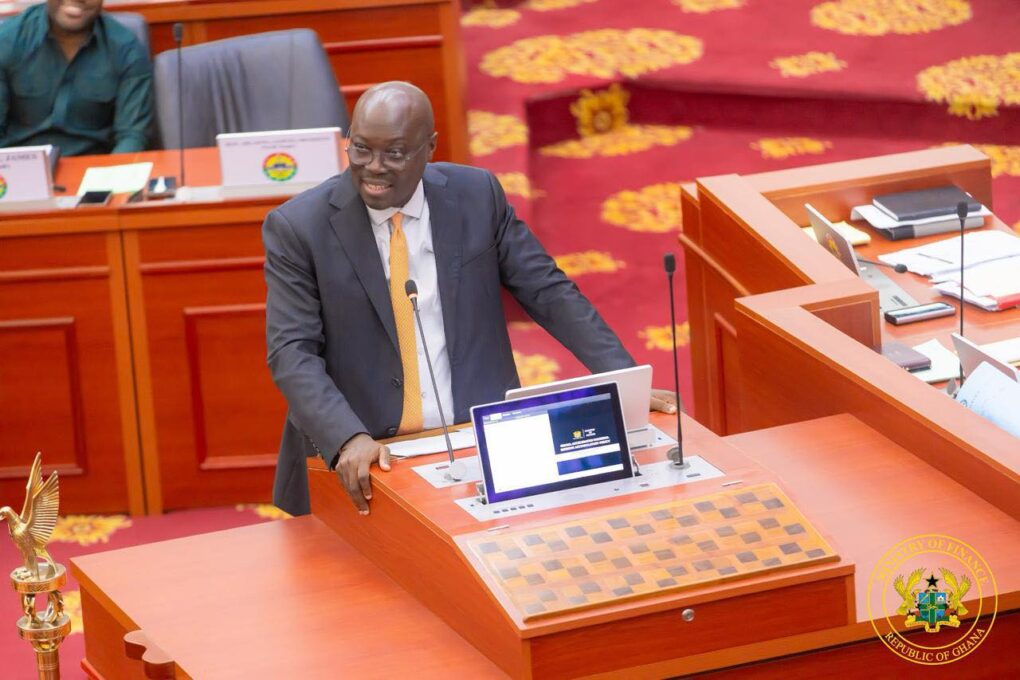
Ghana’s first comprehensive national policy to increase external reserves and protect the country’s future is unveiled by the finance minister.
Ghana’s first-ever comprehensive national strategy was launched by Finance Minister Dr. Cassiel Ato Forson with the express purpose of consciously and sustainably increasing the nation’s external reserves and ensuring long-term macroeconomic stability.
The Ghana Accelerated National Reserve Accumulation Policy (GANRAP) (2026–2028) was introduced to Parliament by the Minister, who characterised the plan as a strategic and historic change in Ghana’s external buffer management, a departure from expensive borrowing and short-term reserve-building measures in favour of a structured, reform-driven, and gold-backed accumulation framework.
The program builds on the significant macroeconomic turnaround that was accomplished in 2025 after the 2022–2023 crisis, Dr. Forson told Parliament. By the end of 2025, important metrics included:
• Real GDP growth averaging 6.1% in the first three quarters of 2025
• Inflation declining sharply from 23.8% in 2024 to 5.4%, and further to 3.8% in January 2026
• The 91-day Treasury bill rate falling from 27.7% at end-2024 to 6.4% in February 2026
• Public debt declining from 61.8% of GDP to 45.3%
• Gross international reserves rising to US$13.8 billion, equivalent to 5.7 months of import cover, up from 4.0 months in 2024
Despite these improvements, the Minister warned that in the current unstable global environment, the conventional standard of three months of import coverage is no longer adequate.
Target: 15 Months of Import Cover by 2028
By the end of 2028, the government hopes to have increased reserves to the level of 15 months’ worth of import cover under GANRAP. The policy establishes intermediate benchmarks for:
• 8.6 months by end-2026
• 11.8 months by end-2027
• 15 months by end-2028
According to the Minister, the goal is to establish a “economic war chest” that will protect Ghana from disruptions caused by the climate, global financing instability, commodity price shocks, and geopolitical conflicts.
The Ghana Gold Board Act, 2025 (Act 1140), which requires the Ghana Gold Board to produce foreign exchange and support the Bank of Ghana’s gold reserve accumulation, is the foundation of the policy’s intentional gold-backed reserve accumulation plan.
The government has set an operational weekly goal of 3.02 tonnes of gold purchases. This will be accomplished by:
• Acquisition of at least 2.45 tonnes weekly from the Artisanal Small-Scale Mining (ASM) sector
• Invocation of pre-emption rights to secure a minimum of 0.57 tonnes weekly from the large-scale mining sector
The purchased gold will be purified, added to Ghana’s physical reserves, and sold only with the Cabinet and Parliament’s prior consent.
The Minister pointed out that in order to increase reserves at a considerable expense, Ghana mostly depended on Eurobonds, swaps, sale-and-buy-back deals, and commercial bank borrowing between 2017 and 2024.
Through swaps and associated transactions, the Bank of Ghana amassed US$5.65 billion in reserves between 2022 and 2024 alone, at an interest expense of US$1.16 billion.
Furthermore, taxpayers paid roughly US$2.5 billion in interest on Eurobond borrowings made between 2018 and 2021 to finance reserve build-up; Ghana is still paying off these obligations.
Dr. Forson emphasised that borrowing to build up reserves is unsustainable and played a role in the debt crisis of 2022.
However, he disclosed that the Ghana Gold Board made over US$10 billion in foreign exchange in 2025 alone, at a cost of US$214 million, which is much less than the cost of borrowing the same amount of money.
In addition to gold, the strategy incorporates structural changes meant to increase foreign exchange inflows and decrease ongoing outflows.
These consist of:
• Scaling up non-traditional exports
• Revitalising cocoa productivity
• Implementing the National Policy on Integrated Oil Palm Development
• Accelerating new oil field developments such as Pecan
• Conserving foreign exchange through a Gas-to-Power Transformation Policy
The Minister stressed that preserving a primary surplus and exercising budgetary restraint are still essential to safeguarding the advantages made.
In his closing remarks, Dr Forson urged Parliament to back a historic and progressive policy framework that would fortify Ghana’s first line of defence against outside shocks.
Building a robust reserve management system that protects macroeconomic stability, maintains investor confidence, raises living standards, and ensures long-term prosperity for future generations is the main goal, he said.
One of the few African nations to implement a planned, legally-anchored national reserve accumulation strategy based mostly on local resource mobilisation rather than borrowing from outside sources is Ghana, which has done so with the introduction of GANRAP.
Full Text Below:
Source: newsthemegh.com