
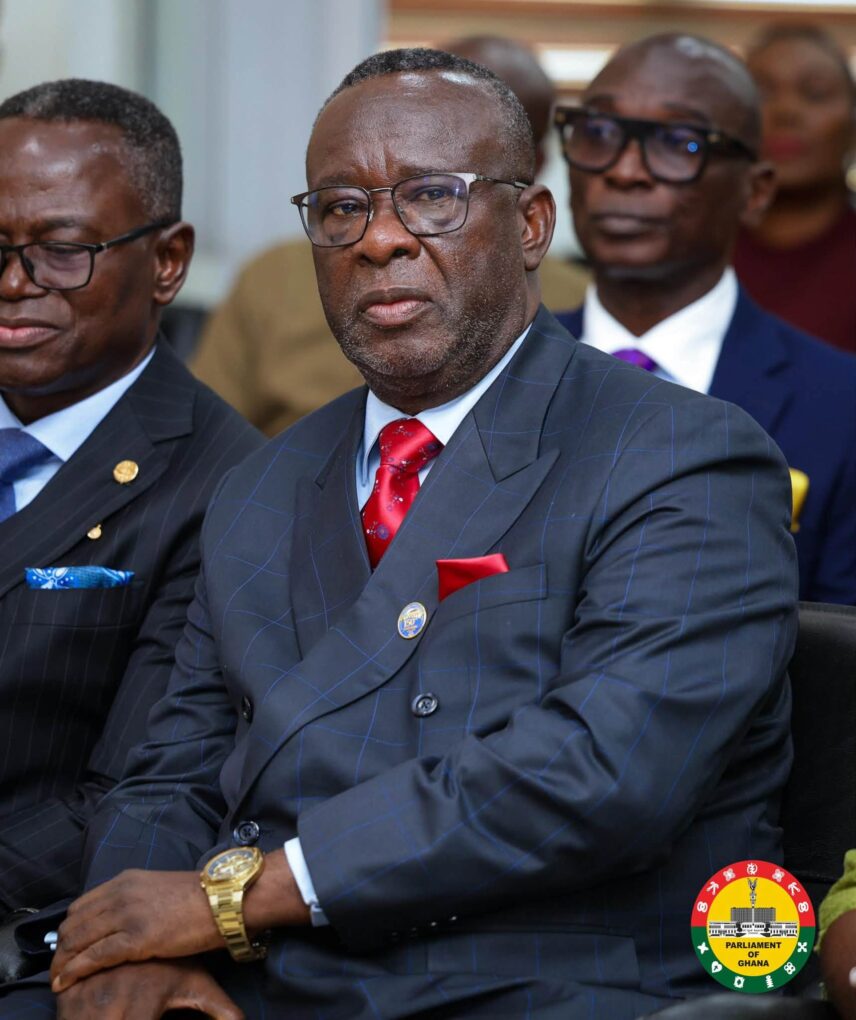
Chief Justice Paul Baffoe-Bonnie, head of Ghana’s Judiciary, has come under criticism after comments he made about the performance of the previous New Patriotic Party (NPP) government raised concerns about judicial neutrality and the principle of separation of powers.
Critics have accused the Chief Justice of entering Ghana’s political discourse and making remarks that could be interpreted as partisan, arguing that such comments could potentially affect public confidence in the independence of the Judiciary.
Justice Baffoe-Bonnie questioned how Ghana’s public institutions had been managed during the previous eight years under the NPP administration, while highlighting what he described as improved performances by institutions such as the Social Security and National Insurance Trust (SSNIT) and the Minerals Income Investment Fund (MIIF) under the current National Democratic Congress (NDC) government.
During a visit to MIIF, the Chief Justice expressed surprise at the progress he had observed at some state-owned institutions.
He said the performance of these organisations raised questions about how public resources had been managed in previous years.
The Chief Justice congratulated the management of MIIF for what he described as impressive progress, stressing that effective leadership, prudent management and responsible use of public resources could produce significant results.
He also referred to his earlier visit to SSNIT, recalling concerns over the possible disposal of some of the institution’s major assets, including the Elmina Beach Resort and Pleasure Beach.
According to Justice Baffoe-Bonnie, developments he had witnessed at various public institutions made him question how Ghana had performed under the previous administration.
He attributed the improved performance of state institutions to better management, efficient resource utilisation and a stronger understanding of the responsibility attached to holding public office.
The Chief Justice further urged public officials to focus on their legacy and consider how they would be remembered for their stewardship after leaving office.
Critics Raise Concerns Over Judicial Independence
The comments have triggered debate among lawyers, academics and political commentators over the appropriate level of public commentary expected from the head of Ghana’s Judiciary.
Lawyer, activist and academic Oliver Barker-Vormawor, who was recently appointed Secretary to the 11-member Constitution Review Implementation Committee (CRIC) by President John Dramani Mahama, criticised the Chief Justice’s remarks.
Barker-Vormawor argued that certain political observations should not come from judges and called on Justice Baffoe-Bonnie to apologise and consider early retirement.
Meanwhile, legal academic and constitutional commentator Professor Stephen Kweku Asare, popularly known as Prof. Kwaku Azaar, said he understood the sentiment behind the Chief Justice’s comments but expressed concern about the language used.
Prof. Kweku Azaar noted that the reference to the “past eight years” could carry an unmistakable partisan meaning within Ghana’s political environment.
He argued that, coming from the Chief Justice, such remarks could be interpreted as an assessment of one political administration against another.
According to him, judges remain citizens after assuming office, but their judicial positions require a high degree of restraint when making public statements, particularly on politically sensitive matters.
He stressed that the Chief Justice carries the institutional authority of the Judiciary, meaning his public comments can have consequences beyond his personal views.
Prof. Kweku Azaar further argued that judicial independence requires restraint from both sides of the political divide.
While politicians are expected to respect the independence of the Judiciary, judges—especially the Chief Justice—must also avoid partisan political engagements that could undermine public confidence in the courts.
He warned that cases involving decisions of both the previous and current governments could eventually come before Ghanaian courts.
For this reason, he said, no litigant should have cause to question whether the head of the Judiciary has already formed a favourable or unfavourable opinion about a particular government.
Source: newsthemegh.com