
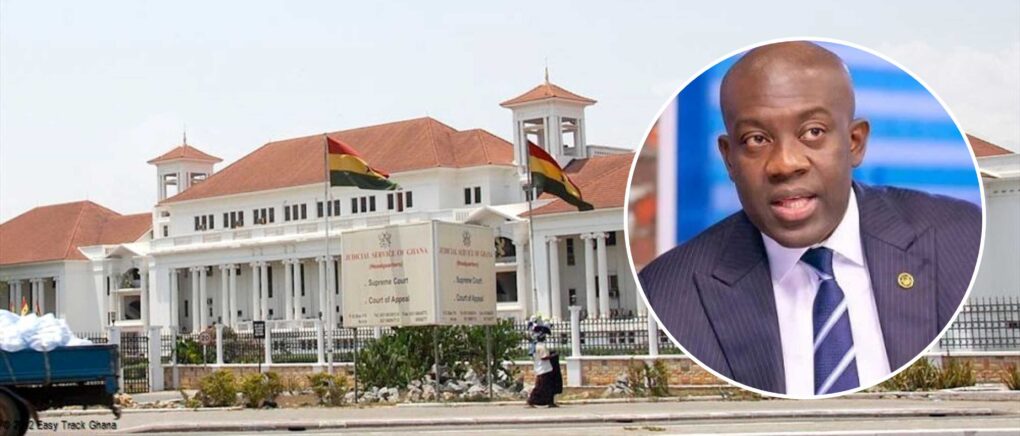
The Supreme Court of Ghana has dismissed an application filed by former Information Minister Kojo Oppong Nkrumah, seeking a review of an earlier decision by a single Justice of the court that rejected his application for an interlocutory injunction.
A five-member Supreme Court panel, chaired by Justice Emmanuel Yonny Kulendi, unanimously ruled that the application did not satisfy the legal threshold required for the court to exercise its review jurisdiction.
The panel, which included Justice Richard Adjei-Frimpong and Justice Gbiel Simon Suurbaareh, described the application as unmeritorious and subsequently dismissed it.
The Supreme Court indicated that the full reasons for its decision would be made available at the court’s registry on September 7, 2026.
Kojo Oppong Nkrumah Challenges Earlier Court Decision
During the proceedings, counsel for Kojo Oppong Nkrumah, Mr Davies, asked the Supreme Court to overturn a ruling by Justice Gabriel Scott Pwamang, who had dismissed an application for an interlocutory injunction filed on August 21, 2026.
At the start of the hearing, Mr Davies requested an adjournment to allow him to file a supplementary affidavit and a supplementary affidavit in reply.
He explained that the legal team had received the Attorney-General’s affidavit in opposition and statement of case at about 5 p.m. the previous day and was only able to consult with the former Information Minister after 8 p.m.
However, Justice Adjei-Frimpong questioned whether the additional court processes were necessary, noting that the issues raised appeared to be largely matters of law rather than disputed facts.
Mr Davies maintained that legal issues contained in the affidavit in reply required a response because, in his view, they went to the core of the application.
Justice Kulendi subsequently rejected the request for an adjournment.
The presiding Justice pointed out that Kojo Oppong Nkrumah’s statement of case was 32 pages long, supported by an affidavit containing 40 paragraphs. The Attorney-General’s response, he noted, consisted of a 15-paragraph affidavit and a 13-page statement of case.
Justice Kulendi said the Supreme Court was capable of determining the legal issues before it without requiring additional arguments from the parties.
The court therefore dismissed the request for an adjournment and directed counsel to proceed with the application.
Lawyers Raise Legal Arguments Over Injunction
In presenting the application, Mr Davies argued that the Supreme Court should reverse Justice Pwamang’s decision dismissing the interlocutory injunction application.
He indicated that the applicant would rely heavily on the 32-page statement of case but would focus the court’s attention on what he described as clear and significant errors contained in the earlier ruling.
Among the issues raised was the treatment of legal vacation and criminal proceedings.
Mr Davies argued that the earlier ruling appeared to suggest that rules governing legal vacation applied to civil proceedings but not criminal proceedings. He contended that if criminal proceedings could continue during legal vacation without a warrant, there should be an explanation as to why the warrant in question was necessary.
He further argued that the single Justice should have exercised judicial restraint and avoided making findings relating to the merits of the substantive case, which would eventually be determined by the full Bench of the Supreme Court.
According to the lawyer, the single Justice also applied the wrong legal test when considering whether the interlocutory injunction should be granted.
He argued that the court should have considered whether there was a serious question of law to be tried rather than focusing on the prospects of success of the substantive case.
Dispute Over Attorney-General’s Representation
Another major issue raised by Mr Davies concerned the Attorney-General’s representation of the Chief Justice.
He argued that the Chief Justice was performing an administrative function within the Judiciary, while the Attorney-General belonged to the Executive arm of government.
According to the lawyer, because the substantive case challenged an administrative function of the Chief Justice, the Attorney-General should not be representing him in the proceedings.
Attorney-General Opposes Review Application
Opposing the application, Dr Srem-Sai, the Deputy Attorney-General, argued that the Supreme Court’s review jurisdiction was subject to a strict legal threshold that the applicant had failed to satisfy.
He said an applicant seeking a review must demonstrate special or exceptional circumstances capable of justifying the intervention of the Supreme Court.
Dr Srem-Sai stressed that the review jurisdiction was not intended to provide another opportunity for parties to re-argue issues already considered by a single Justice, nor was it an alternative route for an appeal.
He argued that the eight grounds relied upon by Kojo Oppong Nkrumah did not establish any special circumstances that would justify a review of the earlier ruling.
On the issue of the Attorney-General representing the Chief Justice, the Deputy Attorney-General maintained that the argument had no direct relevance to the question of whether the interlocutory injunction should be granted.
He also rejected the argument that the absence of the Chief Justice meant that statements contained in the applicant’s depositions should automatically be treated as admitted.
According to Dr Srem-Sai, that argument did not provide sufficient grounds for reviewing the single Justice’s decision.
Court Rejects Claims of Jurisdictional Error
The Deputy Attorney-General further disagreed with the claim that Justice Pwamang exceeded his jurisdiction by making observations concerning issues in the substantive case.
He explained that restrictions against a judge commenting on the merits of a substantive case generally arise where the same judge is expected to preside over the substantive proceedings.
In this instance, Dr Srem-Sai noted that the Justice who heard the interlocutory injunction application was different from the panel expected to determine the substantive case.
He also argued that Kojo Oppong Nkrumah had failed to demonstrate any irreparable injury or exceptional circumstances that would justify overturning the earlier decision.
The Deputy Attorney-General said the latest application essentially relied on the same facts and legal issues presented in the original application, although they had been reorganised.
He therefore urged the Supreme Court to dismiss the review application and allow the single Justice’s earlier ruling to remain in force.
Supreme Court Gives Final Ruling
In delivering its decision, the five-member Supreme Court panel said it had carefully examined all the processes filed before it, including the affidavits and legal arguments contained in the respective statements of case.
The court also considered the oral submissions made by counsel and reviewed previous Supreme Court decisions concerning the legal threshold for exercising its review jurisdiction.
After considering the arguments, the panel concluded that the application had failed to meet the required threshold on all the grounds presented.
The Ghana Supreme Court consequently dismissed the application as unmeritorious.
The ruling means that the earlier decision by Justice Gabriel Scott Pwamang dismissing the interlocutory injunction application remains undisturbed pending any further legal steps available under Ghanaian law.
Source: newsthemegh.com