
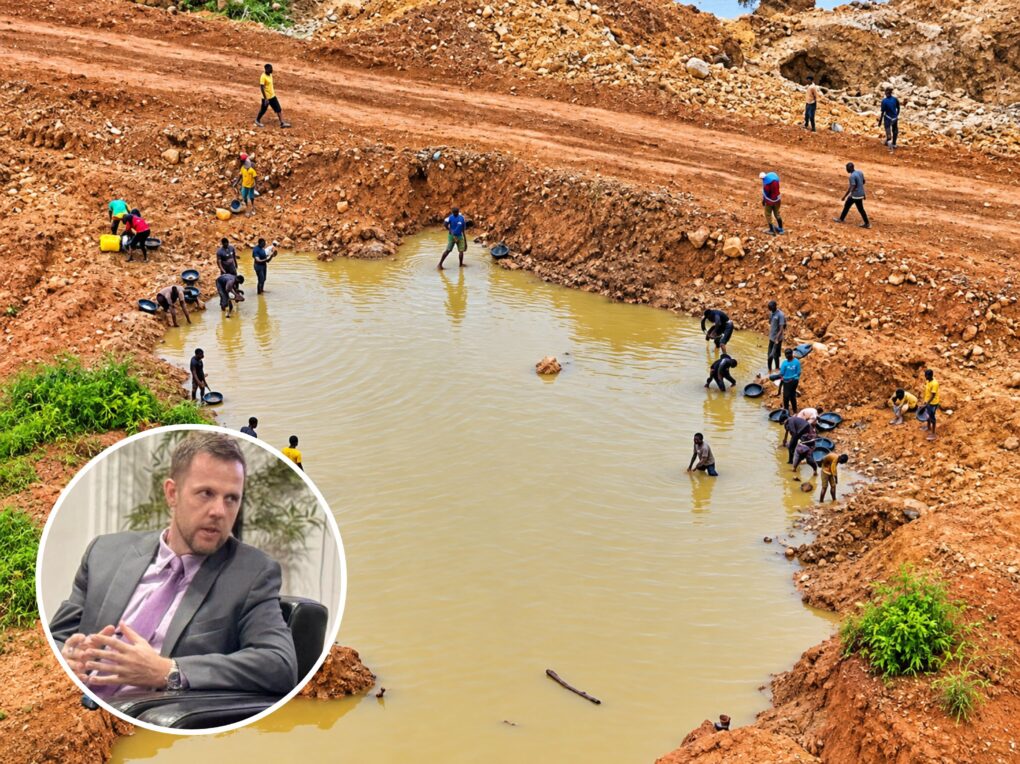
The European Union (EU) has raised concerns over the growing impact of illegal mining, popularly known as galamsey, on its development investments in Ghana, warning that the destructive activities are threatening progress in agriculture, water sanitation, security and forest conservation.
The Deputy Head of the EU Delegation to Ghana, Jonas Claes, said illegal mining was weakening the effectiveness of development programmes supported by the European bloc, particularly initiatives aimed at promoting environmental sustainability and improving livelihoods.
Speaking at the public launch of three baseline studies under the Gold for Good project, Mr Claes explained that the EU had intensified its involvement in Ghana’s fight against illegal mining after previously considering the issue politically sensitive and difficult to address.
He noted that although the European Union had limited engagement in the galamsey crisis three to four years ago, the situation had changed because illegal mining now posed a direct threat to both Ghana’s development priorities and the EU-Ghana partnership.
According to Mr Claes, the EU provides substantial financial support for sustainable agriculture, access to clean water, sanitation, security and reforestation programmes. However, these investments are increasingly being threatened by environmental destruction associated with illegal mining.
He stressed that galamsey was not only damaging Ghana’s natural resources but also undermining development efforts intended to improve living conditions and strengthen local communities.
As part of its commitment to addressing the problem, the EU and some of its member states are supporting interventions to combat illegal mining across the country.
Mr Claes highlighted the €3 million Gold for Good project, which is funded by the European Union and implemented by Coginta, as one of the initiatives designed to address challenges associated with artisanal and small-scale mining.
The EU representative also called for increased public education and awareness campaigns to help communities understand the long-term consequences of illegal mining.
He observed that the immediate financial benefits and social incentives associated with galamsey often make the practice attractive to residents in mining communities.
He therefore emphasised the need to consider the economic realities of affected communities, including access to financial support, education and essential social services, when developing sustainable strategies to discourage illegal mining.
Meanwhile, the Country Director of Coginta Ghana, Rev. Fr. Dr Clement Aapengnuo, has called on the government to strengthen natural resource governance and address security threats associated with artisanal and small-scale mining.
He specifically drew attention to security concerns linked to mining activities in northern Ghana, stressing that responsible management of natural resources is critical to maintaining peace, stability and sustainable development.
Rev. Fr. Dr Aapengnuo explained that decisions regarding the management and exploitation of natural resources have significant consequences for local economic development, employment opportunities, community livelihoods and social cohesion.
The latest concerns from the European Union highlight the growing economic and environmental costs of illegal mining in Ghana and the need for stronger collaboration between government, development partners and local communities to protect the country’s forests, water bodies and natural resources.
Source: newsthemegh.com