
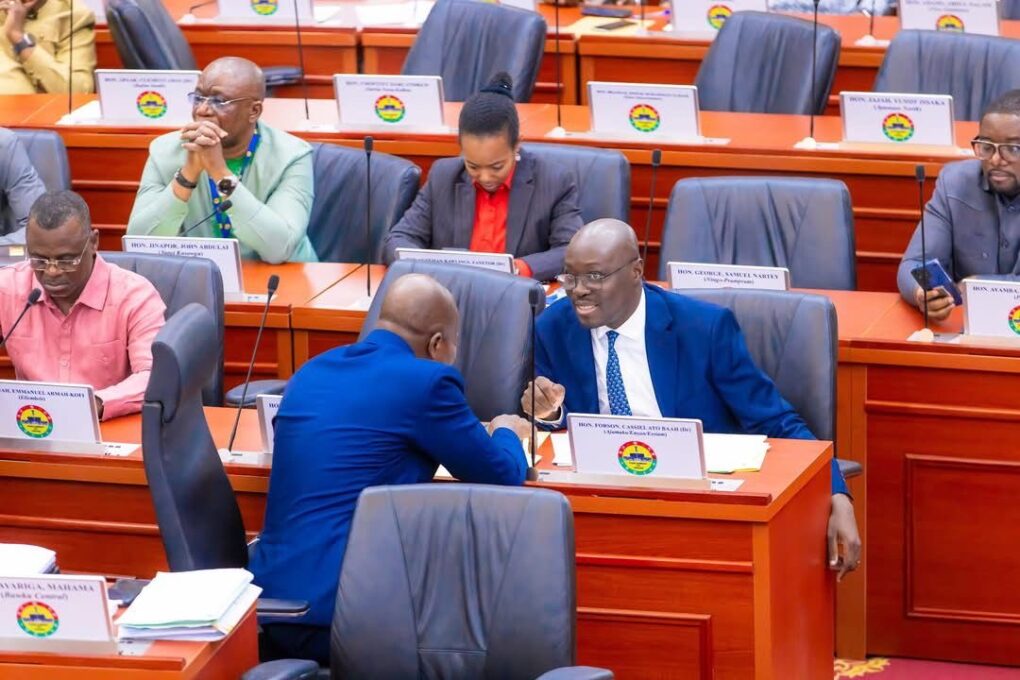
Ghana’s economy has transitioned “from the Intensive Care Unit (ICU) to the Wellness Centre,” with a focus on reform partnerships, according to Finance Minister Dr. Cassiel Ato Baah Forson.
He regarded this as a significant move away from crisis management and toward long-term macroeconomic recovery.
The Minister gave an update to Parliament on Thursday regarding the country’s progress toward re-establishing macroeconomic stability and debt sustainability ahead of schedule. He stated that the nation was now moving away from its reliance on outside financial bailouts and toward a more credible reform partnership based on investor confidence and discipline.
“Mr. Speaker, for Ghana, this marks an important shift from seeking a financial bailout to engaging as a credible reform partner while continuing to benefit from policy discipline, external validation, and strengthened investor confidence,” he said.
Dr. Forson pointed out that the International Monetary Fund’s (IMF) Policy Coordination Instrument (PCI), which offers frequent policy evaluations and technical assistance that boosts investor confidence, will be essential to maintaining changes.
He stated on the Floor of Parliament, “The PCI will enable us to continue leveraging the IMF’s regular policy assessment and expertise as a signal to investors, thereby certifying the credibility of our stewardship and further strengthening our credit rating.”
He continued by saying that Ghana’s improved situation was a result of coordinated policy action and increased budgetary restraint, which had stabilised important macroeconomic indicators.
In an effort to restore long-term investor confidence and economic resilience, the government is still working to cement advances in inflation management, currency stability, debt restructuring, and revenue mobilisation.
The IMF stated that it was moving away from the Extended Credit Facility program and toward a Policy Coordination Instrument with a reform focus.
According to the Fund, current talks have included the final ECF review, the 2026 Article IV consultation, and negotiations on a 36-month non-financing PCI, with a focus on achieving structural reforms, bolstering economic resilience, and preserving a credible fiscal path.
The Fund observed that reductions in Ghana’s debt trajectory have preserved recent achievements in macroeconomic stability while providing some fiscal room to pursue development initiatives.
It emphasised, however, that this area relied on the successful execution of bold public financial management and structural changes meant to lower risks associated with contingent obligations.
The IMF stated that the PCI reform program would prioritise improved safeguards, openness, and accountability in the face of external uncertainties and increased fiscal risks, particularly from state-owned firms and quasi-fiscal operations.
It further stated that these actions were meant to restore budgetary buffers, strengthen the legitimacy of the program, and make space for development and priority investment.
Source: newsthemegh.com