
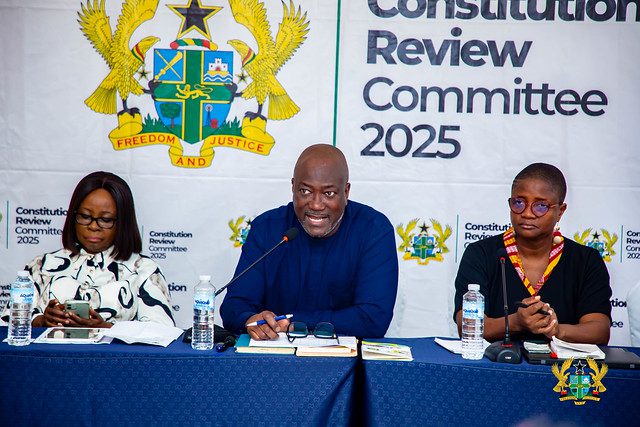
Why are university lecturers not permitted to work until they are 70 or 80 years old if they resign at age 60 and then re-engage as consultants to continue offering services?
Professor H Kwasi Prempeh, the chair of the Constitutional Review Committee (CRC), stated this after defending their proposal to eliminate the 1992 Constitution’s 60-year retirement age.
Lecturers should work for at least 70 years, according to Prof. H. Prempeh and the CRC. He emphasised that some of them are still intellectually capable of working at the age of 70 or 80.
He went on to say that the claims that older people must leave the classroom in order for younger people to take over are unfounded because the younger person seeking employment will not take the position of the 80-year-old who leaves.
“It doesn’t work that way easily” he added.
In an exclusive interview with Kemmeninin Amanor of TV3, Prof. Prempeh stated,
“Our judges are retiring at 65 and 70, and so why must university lecturers, some of them still very sharp, at 60 years, some of them are actually not even in their prime yet. So this is what we are proposing that don’t keep 69 years in the constitution, take it out and then, as and when you need to play with it, it is easier to do it in parliament; you can have a much bigger deliberation around and allow some institutions like universities a bit of a range so they can go up. Because there are universities, faculties, they retire at 60 and then re-engage them on contract, so everybody knows that it is not working. Let them work to 70.
“You don’t use retirement age that way; there is a problem of employment, the 80-year-old who leaves the classroom is not going to be replaced by the guy who is looking for a job, it doesn’t work that way easily. Look at the issue a bit more holistically. Retirement age has some connections with mobility through the system, but let us not use it as an employment kind of valve.”
According to Professor H Kwasi Prempeh, it was refreshing how candidly people spoke during the committee’s work.
He claimed that based on the consultations, it was clear that people were fed up with Ghana’s democratic system and were only interested in attaining power rather than reaping the rewards of the improvements.
In an interview with Kemmini Amanor of TV3, Prof. Prempeh stated, “You could tell from the opinions that were expressed that people were quite dissatisfied. They like the democracy that they are seeing in terms of an ability to speak your mind, to vote for the government you like, to vote against a party you don’t like, to throw, but I think they were getting a bit tired. We change these parties, and then what? For most people, you could get the sense that the democracy was becoming choiceless for them. The openness with which people spoke their ideas was quite refreshing to see.”
Prof Prempeh also backed the recommendation to change Article 62(b) of the Constitution to reduce the minimum age required to be elected President from forty to thirty years.
He does, however, add that just because a person is 30 and runs for president does not guarantee that he or she will be elected.
Speaking in an interview with TV3’s Kemmini Amanor after the CRC presented its final report to President John Dramani Mahama on Monday December 22, he said ” If the people look at you and they say this guy is 90, and so I am not going to vote for a 90-year-old man to get to the presidency or a 90-year-old woman, that is their choice to make.
The people themselves know what they are getting; it is not as if your age is off-limits. They know your age, and if they choose to vote for you, that is their problem. But in the same vein, when we were talking about the minimum age for president, it is currently 40 years, and we said it should come down to 30.”
Prof Prempeh further explained that, “People say how a 30-year-old can? It doesn’t mean that when you are 30, and you stand for president you are going to get elected, it is for the people to decide, if you are 30 and they feel you have accomplished a lot and you have a lot to offer, your maturity shows, your experience shows at 30, and they want to vote for you, that is their choice. In many of the countries that are far more advanced, they are electing much younger people, so 40 years seems to us a bit high because even in 1960, the Constitution allowed 35-year-olds to stand for president.”
The committee thought that approach would result in increased youth engagement in presidential elections.
The Committee proposes amending Article 66(1) to increase the length of a President’s tenure from four to five years.
In the meantime, the committee claims that during its investigation, it was unable to locate a place for a sitting president to serve a third term.
During the presentation of the final report on Monday, December 22, the Committee’s chair, Professor H Kwasi Prempeh, stated that the idea of a third term didn’t seem to be very popular.
He stated, “We couldn’t find a place for a third term; nobody really seemed to like it, there was really no demand for it,”
According to Prof. Prempeh, the committee also wants to examine the appointment process for heads of state-owned businesses.
According to Prof. Prempeh, the committee wants the Attorney General’s powers examined, part of them removed, and transferred to an Ethics Commission to deal with corruption charges.
The group believes that this will allow the A-G to handle major constitutional matters and international arbitration.
Source: newsthemegh.com