
By Jack Bantock
After a lifetime spent shadowing wildlife on the plains of Kenya’s Amboseli National Park, Eric Ole Kesoi’s reputation as one of the Maasai’s finest trackers is built on his ability to know where to look. At the end of this search, however, it takes all of his conviction to keep his eyes on the sight before him.
At the center of the grisly scene are the gnawed remains of a young cow, peppered with bite wounds made by the pride of lions that lie writhing and panting a few feet away, fighting for their lives. Nine blue-stained tongues loll from foaming mouths, the calling card of an unseen weapon.
“Poisoning is really the most brutal form of killing an animal. It’s heart wrenching,” Kesoi tells CNN.
“You need to be very strong to watch them suffer after ingestion. It’s one of the worst things that I’ve experienced.”
Yet it is an experience that is becoming increasingly familiar, with concern growing across East Africa in recent years over herders poisoning lions in retaliation for livestock attacks.
For conservation organizations like Lion Guardians, where Kesoi serves as community manager, it is a threat to their mission statement of mitigating human-wildlife conflict to help restore depleted lion populations in the region.

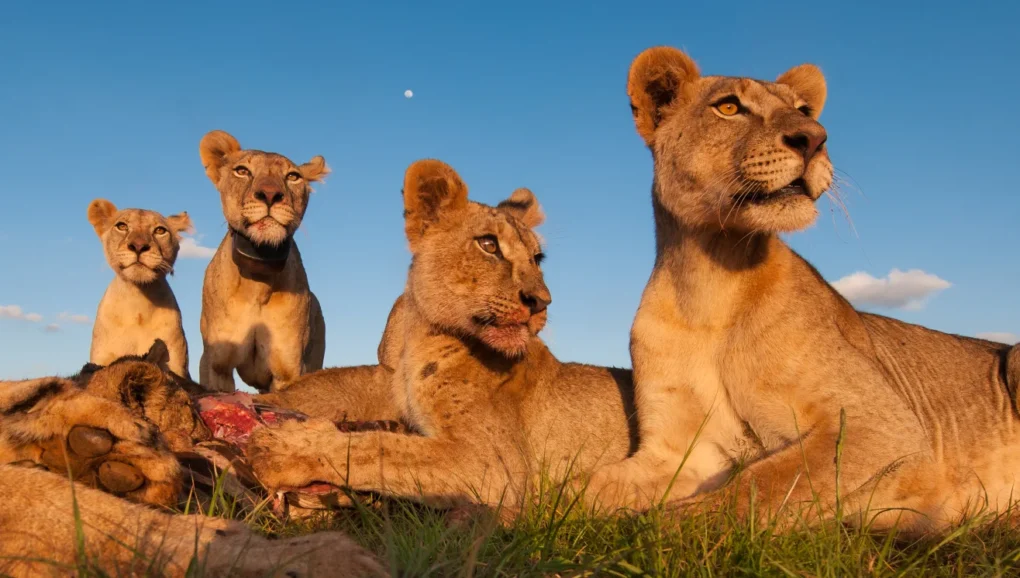
In a census carried out last October, the team documented 275 lions living within a roughly 3,700-square-kilometer (1,429-square-mile) expanse of the greater Amboseli-Tsavo ecosystem, equating to approximately 7.2 lions per 100 square kilometers — a meteoric rise from the estimated one lion in every 100 square kilometers when the organization launched in 2006.
Roughly 177 lions were estimated to be present in a 5,341-square-kilometer (2062-square-mile) area of neighboring Tanzania’s Ngorongoro Conservation Area (NCA), according to a 2025 survey by conservation group Kope Lion, up from 120 in 2022.
As their numbers rise, so does the frequency of livestock attacks and subsequent retaliation; both Lion Guardians and Kope Lion reported “significant” increases in human-lion conflicts last year.
Historically, scores would be settled by way of the spear, often wielded by Maasai warriors in revenge parties or participating in ritual killings — known as “Ala-mayo.” Now, attitudes have changed, with most Lion Guardians staff drawn from local Maasai communities. Only two lions were killed in retaliatory hunts in Amboseli-Tsavo in 2025, according to Lion Guardians.
Over the last few years, a new weapon has been used, one that’s harder to detect and more devastating. On January 7, six lions were found dead by poisoning near the Kenya-Tanzania border, two days after another six — an entire pride — were killed via the same means inside the Amboseli ecosystem.
Last month, 10 lions were discovered dead in the Ngorongoro Conservation Area. Though the investigation is not complete, preliminary findings suggest they ingested poison, according to the Ngorongoro Conservation Area Authority.
Each report is a bitter pill to swallow for Kesoi.
“We [Maasai] regard poison as a cowardly act,” he said. “That is a recent development.”
The silent killer
The killing method is simple: finding slain livestock, herders lace the carcass with poison, which lions ingest upon returning to feast. Sometimes, livestock are not involved at all, with Kesoi recalling one incident where lions had been struck down after feeding on a poisoned giraffe.
Substances used can vary. While bright blue insecticide carbofuran (sold under the name Furadan) has historically been the dominant choice, odorless pesticide strychnine has recently begun to appear, says Kesoi. Both are heavily restricted in Kenya and Tanzania, though black-market channels and smuggling via porous routes between the two countries’ borders have allowed herders to get their hands on the highly toxic chemicals.
Once ingested by lions, the pain follows quickly. Detoxification is frequently successful if administered swiftly. Kesoi and his team saved all but one of the nine lions poisoned by eating the young calf. Yet even the region’s finest trackers cannot monitor the whole national park. Only lions documented as chronic livestock attackers are fitted with GPS collars, meaning scouting teams mostly rely on first-hand monitoring and reports that often never come.
What’s more, poisoners are increasingly moving laced carcasses to remote or secluded areas, says Lion Guardians lion-monitoring coordinator Filberto Mayiani. By the time teams reach the scene, it is often too late — not just for the lions but for other species that consume the tainted meat. More than 30 dead vultures lay strewn around six of the lions fatally poisoned in January.
“You’ve taken so many lives, all because you were overtaken by anger,” Mayiani said of the poisoners. “It’s inhumane and it’s very, very painful.”

“They think they are just poisoning that predator that has killed their livestock, but poison does not just disappear once it is consumed,” he added. “It remains in the soil, in the grass, and once it rains, it will all be swept to the various water bodies around the people … we are connecting it to almost everything.”
Herders are, understandably, often the prime suspects. In 2025, 437 lion attacks resulted in 278 livestock deaths in the NCA alone, according to Kope Lion, equating to a $40,600 loss.
Financial compensation can be sought through various schemes, many of which are led by conservation organizations. The Big Life Foundation, for example, has run a Predator Compensation Fund in the Amboseli region since 2003 that pays Maasai livestock owners a chunk of livestock value lost to predators. Payments are withheld if predators are killed in response.
In recent years, some have sought to adopt a more incentivized approach. Kope Lion piloted a program that saw NCA communities paid roughly $35,000 between 2020 and 2023 based on the number of individual lions observed in the region each month.
Villages participating in the incentive program showed strong support, resulting in zero retaliatory lion poisonings, according to the organization. Kesoi noted that compensatory measures with punitive elements are effective: these collective penalties encouraged neighborhoods to self-police by identifying and holding the responsible individuals accountable.
Yet compensation schemes are not universal and, according to some herders, not always adequate. Kesoi notes that while they are generally considered sufficient within Kenya’s Amboseli, the picture is markedly different across the border.
“For the Tanzanians, they are saying ‘We don’t have [enough] compensation. When they kill our livestock, we kill them,’” said Kesoi.
Antidote
For Lion Guardians, the antidote lies not solely in financial recompense but, rather, drawing a connection between conservation and tangible community benefits.
The organization has hired schoolteachers, contributed to school fundraisers, purchased snake antivenom, treated injured livestock and covered herders’ medical bills as part of a community benefits program that dovetails with its long-established efforts to lower livestock losses: mock hunts inspired by traditional Maasai practices, for example, drive lions away from herder territories without hurting them.
Research has testified to the efficacy of this more rounded strategy. A 99% drop in Amboseli-Tsavo lion killings was recorded when Lion Guardians’ community engagement approach supplemented compensation programs, a 2014 study in the Conservation Biology journal stated, a roughly 8-12% improvement on areas that relied solely on financial recompense.
The surge in poisonings, however, has led to a more tailored response. The organization launched its first Anti-Poisoning Campaign event in late 2024, gathering village communities in hotspots to outline the ripple effect of poison on wider ecosystems, human health and livelihoods.
One event last April in Osewan, Kenya — an area where at least 20 lions had died due to poisoning — saw a popular Maasai singer perform a self-composed anti-poisoning song. For the first time in two decades, no poisonings were recorded in the region across the year, Lion Guardians said.
A cross-border event is scheduled to take place this month in the region bordering Tanzania where the six lions were found dead in January.
The paradox reflected in the data, however, is that the more successful Kesoi and his team are at restoring lion populations, the more likely the big cats are to threaten livestock and tempt the wrath of embittered herders. In short, the better they work, the more work they must do.
For some, that may be cause for fatigue. For the Maasai of Lion Guardians, though, it has the opposite effect.
“I’ve traveled around the world. You go to these big cities and the only place that you can see a lion is the zoo,” Mayiani said.
“You can’t imagine having the next generation — our kids, our grandchildren — coming into this world and having to go 100 miles from here to see a lion. This is what pushes you, so you don’t get tired, to ensure that there is a better tomorrow for our wildlife and our communities.”
Source: edition.cnn.com.com