
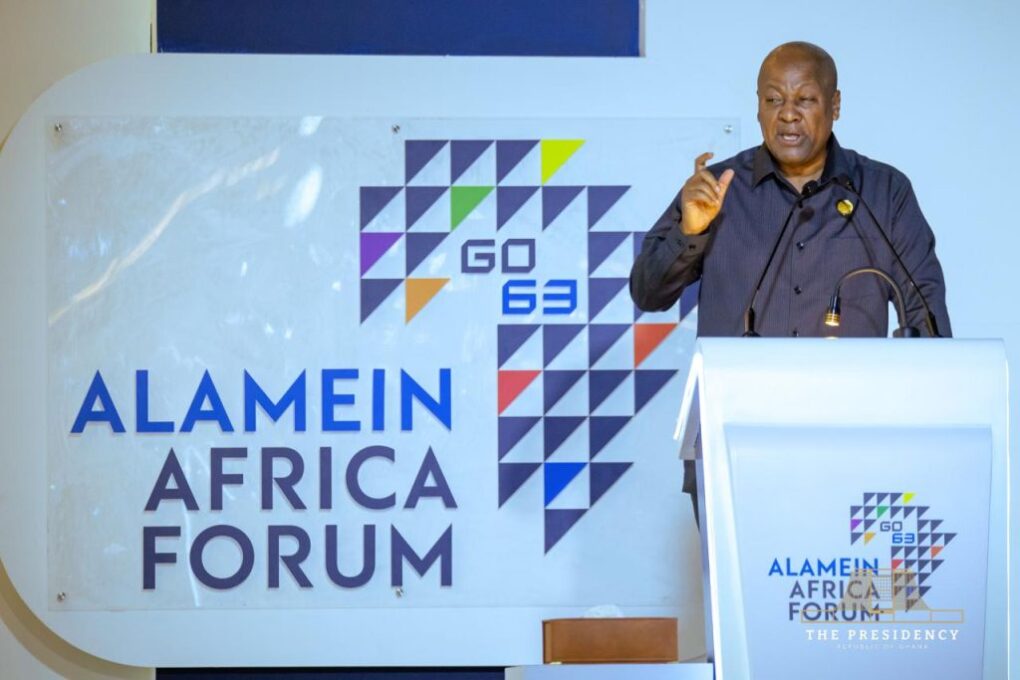
President John Dramani Mahama has called on governments, investors, regulators and pharmaceutical industry leaders across Africa to develop practical strategies to reduce the continent’s dependence on imported medicines and build a self-reliant African healthcare and pharmaceutical industry.
Speaking at the Alamein Africa Forum in Egypt on Saturday, President Mahama challenged stakeholders to stop viewing healthcare primarily as a social expense and instead recognise it as a major economic investment opportunity capable of generating jobs, strengthening local industries and improving public health.
The Ghanaian president made the remarks while addressing a high-level gathering in El Alamein, where he highlighted the urgent need for greater investment in pharmaceutical manufacturing, healthcare infrastructure and medical innovation across Africa.
Mahama Challenges Investors, Regulators and Pharmaceutical Companies
Following his keynote address, President Mahama posed three key questions to stakeholders involved in Africa’s healthcare economy.
He challenged financiers to identify the de-risking instruments and blended finance mechanisms governments should provide to encourage long-term investment in African pharmaceutical manufacturing plants.
President Mahama also challenged regulators to accelerate the operationalisation of the African Medicines Agency (AMA) so that pharmaceutical companies can potentially secure approval for medicines that can access markets across all 54 African Union member states.
To industry leaders, he asked what partnerships are needed to move African pharmaceutical production beyond basic packaging and fill-and-finish operations towards the manufacturing of Active Pharmaceutical Ingredients (APIs) on the continent.
Africa Imports Majority of Its Medicines
President Mahama’s call for increased health investment in Africa comes amid significant concerns over the continent’s reliance on imported pharmaceuticals and vaccines.
Africa currently imports more than 70 per cent of its pharmaceutical products and almost 99 per cent of its vaccines, resulting in substantial foreign exchange outflows and exposing countries to global supply-chain disruptions.
The situation could become more challenging as donor funding for healthcare declines. Citing projections from the Organisation for Economic Co-operation and Development (OECD), President Mahama noted that traditional donor assistance for health programmes in Africa could fall by between 29 and 46 per cent compared with 2024 levels.
Mahama Says Healthcare Can Drive Economic Growth
Rather than viewing declining international aid as only a challenge, President Mahama described the changing environment as an opportunity to build a commercially sustainable African healthcare industry.
He cited findings from the Copenhagen Consensus indicating that every dollar invested in basic maternal and newborn healthcare can generate significant economic and social returns.
The president also referenced research from the Lancet Commission, which found that reductions in mortality contributed significantly to income growth in developing countries during the early 2000s.
According to him, the evidence demonstrates that investment in healthcare can deliver substantial economic benefits while improving health outcomes.
New HINGE Platform to Support African Health Investment
President Mahama announced the introduction of HINGE — Health Investment and National Gateway Enabler, a digital platform designed to help address regulatory and market-access challenges affecting healthcare investment across Africa.
The initiative has been developed through collaboration involving the African Medicines Agency, Institut Pasteur and AfroChampions.
HINGE is expected to support a more coordinated process covering regulation, clinical validation and commercialisation, potentially making it easier for pharmaceutical companies and investors to operate across African markets.
President Mahama also highlighted the work of the Accra Reset Presidential Council, which he chairs. He said the council is deploying dedicated task forces and a Reform Interlock Observatory to monitor continental capital flows and address non-tariff barriers affecting regional value chains.
Mahama Highlights Egypt and Nigeria Healthcare Models
The Ghanaian president pointed to successful healthcare initiatives in other African countries as examples of what can be achieved through local production, technology transfer and strategic investment.
He cited Egypt’s fight against Hepatitis C, noting that the country significantly reduced the prevalence of the disease by prioritising local pharmaceutical production, technology transfer and domestic pharmaceutical companies.
President Mahama also highlighted the African Medical Centre of Excellence (AMCE) in Abuja, Nigeria, as an example of efforts to strengthen specialist healthcare capacity on the continent and reduce the economic impact of outbound medical tourism.
‘Stop Treating Health as a Line-Item Expense’
President Mahama’s address at the Alamein Africa Forum centred on the need for a fundamental shift in how African governments approach healthcare financing and investment.
He urged African leaders and private-sector stakeholders to see healthcare not simply as a budgetary obligation but as a strategic sector capable of supporting economic growth, industrialisation, job creation and pharmaceutical self-sufficiency.
“Let us stop treating health as a line-item expense,” President Mahama told delegates, calling for stronger partnerships between governments, investors, regulators and pharmaceutical manufacturers to build a more resilient African healthcare system.
Source: newsthemegh.com