
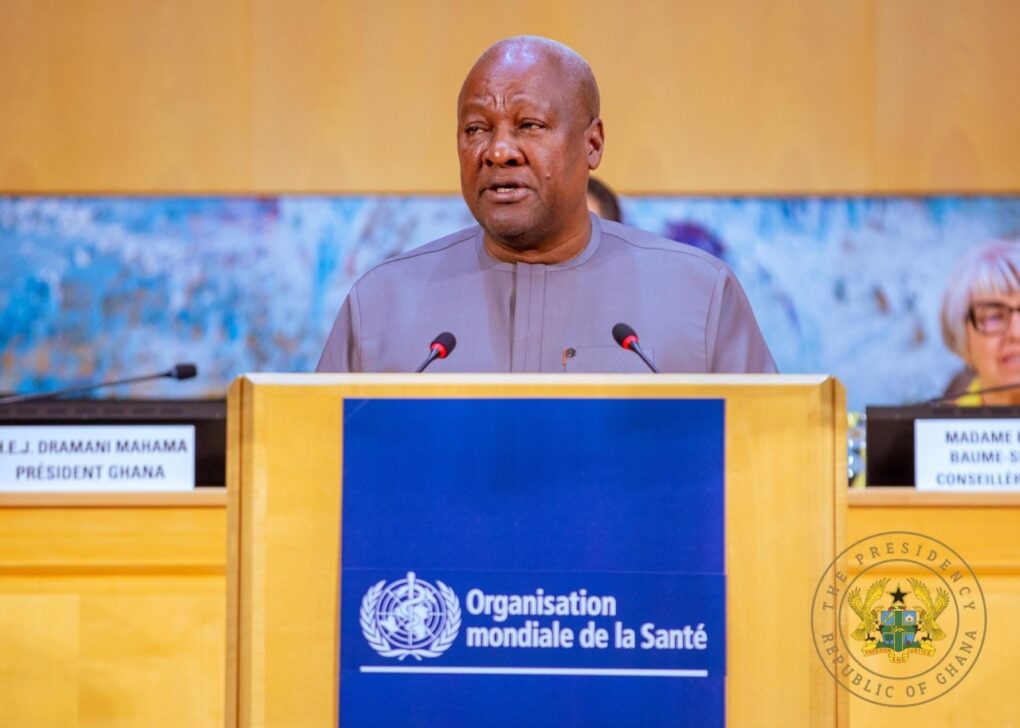
President John Dramani Mahama has announced a bold new framework for reforming global health governance and reducing Africa’s reliance on foreign-controlled healthcare systems.
Speaking today, Monday, May 18, at the 79th World Health Assembly, President Mahama stated that in order for the Global South to develop robust health sectors, they must be given the authority to fund their own healthcare systems, produce necessary medications, and handle health data on their own.
He claims that the current global health framework has put undue administrative strain on poor nations, with many health ministers devoting more time to creating donor reports than to improving basic healthcare service inside their own nations.
He maintained that the expansion of organisations does not always result in a significant benefit for vulnerable communities, arguing that the international system has mistakenly associated the expansion of healthcare facilities with real improvements in healthcare results.
President Mahama responded to the challenge by announcing the launch of “Accra Reset,” an initiative supported by a Presidential Council of Global South leaders that aims to press for realistic reforms in global health financing and governance.
He outlined the three main pillars that will support the endeavour, one of which is a High-Level Panel on Reform composed of independent international experts whose job it is to examine the current global health architecture.
In order to avoid policy disputes at the local level, the Reform Interlocking Observatory, another pillar, is anticipated to coordinate the policies of significant international health organisations including the World Health Organization, GAVI, and the Global Fund.
The Health Investment National Gateway (HINGE), the third pillar, is designed to act as an implementation engine that transforms political pledges into tangible, bankable investments in regional pharmaceutical manufacturing, bioinnovation, and overall health system strengthening.
According to him, the program is meant to put African nations in a better position to take charge of their healthcare systems and lessen their long-standing reliance on outside assistance.
Source: newsthemegh.com