
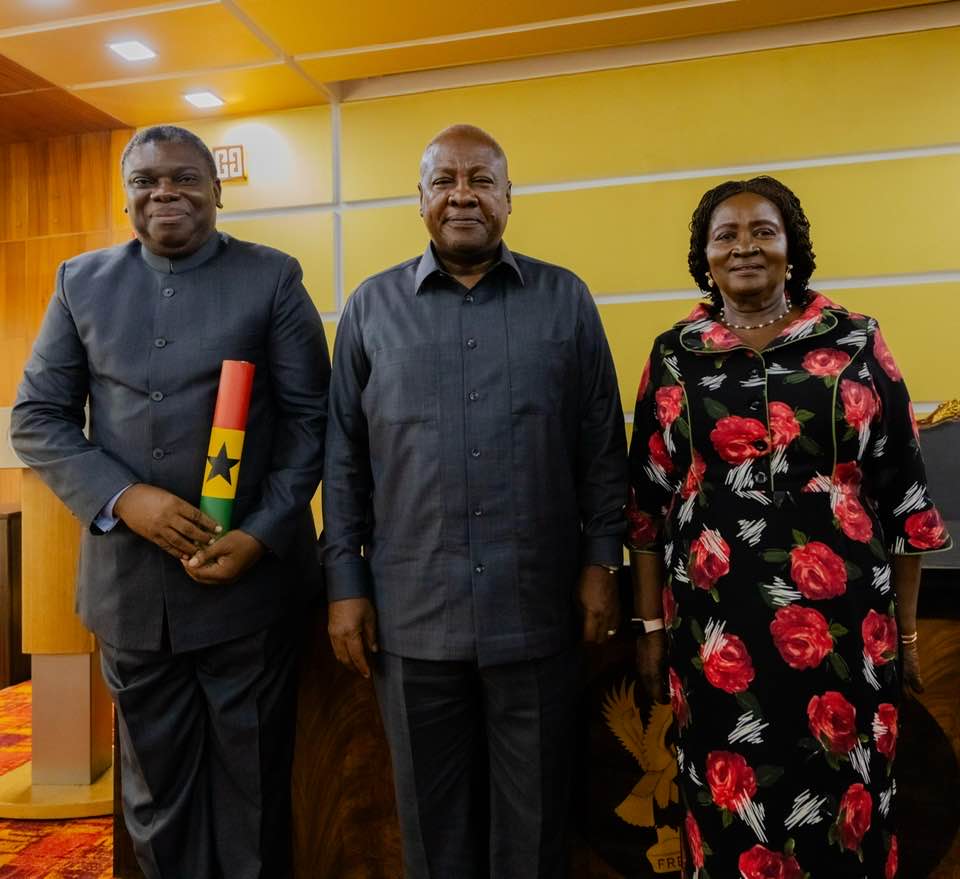
Mr. Michael Harry Yamson, a management consultant and governance specialist, was sworn in as the Administrator of the District Assemblies’ Common Fund (DACF) by President John Dramani Mahama on Tuesday.
The appointment of Mr. Yamson was made in accordance with Section 3 of the District Assembly’s Command Fund Act 1993, Act 455, and Article 252(4) of the 1992 Constitution, which requires the President to designate a qualified person to supervise the fund’s operation with parliamentary approval.
Mr. Yamson was unanimously approved by the House to serve as the DACF Administrator.

A well-run DACF could only have the desired effect if the central government remained dedicated to making sure that monies were released on time and in full, President Mahama said during the swearing-in ceremony at the Presidency in Accra.
According to him, this understanding underpinned the 2025 budget’s resolute pledge to provide at least 80% of DACF monies straight to the districts.
In the past, he continued, up to 47% of the Common Fund was distributed from the Center, leaving very little up to the Assemblies’ discretion.
According to President Mahama, the goal of the strategy was to cut down on needless delays, lessen bureaucratic inefficiencies, and give local governments the confidence they need to plan and carry out development initiatives.
“By strengthening the financial autonomy of District Assemblies, we are not only reinforcing the constitutional principle of decentralization and equitable development, but also ensuring that communities across Ghana receive the resources they need to drive economic growth, infrastructure expansion, and essential public services,” the President said.
“My government is committed to instituting robust monitoring and evaluation mechanisms to ensure that the fund allocations were used effectively and transparently.”
According to President Mahama, their goal was to make sure that every city was taken into consideration and that funds were allocated to initiatives that enhance the quality of life for its residents.
In order to accomplish this, he said, they will work with local stakeholders, civil society, and Parliament to improve supervision, get rid of inefficiencies, and encourage best practices in fund administration.
“I believe that this approach will restore public confidence in the DACF and maximize its impact as a driver of equitable development, job creation, and improved service delivery.”
“As Administrator, Mr. Yamson shall be at the forefront of this effort,” the President stated, adding that by bolstering decentralization, they would guarantee that each region receives assistance to grow, promote national advancement, and share prosperity.
According to the President, the task at hand requires teamwork, open management, effective execution, and community involvement.
“When we invest wisely in local government today, we secure national progress for generations to come,” he stated.

He claimed that in order to guarantee efficient local governance, the Constitution not only created a framework for decentralized administration but also provided funding for it through the DACF.
According to President Mahama, the system was created to guarantee fair resource distribution, enabling each district to make a significant contribution to the advancement of the country.
However, in recent years, the DACF has faced significant challenges that have hindered its ability to fulfill the Earmarked Funds Capping and Realignment Act of 2017 Act 947, which significantly reduced the financial resources made available to district assemblies, thereby restricting their capacity to undertake critical development projects. In effect, this means that it gave districts the freedom to take control of their own destiny.
He claimed that even though the Supreme Court ultimately ruled that the Act’s provisions pertaining to the DACF were constitutional, the time it was in effect had a significant effect on local governance, depriving districts of much-needed funding and delaying the provision of social services and necessary infrastructure.
Additionally, he claimed that local governance operations have been affected by multiple delays in the fund’s disbursement and, in certain cases, the failure to submit the constitutionally required 5% of total national earnings.
According to him, the setbacks have resulted in stalled infrastructure projects, poor service delivery, and mounting annoyance among communities and local authorities who rely on this money for vital development.
“If we are to truly uphold the spirit of decentralization and inclusive growth, we must correct these shortcomings and ensure that the District Assemblies’ Common Fund functions as it was originally envisioned, to empower local governments and accelerate national development from the grassroots,” the President said.
“To address these challenges and restore the District Assemblies’ Common Fund to its rightful role as a catalyst for local development, we must ensure that its administration is placed in capable hands.”
According to President Mahama, the intricacy of overseeing such a vital national asset necessitates a good grasp of finance, strategic vision, and an unflinching dedication to accountability and openness.
He stated that in addition to having a thorough understanding of public finance and governance, the Administrator must also have the leadership abilities required to promote efficiency, uphold compliance, and carry out reforms that increase the fund’s influence.

“It is with these high standards in mind that I decided to nominate Mr Michael Harry Yamson, a seasoned strategist and governance expert whose extensive experience makes him well-equipped to navigate the challenges ahead and reposition the District Assemblies’ Common Fund as an effective tool for decentralized development.”
With a wealth of knowledge in financial systems, investment planning, and corporate governance, the President said Mr. Yamson’s career has been characterized by a dedication to operational excellence, accountability, and sustainable growth. He also declared that he possesses the essential abilities needed to manage national resources and promote significant reforms.
He claimed that Mr. Yamson was qualified to lead the DACF at this pivotal moment because of his honesty, imaginative leadership, and results-driven attitude.
According to the President, Mr. Yamson’s duties as an Administrator of the District Assembly’s Common Fund would include enhancing transparency, operational efficiency, and financial discipline.
“You are to ensure that the Fund will implement accountability-driven processes, ensuring that District Assemblies receive the necessary resources to accelerate grassroots development and enhance service delivery across the country,” he said.
“I am confident that you will bring your extensive experience in institutional reform and financial management to strengthen the DACF’s operations and position the fund as a key pillar of Ghana’s decentralization agenda.”
He stated that in addition to the requirement for capable fund administration, his government fully understands that prompt, effective, and sufficient resource distribution is equally important to local government performance.
Mr. Yamson stated that the central government, via the Finance Ministry, must promptly and consistently provide the DACF with the monies needed to support the operations of the various District, Municipal, and Metropolitan Assemblies.
He assured the President that they were nearly finished with the mechanism for allocating the cash for 2025.
Source: newsthemegh.com