
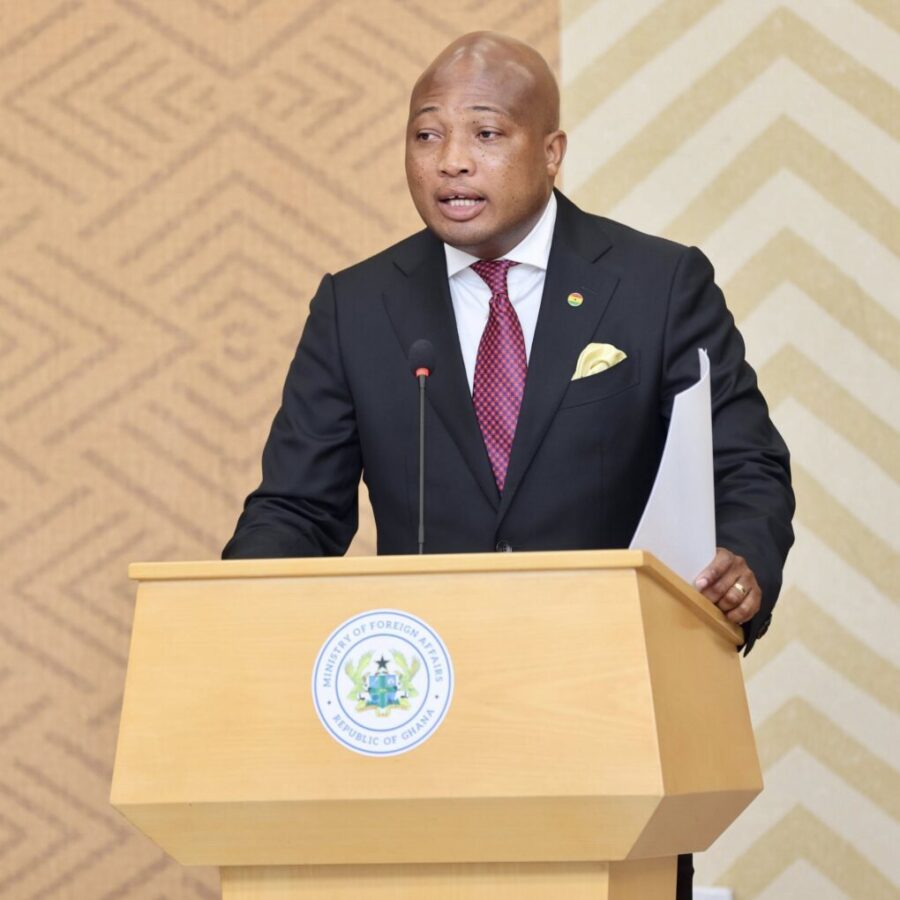
The Mahama administration’s decision to not submit its agreement with the United States regarding third-party deportees for parliamentary ratification was supported by Foreign Affairs Minister Samuel Okudzeto Ablakwa.
Samuel Abu Jinapor, the Ranking Member of the Foreign Affairs Committee, asked for clarification on the arrangement’s legal basis, security ramifications, and national interest considerations during a heated exchange on Wednesday. Ablakwa insisted that the agreement does not endanger national security or sovereignty.
“Such matters are managed in coordination with the appropriate security and immigration agencies to ensure that Ghana’s sovereignty, security, and international responsibilities are fully protected,” he said.
He underlined the government’s dedication to preserving peace and stability in Ghana, claiming that the foreign policy apparatus functions in the best interests of the nation.
Citing the Supreme Court’s decision in Bamfo v. Attorney-General, which held that even non-binding instruments, like note verbales, require parliamentary ratification, Abu Jinapor questioned why the minister had not submitted the understanding for approval under Article 75(2) of the Constitution. He claimed that a clear constitutional mandate is being ignored by the government.
According to Hon. Ablakwa, the agreement with the United States is an exchange of notes rather than a treaty, and as such, it is not subject to parliamentary ratification.
“It is not a binding agreement. We can walk away from this at any time, and the Attorney-General has advised that such understandings do not require parliamentary ratification,” he asserted.
He cautioned that the nation’s foreign policy activities would be severely hampered if all non-binding diplomatic agreements required parliamentary approval.
“We enter into about 50 MOUs a day. If we were to bring all non-binding instruments to Parliament, it would be impractical,” he continued.
The Ranking Member further asked what concrete advantages Ghana would get from accepting third-party deportees.
Ablakwa responded by stating that there are no financial incentives and that the arrangement is solely humanitarian.
“The Government of Ghana has not requested any monetary, logistical or material support. This is purely on humanitarian grounds as a Pan-Africanist nation,” he stated.
The deportees in question are fellow West Africans, he emphasised.
“These are fellow West Africans detained and treated shabbily. Ghana cannot look on. Ghana is their home. West African nationals do not need visas to enter Ghana anyway and may stay for at least 90 days. So this is in line with regional integration,” the minister reiterated.
Source: newsthemegh.com