
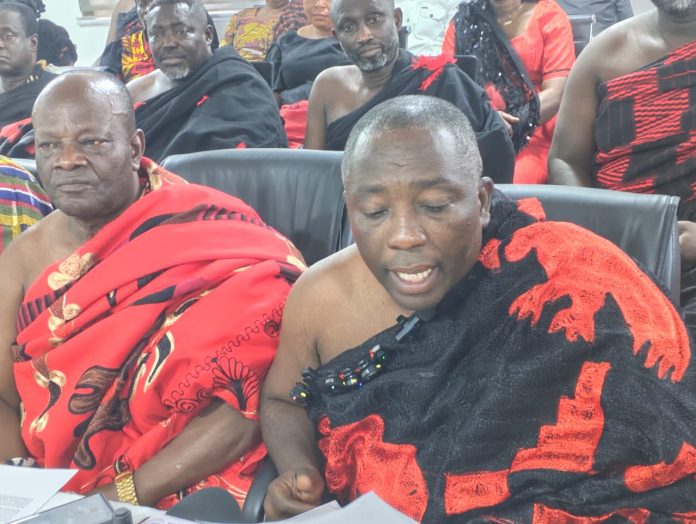
The Apinto Divisional Council, the traditional custodians of the land, on which GoldFields Ghana Limited operates in Tarkwa, has formally called on the Government of Ghana not to renew the company’s mining lease, arguing that decades of mining have yielded little meaningful development for the host communities, despite extensive exploitation of their ancestral lands.
The position, announced at a press conference on Friday, marks the clearest indication yet of the traditional authorities’ opposition to the extension of Gold Fields’ lease, which is due to expire in April 2027.
Although the final decision on the renewal of the mining lease rests with the Government of Ghana, the stance of the Apinto Divisional Council is expected to carry considerable weight in the national debate, given its status as the customary owner of the land on which the mine is situated.
Reading a statement on behalf of the Council, the Gyasehene of the Apinto Divisional Stool, Dr. Bediako Adarkwa, said the chiefs were instead advocating the establishment of a Government-owned mining operation in Tarkwa under what they described as a new “shared prosperity” model.
According to the Council, the proposed transition presents a historic opportunity for Ghana to maximise the benefits from its mineral resources while addressing what it described as the longstanding imbalance between mineral extraction and the development of host communities.
“The transition from a foreign-owned mine to a Ghanaian-owned mining enterprise will not only advance Ghana’s national economic interests, but will also ensure that the traditional authorities and host communities become genuine partners in the ownership, governance and benefits of the mine,” Dr. Adarkwa stated.
The Council maintained that multinational mining companies, including Gold Fields Ghana Limited and AngloGold Ashanti Iduapriem Mine, had operated within the Apinto traditional area for many years, but had failed to deliver development commensurate with the wealth extracted from the area.
The chiefs said a recent inspection of Gold Fields’ Tarkwa Mine revealed that more than 4,000 hectares of Apinto lands had been degraded, depriving many residents, particularly the youth, of farmlands, livelihoods and the effective enjoyment.
The statement argued that while mining had generated substantial revenue over the years, host communities continued to grapple with poor roads, inadequate educational infrastructure, limited healthcare facilities, youth unemployment and other socio-economic challenges.
“The level of development provided by Gold Fields Ghana Limited does not commensurate with the extent of the degradation of our lands and the socio-economic challenges confronting our communities,” the Council asserted.
Beyond opposing the lease renewal, the traditional authorities unveiled what they termed the Apinto Shared Prosperity Proposal, which they intend to submit to the Government for consideration.
The proposal seeks to establish a new framework for mining in the Tarkwa-Apinto area based on partnership among the State, investors and host communities.
According to the Council, the proposal is anchored on the principles of history, justice, equity and sustainable development.
The chiefs argued that before colonial rule, the people of Wassa Fiase were the original owners, regulators and beneficiaries of gold mining.
However, colonial legislation and subsequent post-independence laws transferred control of mineral resources to the State, leaving host communities to bear the environmental and social costs of mining while receiving limited direct benefits.
While reaffirming their support for responsible mining and private investment, the Council insisted that future mining arrangements must move beyond the payment of royalties and corporate social responsibility projects.
Instead, it called for a model that gives traditional authorities and host communities meaningful participation in the ownership, governance and economic benefits of mining operations.”Our proposal seeks not charity, but fairness. It presents a practical model that balances national interests, investor confidence and meaningful community participation,” Dr. Adarkwa said.
The Council appealed to the Government, Parliament, the Minerals Commission and other stakeholders to give serious consideration to the proposal, expressing confidence that a Government-owned mine would usher in a new era of inclusive and sustainable mining.
Background
Friday’s announcement follows an inspection tour undertaken earlier this week by about ten titled chiefs of the Apinto Divisional Stool to Gold Fields Ghana’s Tarkwa Mine.
The inspection was conducted as part of the Council’s assessment of the company’s operations ahead of deliberations on whether to support the renewal of the mining lease.
Speaking after the tour, the Gyasehene, Dr. Bediako Adarkwa, indicated that the chiefs wanted to assess the mine first-hand before reaching a decision.
Gold Fields Ghana, for its part, had expressed confidence that its long-standing engagement with host communities and investments in community development, environmental stewardship, local employment and procurement would justify an extension of its lease.
The company’s Executive Vice President and immediate past President of the Ghana Chamber of Mines, Michael Akafia, told The Chronicle earlier this week that Gold Fields had consistently engaged traditional leaders through the Tarkwa Community Consultative Committee and believed its record presented a compelling case for renewal.
However, Friday’s declaration by the Apinto Divisional Council signals a sharp divergence between the company’s assessment of its community impact and the position of the customary landowners.
The Government of Ghana is expected to make the final determination on whether Gold Fields Ghana’s mining lease will be renewed beyond its April 2027 expiry, but the opposition of the traditional landowners is likely to become a significant factor in one of the country’s most closely watched mining policy decisions.
Source: thechronicle.com.gh