
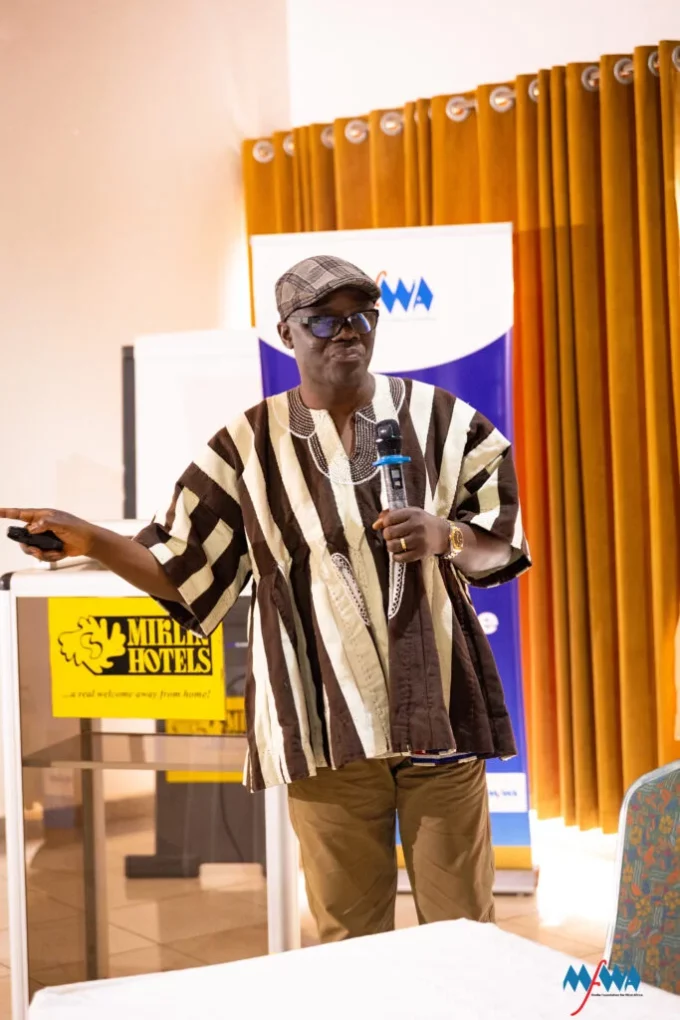
Lawyer and broadcaster Samson Lardy Anyenini has urged journalists in Ghana not to allow the fear of expensive lawsuits to discourage them from pursuing bold, accurate and credible public-interest journalism.
Mr Anyenini said while individuals who feel aggrieved by media reports have a constitutional right to seek redress, some legal actions may be used to intimidate journalists and discourage them from reporting on issues of public concern.
He made the comments in an interview on the sidelines of a four-day legal training for journalists organised by the Media Foundation for West Africa (MFWA) in the Ashanti Region on September 22, 2026.
As a facilitator at the training, Mr Anyenini stressed that journalists must protect themselves by ensuring that every publication is supported by proper verification, accurate information and credible evidence.
He noted that Ghana’s constitutional democracy gives individuals the right to respond to media reports or seek legal redress through the courts.

Journalists Must Be Prepared for Legal Challenges
According to Mr Anyenini, journalists should not be intimidated by the possibility of legal action when they have conducted their work professionally and in the public interest.
He explained that some lawsuits against media organisations may constitute what is commonly referred to as Strategic Lawsuits Against Public Participation (SLAPP).
SLAPP cases are generally associated with legal actions that seek to discourage or silence individuals or organisations from participating in public-interest discussions.
Mr Anyenini said some media houses struggle to defend themselves against such cases because of the significant financial cost associated with litigation.
He therefore welcomed the establishment of a Legal Support Fund by the MFWA and its partners, describing the initiative as an important source of assistance for journalists and media organisations facing legal challenges because of their work.
He said the availability of legal support could allow journalists to continue investigating and publishing legitimate public-interest stories without being paralysed by concerns over the cost of defending themselves in court.
MFWA Legal Support Fund for Journalists
The lawyer encouraged journalists to remain professional and accountable, noting that legal support should not be viewed as a licence to publish unverified allegations.
He urged journalists to make thorough fact-checking and verification a central part of their work.
This includes seeking responses from all relevant parties, obtaining documentary evidence and using Right to Information (RTI) requests where necessary to access official records.
Mr Anyenini also cautioned journalists against presenting allegations, claims or personal opinions as established facts.
He stressed the importance of preserving the evidence used to support published reports in case the material is later challenged in court.
Constitutional Protection for Ghanaian Media
Mr Anyenini further reminded journalists about the constitutional mandate and protections provided to the media under Ghana’s 1992 Constitution.
He referred to provisions including the Constitution’s preamble, Article 1, Chapter 12 and Chapter 5, which he said provide an important foundation for the work of the media.
According to him, the constitutional framework places an important responsibility on journalists to provide bold, fearless and credible journalism in the interest of Ghanaian citizens.
He urged media professionals to approach their work as a responsibility to the public rather than simply as a special privilege.

MFWA Training Focuses on Media Law and Press Freedom
The legal training is being held at the Miklin Hotel in Kumasi from September 22 to 25, 2026, as part of the African Media Integrity and Resilience Programme: Ghana, Central African Republic (AMIRP Programme).
The Programme Manager of the MFWA, Dr Daniel Kwame Ampofo Adjei, said the training is designed to strengthen journalists’ professional capacity and equip them to confidently defend their rights when confronted with litigation, threats and judicial harassment.
The programme is being implemented in Ghana by the MFWA in partnership with DW Akademie, with funding from the European Union through International Media Support (IMS).
A key component of the training is an orientation on the operational guidelines of the newly established Legal Support Fund. A similar training session was previously held in Accra for journalists from Ghana’s southern sector.
Dr Ampofo Adjei explained that the fund is intended to provide financial assistance for legal representation to journalists facing lawsuits or judicial harassment in the course of their professional duties.
Concerns Over SLAPPs and Defamation Cases
The MFWA official said the initiative comes amid concerns over SLAPP lawsuits, defamation cases and other forms of legal pressure against journalists engaged in critical and investigative reporting.
He noted that limited financial and legal resources can sometimes force media organisations to withdraw or soften legitimate reports when faced with threats of legal action.
The Legal Support Fund is therefore expected to assist journalists who conduct responsible public-interest journalism but subsequently face legal challenges because of their work.
Dr Ampofo Adjei said the AMIRP initiative is a two-and-a-half-year programme being implemented in Ghana, Ethiopia and the Central African Republic.
The programme focuses on several areas aimed at strengthening media integrity and resilience, with the current training concentrating on creating an enabling legal and policy environment for independent media.
The discussions highlight the importance of balancing press freedom, responsible journalism, legal accountability and the public’s right to information in Ghana’s democratic environment.
Source: newsthemegh.com