

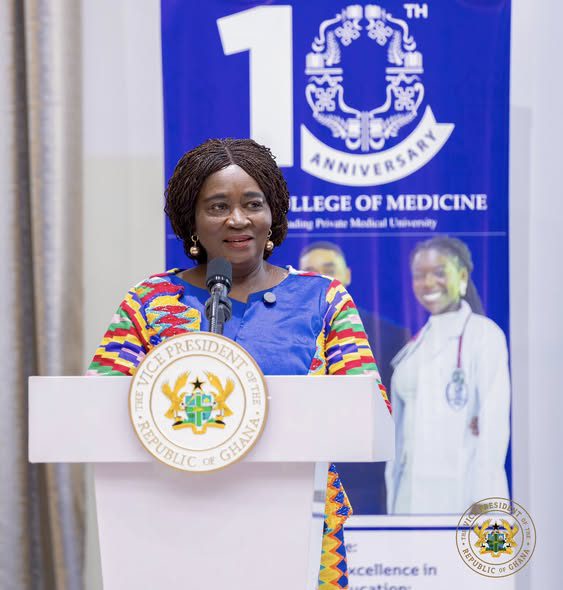
Professor Naana Jane Opoku-Agyemang, the vice president, has advised recently graduated medical professionals to focus their careers on helping the most vulnerable populations rather than putting their own convenience first.
She clarified that their training was a national call to duty, asking them to assist in providing high-quality healthcare to communities experiencing the most serious service gaps.
“I remind you that the privilege of your training comes with a duty to save, not where it is easiest, but where you are most needed. You are entering a profession built on service, courage and equity. Let your choices reflect not just your ambitions, but your commitment to the oath. That is to go where suffering is, to heal where healing is scarce and to honour the trust Ghana has placed in your hand,” she stated.

Last Saturday, the Vice-President gave a speech at the Accra College of Medicine’s (ACM) 10th Anniversary and Sixth Congregation in Accra.
Twenty-three graduating students received their Bachelor of Medicine, Bachelor of Surgery (MBChB) degrees at the ceremony, formally becoming the next generation of medical professionals in the country.
In recognition of their dedication, students who demonstrated exceptional performance were also given special medals and trophies.
Prof. Opoku-Agyemang advised the graduates to remember their parents, instructors, and everyone else who helped them along the way, as well as to carry ACM’s values of integrity, empathy, leadership, and community service into their future employment.
She praised the university for a decade of intentional medical training based on compassion, excellence, and innovation, emphasizing its growth from a modest idea to a fully certified medical school producing doctors who work in hospitals across the country.
She cited the college’s broad admissions method as a crucial achievement, stating that it provided possibilities to passionate students who may have missed challenging public medical school cut-offs.
“By recognising potential where others must place limitations, ACM has shown us that excellence can come from combining nurturing with perseverance,” she stated.
The Vice-President also commended the school’s use of cutting-edge teaching tools, collaborations with regional and global organizations, and outreach initiatives that provided healthcare to underprivileged areas.
In order to improve the college’s ability to lead in research, innovation, and international cooperation over the next ten years, she urged increased donor assistance.

Ekwow Spio-Garbrah, the chairman of the Africa Education Trust Fund, characterized ACM as an exemplary Ghanaian leadership model whose influence ought to spur replication throughout the continent.
Using his position as an example, he emphasized that the Fund, which was established in the spirit of GETFund, could help develop Pan-African medical universities to improve health education throughout the continent.
He praised ACM’s distinctive fusion of next-generation entrepreneurship and parental leadership, calling it a potent illustration of intergenerational cooperation.
Prof. Afua A. J. Hesse, the ACM’s president, described the organization’s impressive expansion, pointing to an increase in enrollment, a growing student body, and consistently small class sizes that provide individualized instruction.
She underlined the institution’s technological innovations, such as updated digital anatomy systems, virtual patient simulators, updated classrooms, and increased internet infrastructure.
She also praised the availability of scholarships, more female involvement, excellent academic achievement, and significant community outreach.
“Of our alumni, 97 per cent currently serve in hospitals and health institutions in Ghana. As our contribution to national development, we have consistently aligned our work with the national health priorities. Our graduates are providing health care at district, regional and teaching hospitals in the country,” she stated.
In order to spur innovation and provide access to high-quality medical education, Prof. Hesse outlined plans for graduate-entry programs, increased research capacity, increased scholarships, and deeper international relationships.

Source: newsthemegh.com