

President John Dramani Mahama has provided the firmest guarantee yet that the government will not “take its legs off the pedal” as it seeks to cement its economic accomplishments thus far.
“I can assure Ghanaians that we’ll not relax the current fiscal discipline and efficient management of the economy even in the election year of 2028,” he assured.
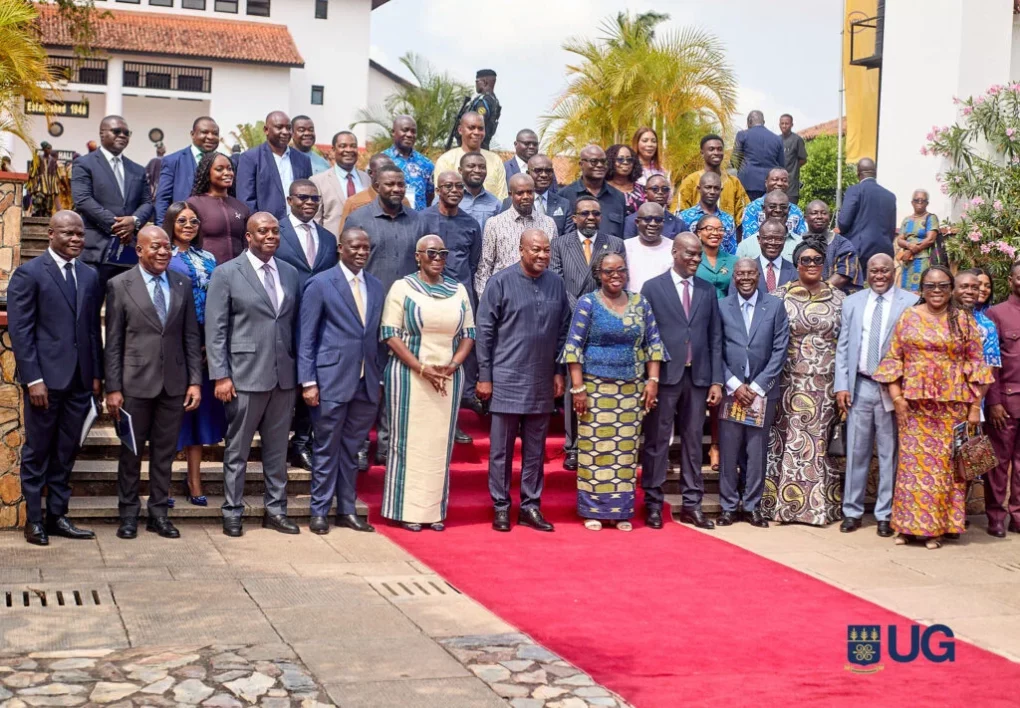
President Mahama (centre) and other dignitaries attend the conference’s opening ceremony.
Since assuming power on January 7, 2025, Ghana’s international reserve has increased from US$8.9 billion to US$13.8 billion, inflation has decreased from 23% to 6.3% in November, the local currency, the Ghana Cedi, has appreciated by 40.6% against the US dollar, and the debt to GDP has decreased from 66% to 45%, among other positive economic indicators.
Yesterday, the President opened the 77th Annual New Year School and Conference of the University of Ghana in Accra. He stated that it was time for the country to grow into a resilient, equitable, and sustainable nation where decisions are made with the country’s best interests in mind, nearly seven decades after independence.
President Mahama emphasised that in an area where democracy is regressing, it is critical to demonstrate to the populace that democracy functions and that they can rely on the political elite to protect their interests and generate possibilities for national progress.
The President stated that no one person or government could create Ghanaians; instead, cooperation, self-control, creativity, and the development of a national consensus are needed.
“It demands that we moved beyond rhetoric to implementation, short term fixes to long term solutions, and beyond narrow interest to the national interest. Growth and consolidation must be permanent.”
To cheers, he declared, “We cannot build the Ghana we want if the progress made under one regime is reversed under another. Our economic development programmes must be medium to long term. Our progress as a nation must transcend political seasons and this why I decided to make this second mandate, so graciously granted me by Ghanaians count,”
To that end, he stated that the consolidation would be built on five pillars: value addition, infrastructure, and revenue mobilisation; human capital development; good governance, accountability, and discipline; environmental stewardship and climate resilience; and inclusion, cohesion, and a shared national purpose.
In addition, he indicated that the government will roll out a policy this year that would require value addition to mineral resources, petroleum, and agriculture products before export, GH¢30 billion earmarked for infrastructure under the Big Push program, and enhanced domestic revenue mobilisation, among other measures.
President Mahama emphasised the need for better learning outcomes at all educational levels, particularly at the basic level, and stated that “no nation has ever developed beyond the quality of its people” when discussing human capital development as the engine of growth.
In terms of accountability and good governance, President Mahama declared that his administration is bolstering anti-corruption institutions, reinstating respect for the rule of law, and insisting on value for money in public spending. He also disclosed the existence of an independent value for money office to guarantee that every cedi spent on behalf of the people produced genuine value.
He stated that if environmental degradation persisted, it would be impossible to develop the “Ghana we want.”
For this reason, he said, the government will keep fighting illicit mining in order to safeguard forests, waterways, and agricultural areas.
President Mahama emphasised that “A divided nation, cannot sustain development. The Ghana we want to build together must be inclusive, cohesive, and fair where no region of the country is left behind, no gender is marginalised, and no generation is excluded.”
Additionally, he emphasised that the conference should serve as a reminder that national development is a team effort, calling on academia to contribute ideas, the private sector to innovate and invest, civil society to engage and hold the government accountable, traditional and religious institutions to uphold moral values, and the media to provide accurate and honest information.
“Building the Ghana We Want Together For Sustainable Development” was the theme of the New Year School, which brought together academics, policymakers, business executives, and development partners to discuss Ghana’s development priorities and paths towards sustainability.
The platform offers a forum for critical analysis of national concerns, evidence-based policy discussion, and the creation of workable solutions to promote equitable and sustainable growth.
Source: newsthemegh.com