

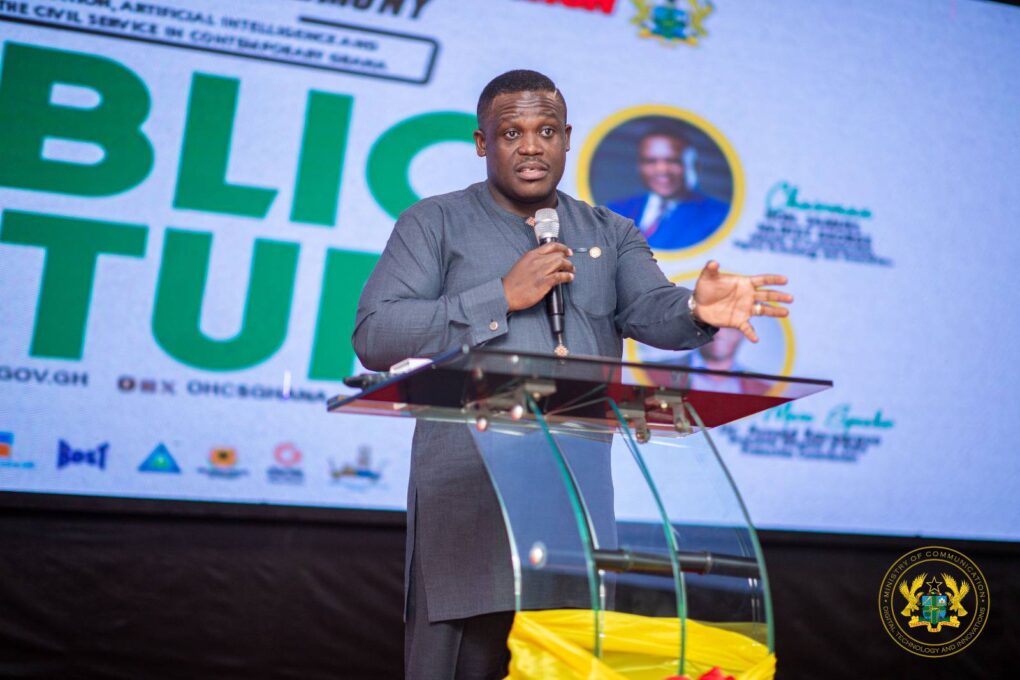
The Office of the Head of Civil Service (OHCS) has been urged by Hon. Samuel Nartey George (MP), Minister for Communication, Digital Technology, and Innovations, to take into account immediate institutional reform, increased digital capacity, and the urgent adoption of artificial intelligence (AI) in order to stop what he called the next frontier of “data colonization.”
He emphasized that without a clear vision, transformation will only produce patchy outcomes, and he warned Ghana not to repeat the mistakes of past technological shifts.
These statements were given by Hon. Nartey George during a public lecture organized by the OHCS as a component of the events scheduled for the 2025 Civil Service Week Celebration and 2024 Awards Ceremony, which took place at the CLOGSAG Auditorium in Accra.
“Adapting to Automation, Artificial Intelligence, and E-Government: The Civil Service in Contemporary Ghana” was the theme of the event.


The Minister emphasized the pressing need for reform and cautioned that public institutions may become outdated if they do not adjust to new technologies like artificial intelligence, automation, and e-governance.
Those who refused to switch from typewriters to computers were left behind, since computers improved civil service jobs rather than diminishing them.
“AI will experience the same thing. We shall become obsolete if we don’t upskill and reskill,” he said.
The Minister emphasized Africa’s demographic advantage, pointing out that 68% of its 1.5 billion inhabitants are under 35.
This tech-savvy population produces enormous amounts of data, so if this data is not managed and protected locally, the continent may be vulnerable to online abuse.
The Minister said that all Cabinet Ministers, Ministers of State, and designated focal individuals will take part in a two-day AI Boot Camp in the Eastern Region on July 25–26, 2025, as part of initiatives to mainstream AI throughout the public sector.
He claims that the program, which was created in partnership with UNDP, was intended to educate government officials on AI concepts and produce customized AI use cases for every ministry.
The Ministry cannot be the only ICT institution driving AI adoption. It must be a whole-of-government approach. Every Minister will leave that camp with actionable cases to improve service delivery,” he said.
Ministers may change, but institutions must stay strong to guarantee that “we build a Civil Service that is future-proof.” Each Ministry was expected to choose a technical focal person to facilitate implementation and retain institutional memory in order to assure sustainability.
The Minister revealed that all Ministries had already undergone a digital maturity mapping and were anticipated to execute reforms in accordance with their readiness levels. The Office of the President will conduct progress reviews every two months.
He urged Chief Directors to assist Ministers and focal points in advancing institutional transformation, highlighting the critical role they play as technical leaders of their Ministries.

One Million Coders Initiative: Civil Service Reskilling
Hon. George declared that the Civil Service Training Center will receive 200 AI training kits from the One Million Coders Project to support the digital transformation of Ghana and enable the broad upskilling of public employees.
Additionally, he suggested reforming the civil service IT cadre, emphasizing that each ministry must have a minimum of five digital officers. These officers would include:
1. A network/system engineer
2. A software developer
3. A certified data protection officer
4. An AI officer
5. A cybersecurity officer
“The era of relying on a single IT technician is over. We need full-spectrum digital teams embedded in every Ministry,” he added.
“This lecture must not be ceremonial. It must mark a turning point toward building smarter, more agile, and citizen-focused institutions, ones that deliver services with efficiency, security, and fairness.”
Hon. Nartey George urged stakeholders to go beyond ceremonial observances and take on the duty of creating a contemporary civil service in her closing remarks, which called for bold, moral, and context-driven reform.
He expressed optimism that the knowledge exchanged will lead to significant policy reform throughout the public sector and praised the planning committees and all stakeholders for their ongoing commitment to national development.


Source: newsthemegh.com