

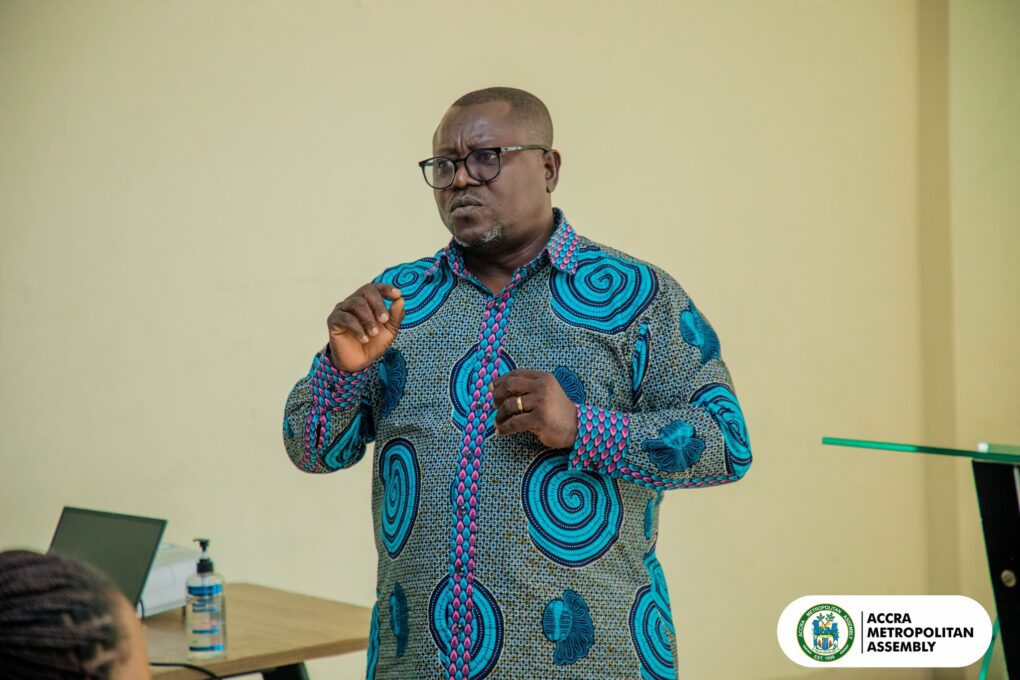
Members of the Accra Metropolitan Assembly (A.M.A.) have been called together by the Metro Planning Coordinating Unit (MPCU) to review the Assembly’s proposed Medium-Term Development Plan (MTDP) for 2026–2029, which places a high priority on infrastructure development, employment creation, and climate resilience, among other things.
To evaluate the draft plan’s progress and provide crucial input to finalize action areas before submitting it to the National Development Planning Commission (NDPC) via the Greater Accra Regional Coordinating Council (GARCC), the 17-member meeting included department heads, traditional leaders, and security representatives.
Mr. Douglas N.K. Annoful, the MPCU Committee chairman and the AMA’s Coordinating Director, emphasized the value of team planning in determining the future of the city, characterizing the Medium-Term Development Plan (MTDP) for 2026–2029 as a vital instrument for tackling Accra’s most urgent issues.

He stated that the plan addresses the actual needs of citizens in the city and added that Accra has a number of issues, from sanitation and climate vulnerability to infrastructure deficiencies and young unemployment, all of which call for creative and well-coordinated solutions driven by sound planning.
The A.M.A.’s Director of Development Planning, Mr. Richard Kwame Oduro, gave a thorough presentation outlining the new plan’s alignment with the country’s “Resetting Ghana Agenda” and its vision of Accra as a “Smart, Safe, and Climate-Resilient City with Secured Jobs and Prosperity for All.”
The Assembly has identified urgent local issues, such as bad roads, flooding, youth unemployment, open defecation, drug abuse, prostitution, inadequate school security, broken traffic lights, and coastal erosion, he said, after conducting extensive community engagements in the Ablekuma South, Okaikoi South, and Ashiedu Keteke Sub-Metropolitan District Councils.
The draft plan, according to Mr. Oduro, focuses on five important development dimensions: governance, institutional development, environmental and human settlement management, social development, and economic development.
He called for increased tax collection, digitalized systems, prompt distribution of the District Assemblies Common Fund (DACF), and the building of alliances with regional and global development partners in order to increase revenue mobilization.
MPCU members praised the presentation and reaffirmed their dedication to seeing the plan through to completion, emphasizing the value of group ownership in producing measurable outcomes for Accra citizens.

Source: newsthemegh.com