
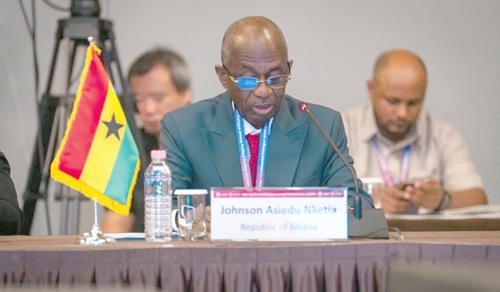
National Democratic Congress (NDC) National Chairman Johnson Asiedu Nketiah has called on political parties to adapt to changing social and economic conditions, invest in leadership development and take deliberate steps to restore public trust in political institutions.
Speaking at the inaugural Inter-Continental Dialogue on Political Parties in Seoul, South Korea, Asiedu Nketiah said political organisations that failed to understand the changing expectations of citizens could lose the public confidence needed to remain politically relevant.
He delivered the address on behalf of political parties participating in the African Political Parties Initiative (APPI). The international dialogue brought together the Africa Governance Centre (AGC), through APPI, the International Conference of Asian Political Parties (ICAPP), and the Permanent Conference of Political Parties of Latin America and the Caribbean (COPPPAL).
Political Parties Must Respond to Changing Times
According to Asiedu Nketiah, political parties can no longer depend entirely on historical identities, ideological traditions or long-standing generational loyalties to maintain voter support.
He explained that each new generation evaluates political parties based on their ability to address current social, economic and governance challenges.
The NDC chairman noted that while a political party’s history could explain its contribution to national development, its past achievements could not guarantee its future relevance.
He said political organisations must continuously demonstrate how their policies and leadership can respond to the changing needs of citizens.
Youth Expectations and Economic Challenges
Asiedu Nketiah highlighted the growing expectations of young people, who have access to more information about political and economic developments both within their countries and around the world.
He said many young people are facing serious challenges, including youth unemployment, economic insecurity, rising living costs and uncertainty about their future economic prospects.
He stressed that concerns about whether education, employment and hard work can still provide a reliable pathway to an improved standard of living could influence how young people view political institutions.
Public Trust Linked to Citizens’ Economic Experiences
The NDC National Chairman also linked public confidence in political leadership to the everyday experiences of citizens.
He argued that frustration could increase when people work, obey the law, raise families and make sacrifices for their children but still struggle to identify a realistic path towards a better quality of life.
According to him, such frustrations can extend beyond dissatisfaction with individual government policies and develop into wider scepticism about political parties, governance systems and democratic institutions.
Call for Stronger Political Leadership
Asiedu Nketiah therefore urged political leaders to treat declining public confidence as an important warning about the health of political institutions rather than dismissing it as temporary public dissatisfaction.
He called for stronger political leadership, leadership development, institutional reform and greater responsiveness to citizens’ needs.
He maintained that political parties must remain connected to the realities of the societies they seek to govern if they are to retain public confidence and remain relevant to future generations.
The remarks come amid growing global discussions about political reform, democratic governance, youth participation in politics and restoring public trust in political institutions.
Source: newsthemegh.com