
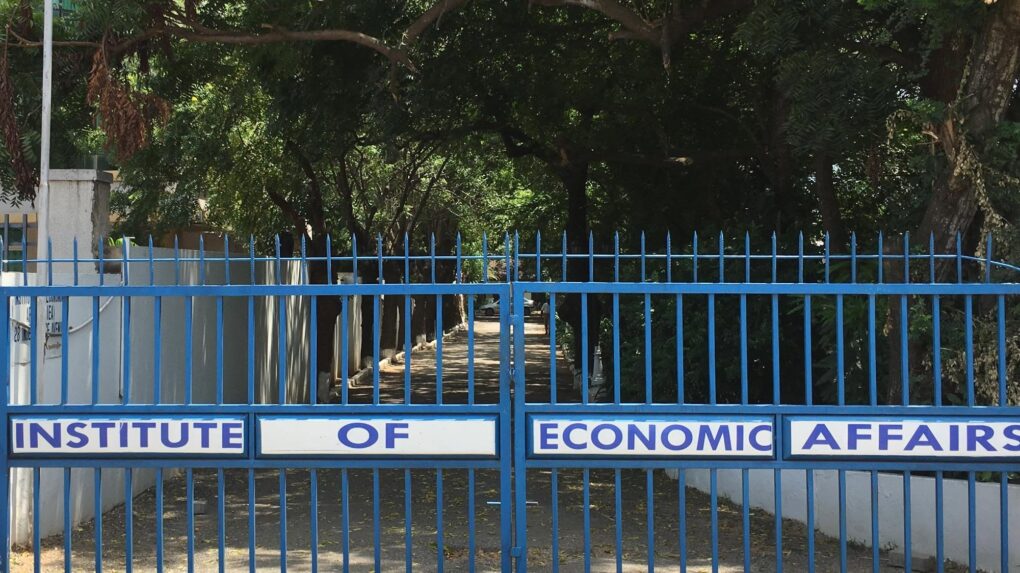
The Institute of Economic Affairs (IEA) has rejected proposals for the government to provide state funding for the non-election activities of political parties in Ghana.
However, the economic policy think tank believes the state could provide limited and clearly defined support for political parties, particularly by funding the Electoral Commission of Ghana (EC) to oversee internal party elections following the proposed abolition of the delegate system.
The IEA also opposed the proposed Democracy Fund, which was recommended by the H. Kwasi Prempeh Constitution Review Committee (CRC). The committee had proposed that the fund be managed by an Independent Registrar and Regulator of Political Parties and Campaigns (IRRPC).
Although the government has accepted the establishment of the Democracy Fund in principle, it prefers to introduce the initiative through legislation rather than making it a constitutional requirement. The IEA, however, said it does not support the proposal.
IEA Criticises Proposed Political Reforms
Speaking at a press conference on the IEA’s position regarding key recommendations of the Constitution Review Committee and the government’s response, former Chief Justice and IEA Fellow Justice Sophia Akuffo raised concerns about the proposed structure of political governance in Ghana.
The IEA disagreed with a system that would effectively give the President the power to select his principal advisers.
Instead, the institute proposed that the council should be based on institutional representation, similar to the traditional councils of chiefs, combined with elected representatives from Ghana’s regions.
IEA Calls for Greater Women Representation in Politics
The IEA also called for stronger measures to improve women’s participation in Ghanaian politics and increase representation for other marginalised groups.
Justice Sophia Akuffo said Ghana should consider a proportional representation system that would enable political parties to nominate women and members of marginalised groups according to the percentage of votes secured during elections.
She further advocated mandatory quota and non-quota measures to address the continued under-representation of women in Ghana’s political institutions.
According to the IEA, public institutions should be required to achieve at least 30 percent representation for each gender, alongside appropriate representation for other identified marginalised groups.
Justice Akuffo described the proposals put forward by both the Prempeh Committee and the government as grossly insufficient to address Ghana’s political representation challenges.
IEA Supports Independent National Development Planning
On Ghana’s national development planning, the IEA backed the establishment of an independent National Development Planning Commission (NDPC) with members selected through institutional representation.
The institute wants the NDPC to have the authority to develop binding long-term national development plans that successive governments would be required to follow.
It also recommended that the tenure of NDPC members should not coincide with the President’s term in office. Political parties should also be required to ensure that their election manifestos reflect the approved national development plan.
The IEA said a long-term national development framework would help prevent Ghana from repeatedly changing its development priorities whenever a new government takes office.
Justice Akuffo explained that a credible national development framework could provide policy continuity while still allowing elected governments enough flexibility to implement the mandates given to them by voters.
IEA Pushes for Stronger Asset Declaration Laws
The former Chief Justice also called for significant improvements to Ghana’s asset declaration system as part of efforts to strengthen public accountability and fight corruption.
She argued that a stronger asset declaration regime would make it easier to identify unexplained increases in the wealth of public officials and provide a timely mechanism for investigating possible illicit enrichment.
According to Justice Akuffo, Ghana’s fight against corruption requires more than broad constitutional principles. She said the country needs clear, enforceable and credible constitutional obligations that cannot easily be weakened or amended.
The IEA therefore supports constitutionalising the Constitution Review Committee’s recommendations to strengthen Article 286(4) of the 1992 Constitution.
The proposed reforms would provide stronger mechanisms for addressing unexplained increases in the wealth of public officeholders, including the introduction of lifestyle audits and wealth audits.
The IEA believes these reforms could strengthen transparency, accountability and good governance while improving Ghana’s broader fight against corruption.
Source: newsthemegh.com