

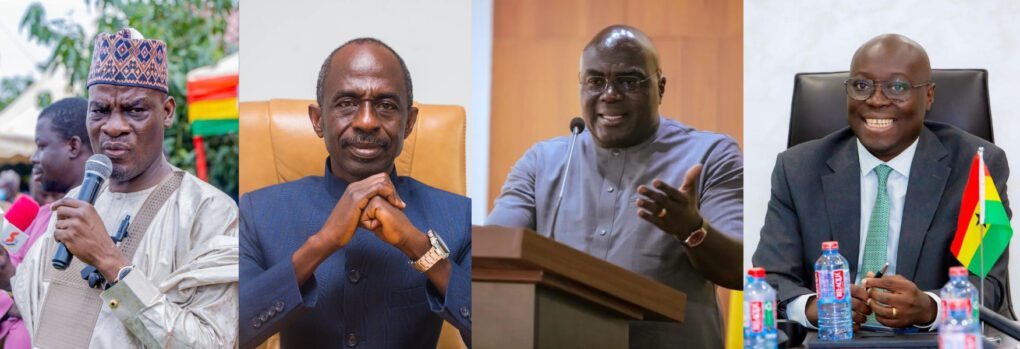
The leaders of the National Democratic Congress (NDC), which has only been in power for 15 months, are vying to succeed President John Dramani Mahama.
President Mahama will be concluding his legally permitted two terms in office on January 6, 2029, and as a result, he will be constitutionally prohibited from standing for president of Ghana.
As a result, some NDC kingpins have been running both overtly and covertly to become the party’s flagbearer in the 2028 general election, disregarding the protests of the majority of Ghanaians that it is premature to begin the presidential contest given that the government has yet to fulfil even thirty percent of its enticing campaign promises.
For example, ahead of the presidential primary, Mr. Johnson Asiedu Nketiah, National Chairman of the NDC and Board Chairman of the Ghana Ports and Harbours Authority (GPHA), is secretly campaigning throughout the nation under the guise of a “Thank You” tour.
Other state ministers are also running hidden and whispered campaigns for the top position because they are afraid of losing their jobs if they run an open campaign.
Africa Policy Lens (APL), a policy think tank, has chosen to survey potential NDC leaders for the upcoming presidential race, perhaps as a result of what some political observers have called indecent haste to successor President Mahama.
APL used a standardised survey tool to gather data over three days from April 17–19, 2026.
Respondents were able to access and finish the survey from a distance thanks to its bulk SMS delivery.
This approach made it possible to quickly deploy the survey instrument across all constituencies, present it consistently, and efficiently gather results in a brief amount of time.
Mr. Johnson Asiedu Nketiah and Chief of Staff Mr. Julius Debrah emerged as the two front-runners in the fiercely contested internal campaign inside the NDC, according to the study.
Based on replies from NDC Constituency Executives in all 276 seats, the results showed a fiercely contested environment with no obvious leader.
By the time the poll ended, 2,408 replies had been recorded.
The statistics revealed a fluid and dynamic competition, with voter preferences split about evenly at the upper end and thin margins separating the top contenders, rather than a dominant figure moving ahead.
The poll indicates that Mr. Asiedu Nketiah and Julius Debrah are well-known as seasoned political players with solid organisational backgrounds and significant influence inside national politics and party structures.
Respondents who respect long-standing political experience, effective communication, and internal party leadership strongly supported Mr. Asiedu Nketiah, as seen by his 31.9% poll.
He remains a leading voice in the campaign due to his reputation as an experienced strategist.
However, Mr. Julius Debrah came in second with 30.1%, thanks to his administrative background, calm leadership style, and technocratic aptitude.
He was characterised by many responders as a stable, unifying person who could successfully handle governance issues.
Despite prominence of the two leading contenders, the Africa Policy Lens poll stressed that the race remains wide open.
The lack of a clear lead for either candidate in the data suggests that future standings could be drastically changed by changes in party mobilisation, campaign dynamics, and national events.
A second set of credible candidates, lead by Haruna Iddrisu and Cassiel Ato Forson, who are both described as constituting a strong and competitive second tier with expanding influence, were found in the survey below the top tier.
At 17.9%, Mr. Haruna Iddrisu, the current Minister of Education and Member of Parliament for Tamale South, came in third.
He has a strong grassroots base and a wealth of parliamentary experience, making him a well regarded political communicator.
His prominence in national policy discussions has contributed to his continued relevance in the changing political environment.
In the meantime, Ajumako-Enyan-Esiam MP and Minister of Finance Dr. Cassiel Ato Forson placed fourth with 13.0%.
Respondents associate him with leadership on economic matters in Parliament and fiscal policy competence, making him a crucial economic figure within the party.
According to the poll, all numbers are still within striking reach of the top two, particularly in a political climate where alliances, endorsements, and campaign momentum could swiftly change voter mood.
Minister of Foreign Affairs Samuel Okudzeto Ablakwa received 1.0% of the vote, while Vice President Naana Jane Opoku-Agyemang received 3.6%.
All things considered, the Africa Policy Lens results depict a very competitive and uncertain race within the NDC.
The data shows a group of strong candidates with comparatively close levels of support at the top rather than a single dominant candidate.
The survey’s conclusion is unambiguous: there isn’t now a clear front-runner.
Rather, the competition is characterised by a close rivalry between Asiedu Nketiah and Julius Debrah at the top, while Haruna Iddrisu and Cassiel Ato Forson form a respectable and powerful second tier.
Future developments, from internal party dynamics to national issues and campaign strategies, are expected to have a significant impact on the final result of this highly watched fight as the political landscape continues to change, according to observers.
Source: newsthemegh.com