
Writer Charles Moncar | [email protected]
Air pollution is now the second biggest threat to health in Ghana and is linked to an estimated 28,000 premature deaths every year.
While dust is only one part of the problem, expanding green spaces is a proven way to improve air quality and public health.
Walk through almost any town or city in Ghana during the dry season and you’ll notice the same thing. Dust settles on freshly cleaned furniture, coats parked cars, drifts into homes, hospitals, and schools, and has become an accepted part of daily life.
But it doesn’t have to be.
What if one of Ghana’s biggest environmental challenges could be tackled with one of nature’s simplest solutions?
More trees. More grass. Better-maintained landscapes.
Cleaner air would be only the beginning. Greener communities could reduce dust, improve public health, create jobs, cool our cities, and build a healthier future for generations to come.

A Greener Ghana Benefits Everyone
Planting more trees and growing grass across our communities may sound like a simple idea, but the impact reaches much further than most people realize.
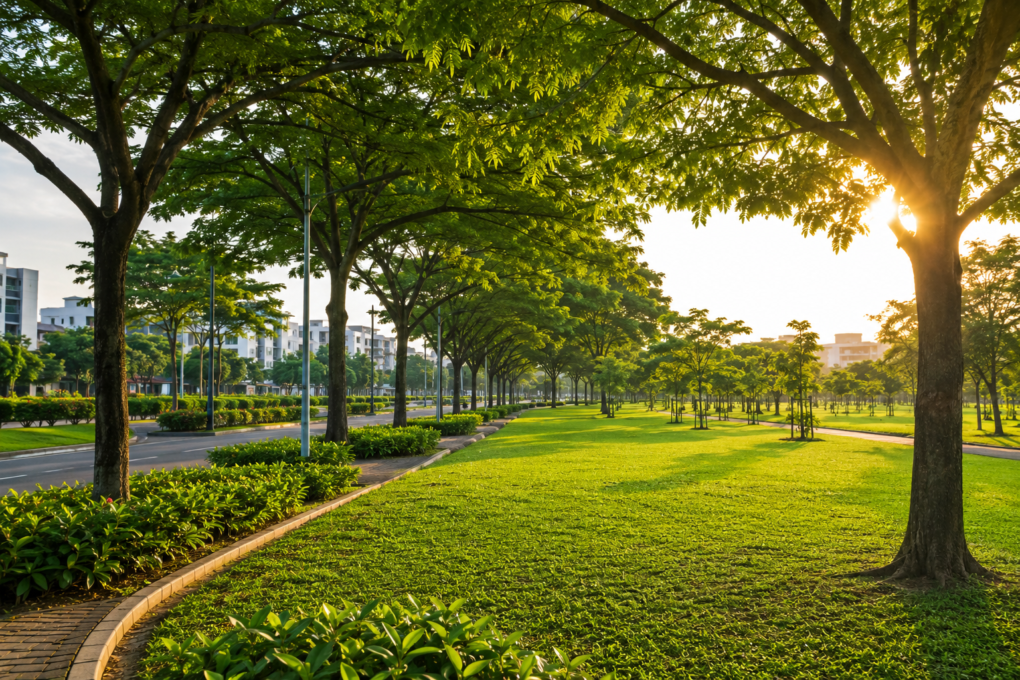
Tree-lined streets provide shade that helps lower surrounding temperatures, making neighborhoods more comfortable during hot afternoons. Grass holds the soil together, reducing erosion and preventing loose soil from becoming airborne dust. Together, they create cleaner surroundings, healthier air, and communities that people are proud to live in.
This is important for another reason. Research highlighted by the United Nations Environment Programme (UNEP) shows that expanding urban green spaces can reduce temperatures by as much as 4°C, improve air quality, and help cities better cope with the impacts of climate change. The benefits are environmental, economic and social.
The Ghana government has good grounds to give green spaces high priority.
Growing Trees Can Also Grow Jobs
A nationwide greening programme would create opportunities across multiple sectors.
The government could strengthen the Department of Parks and Gardens to lead tree planting and landscaping efforts. Students from universities, technical institutes, and agricultural colleges could complete internships by growing grass, raising tree seedlings, and restoring public spaces.
The National Youth Employment Agency could employ young people to plant and maintain trees and landscapes across the country, while the Ghana Prison Service could support supervised community landscaping projects.
The impact would stretch far beyond planting. Landscapers, gardeners, nursery operators, irrigation specialists, lawn maintenance businesses, and equipment suppliers would all benefit, creating jobs while supporting local economies including importation of machinery.
Small Policies Can Create Lasting Change
Simple landscaping standards for homes, businesses, schools, and government properties could gradually transform Ghana’s towns and cities. Property owners could be encouraged, and where appropriately required, to maintain grass, plant suitable trees, and care for their surroundings.
Many countries already treat green spaces as an essential part of urban planning rather than an afterthought. The result is cleaner streets, cooler neighborhoods, less dust, and more attractive communities.
With the right policies and consistent enforcement, Ghana can achieve the same results.
The Green Africa, Green Ghana Initiative
This vision reaches beyond Ghana.
Many African countries face similar challenges with deforestation, soil erosion, and dust. Restoring trees and expanding green spaces could improve public health while creating employment and building cleaner, more resilient communities across the continent.
This is the vision behind the Green Africa, Green Ghana Initiative, championed by Mr. Abraham Charles Moncar.
Every lasting change begins with a single step. The trees and grass planted today will benefit communities for decades, helping create cleaner cities, healthier families, and a greener future for Ghana and Africa.
Source: newsthemegh.com