
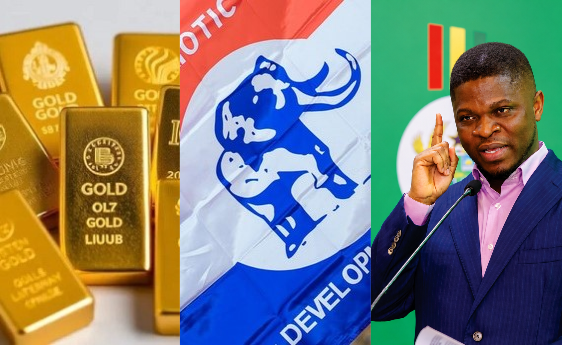
The New Patriotic Party (NPP) has intensified its call for transparency in Ghana’s gold trading sector, demanding that the Ghana Gold Board (GoldBod) disclose the names of companies that purchased the country’s gold under the Domestic Gold Purchase Programme (DGPP).
The NPP is seeking details of the foreign companies involved, including the commercial terms, discounts and contracts associated with the transactions that the party says contributed to an estimated US$1.7 billion, or about GH¢22 billion, economic loss in 2025.
According to the party, the scale of the reported loss requires full disclosure and an independent investigation into Ghana’s gold purchase and export operations.
NPP Questions GoldBod Over Ghana Gold Exports
The NPP said GoldBod has failed to provide sufficient information about companies purchasing Ghana’s gold, despite the significant volume of gold exported under the programme.
Speaking at a joint press conference in Accra on September 1, 2026, NPP Policy Co-ordination Committee Chairman Kojo Oppong Nkrumah and committee member Dr. Mohammed Amin Adam said their review of the International Monetary Fund (IMF) report, Bank of Ghana audited accounts, GoldBod financial statements and other official documents had raised serious concerns.
The party said the discrepancies in the figures reported by different institutions require a detailed reconciliation to determine the actual financial impact of the programme.
Dr. Amin Adam, a former Finance Minister and Member of Parliament for Karaga, questioned the destination of Ghana’s exported gold and demanded that GoldBod publish the identities of the companies that purchased it.
NPP Demands Disclosure of Foreign Gold Buyers
Dr. Amin Adam argued that GoldBod should make public the names of foreign buyers as well as the discounts and commercial arrangements attached to the gold transactions.
He said GoldBod exported approximately 103.8 tonnes of gold sourced from small-scale miners in 2025, with about 98.8% reportedly going to India and Dubai.
According to him, the pricing arrangements for some of these transactions resulted in substantial financial losses for Ghana.
The former Finance Minister explained that although foreign buyers may provide faster payment for gold, such transactions can involve discounts that reduce the amount ultimately received by Ghana.
He claimed that discounts associated with some transactions contributed to an estimated US$450 million loss.
GoldBod Quarterly Reports Under Scrutiny
The NPP also questioned GoldBod’s compliance with reporting requirements under the Ghana Gold Board Act.
The party said quarterly reports required under Section 42 of the Act have not been adequately published, raising concerns about transparency and accountability in the management of Ghana’s gold resources.
The NPP maintained that GoldBod should publish the relevant contracts and commercial arrangements to allow the public to understand how the country’s gold was traded.
Afenyo-Markin and Sammy Gyamfi GoldBod Dispute
The latest demand comes amid an ongoing public disagreement between Minority Leader Alexander Afenyo-Markin and GoldBod Chief Executive Officer Sammy Gyamfi over accountability for the reported US$1.7 billion financial impact associated with the gold programme.
The NPP said the debate should focus not only on future reforms but also on establishing what happened under the programme and identifying the factors responsible for the reported losses.
NPP Calls for GoldBod, BoG and Finance Ministry Reconciliation
Kojo Oppong Nkrumah said the NPP also has concerns about the legal basis for some of the fees charged by GoldBod.
He called on the Attorney-General to clarify whether the fees were authorised through the appropriate legislative process.
The NPP welcomed the decision to end the Bank of Ghana’s pre-financing of gold purchases and transfer the programme’s operations to GoldBod.
However, the party insisted that the new arrangements should not prevent scrutiny of previous transactions.
The NPP is therefore demanding a signed reconciliation involving GoldBod, the Bank of Ghana and the Ministry of Finance, alongside a full parliamentary inquiry into the Domestic Gold Purchase Programme.
GoldBod Surplus vs Bank of Ghana Loss
A major issue raised by the NPP is the significant difference between financial figures reported by GoldBod, the Bank of Ghana and the IMF.
The party said:
- GoldBod reported a GH¢5.45 billion surplus.
- Bank of Ghana audited accounts recorded a GH¢9.05 billion net loss.
- The IMF reportedly estimated the programme’s broader economic cost at about GH¢22 billion.
The NPP argued that the figures may represent different stages or components of the same gold transaction chain, making a comprehensive reconciliation necessary.
The party maintained that the IMF’s estimate should not simply be dismissed, arguing that the Bank of Ghana needs to explain how the reported GH¢9.05 billion loss relates to the wider GH¢22 billion economic cost.
GH¢5 Billion Recapitalisation Bond Raises Questions
According to the NPP, one of the factors behind the difference between the IMF estimate and the Bank of Ghana’s reported loss was a GH¢5 billion transfer from the Consolidated Fund, which the party said was described by the Finance Minister as a recapitalisation bond.
The party also identified GH¢7.99 billion in unrealised gains that it said were recognised as income after the Bank of Ghana sold 22.24 tonnes of reserve gold in October 2025.
The NPP argued that when the GH¢5 billion transfer and GH¢7.99 billion accounting gains are considered against the reported GH¢22 billion economic cost, the resulting figure is close to the Bank of Ghana’s reported GH¢9.05 billion loss.
It said this further demonstrates why GoldBod, the central bank and the Finance Ministry should jointly sign a reconciliation explaining the figures.
NPP Challenges GoldBod’s GH¢5.45 Billion Surplus
The opposition party also questioned GoldBod’s reported GH¢5.45 billion surplus, claiming that about GH¢4.54 billion represented a government capital injection recorded toward the end of the 2025 financial year.
The NPP argued that government capital injections should not be treated as operating revenue or profit.
It further claimed that a significant portion of the remaining surplus consisted of fees generated from gold-related transactions.
The party questioned how GoldBod could report a substantial surplus while the institution financing parts of the gold purchase programme recorded significant losses.
Bank of Ghana Gold Gains Also Questioned
The NPP also drew attention to the GH¢9.57 billion gain from gold sales reported by the Bank of Ghana in 2025.
According to the party, GH¢7.99 billion of this amount represented unrealised gains accumulated from gold purchased in earlier years and recognised after reserve gold was sold.
The NPP argued that excluding the accounting gain would have further weakened the central bank’s financial position.
It also noted that the Ministry of Finance had already provided GH¢5 billion to support the Bank of Ghana’s financial position, warning that taxpayers could ultimately bear the financial consequences.
Three Factors Behind the Gold Purchase Programme Losses
The NPP identified three major factors it believes contributed to the financial losses recorded under the Domestic Gold Purchase Programme.
These are:
- Exchange rate differences used during transactions.
- Discounts offered to foreign gold buyers.
- Fees charged at different stages of the gold trading process.
The party alleged that the Bank of Ghana advanced cedis using one exchange rate while gold purchases were subsequently made at higher market rates, creating additional costs for the programme.
The NPP further cited an IMF estimate that placed the combined cost of the programme at approximately 14.5% of its value in 2025.
NPP Calls for Full Investigation Into Ghana Gold Programme
The NPP maintains that the reported GH¢22 billion economic cost cannot be adequately explained without a transparent investigation into Ghana’s gold trading arrangements.
The party wants GoldBod to disclose the names of foreign gold buyers, contracts, discounts and commercial terms associated with the transactions.
It is also demanding a signed financial reconciliation between GoldBod, the Bank of Ghana and the Ministry of Finance, as well as a parliamentary inquiry into the Domestic Gold Purchase Programme.
The party argues that such measures are necessary to establish how the different financial figures were calculated, determine the actual cost of the programme and ensure accountability in the management of Ghana’s gold resources.
Source: newsthemegh.com