
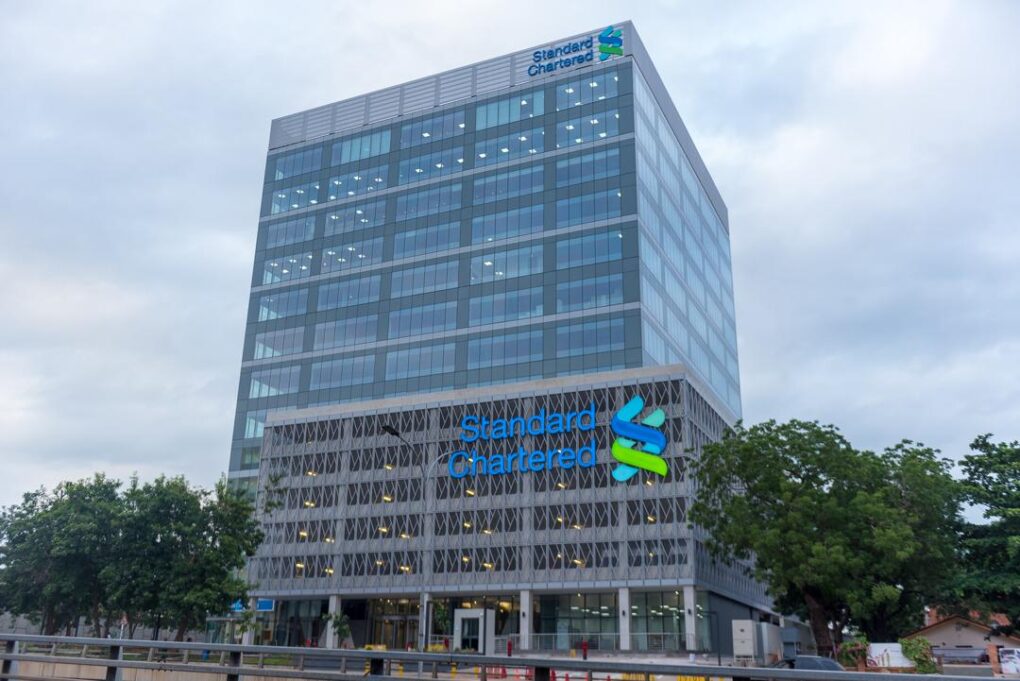
Standard Chartered Bank Ghana has emerged as the bank with the highest average employee compensation in Ghana, spending approximately GH¢931,000 per staff member annually in 2025, according to an analysis of audited financial statements.
The report highlights a significant shift in Ghana’s banking industry, showing that employee compensation is increasingly influenced by each bank’s business strategy, digital transformation, operational model, and workforce structure, rather than its size or historical reputation.
Standard Chartered, Absa and Ecobank Lead Staff Compensation Rankings
Among the 14 banks analysed, Standard Chartered Bank Ghana ranked first with an average personnel cost of GH¢931,000 per employee. Absa Bank Ghana followed with GH¢724,000, while Ecobank Ghana recorded an average of GH¢700,000 per employee.
On the opposite end, Guaranty Trust Bank (GTBank) Ghana posted the lowest average personnel cost at GH¢216,000 per employee—less than one-quarter of Standard Chartered’s figure.
Overall, the average personnel cost across the sampled banks stood at approximately GH¢457,000 per employee, revealing wide disparities in compensation strategies across Ghana’s financial sector.
Banking Strategy Drives Employee Compensation
The findings suggest that banking strategy, rather than foreign ownership, is the primary factor influencing employee costs.
According to Bernard Obeng Boateng, Data Analyst, Founder and Lead Trainer at Finex Skill Hub, although multinational banks dominate the top rankings, ownership alone does not explain the differences.
For example, Access Bank Ghana and Zenith Bank Ghana, despite being subsidiaries of Nigerian banking groups, reported personnel costs below the industry average. Similarly, GTBank Ghana recorded the lowest average staff cost among all banks reviewed.
Banks that focus on corporate banking, investment banking, risk management, structured finance, and financial technology (FinTech) generally employ smaller teams of highly skilled professionals whose expertise commands premium salaries.
In contrast, retail banks maintain larger branch networks with more customer service personnel, resulting in lower average employee costs despite substantial overall payroll expenses.
Digital Banking Reshaping Workforce Costs
The report also points to digital banking and automation as major factors transforming workforce economics in Ghana’s banking sector.
Banks investing heavily in digital transformation, automated banking services, centralized processing, and online financial services can manage larger transaction volumes with fewer employees, helping reduce average personnel costs while maintaining operational efficiency.
However, the report cautions that higher employee spending should not automatically be viewed as inefficient.
Instead, banks may intentionally invest in experienced professionals capable of generating higher revenues, while institutions with lower personnel costs may simply operate different workforce structures supported by technology.
Labour Costs Continue to Rise
The 2025 financial statements show that OmniBSIC Bank recorded the largest increase in personnel cost per employee following adjustments in its audited accounts. CalBank and Ecobank Ghana also registered notable increases.
Industry analysts attribute these changes to salary reviews, organisational restructuring, workforce optimisation, accounting adjustments, and continued investment in skilled professionals as banks adapt to evolving customer expectations and increasing digital adoption.
Transparency Challenges Remain
The analysis also highlights transparency concerns within Ghana’s banking industry.
Two major financial institutions—Stanbic Bank Ghana and GCB Bank—were excluded because their published financial statements did not disclose employee headcount in a comparable format.
Experts say improved disclosure of workforce data would enhance corporate governance, ESG reporting, investor confidence, productivity analysis, and financial transparency across Ghana’s banking sector.
Ghana Banking Industry Adapts to a New Competitive Landscape
The report concludes that personnel cost per employee has become an important indicator of a bank’s strategic direction rather than simply a measure of generosity or cost efficiency.
As Ghana’s banking sector continues to evolve through digital innovation, financial technology, workforce transformation, and changing customer demands, institutions are adopting different approaches to balancing talent acquisition, operational efficiency, and long-term profitability.
The 2025 data demonstrate that the cost of employing a banker in Ghana now depends far more on a bank’s business model and investment strategy than on the size of its balance sheet or legacy market position.
Source: newsthemegh.com