

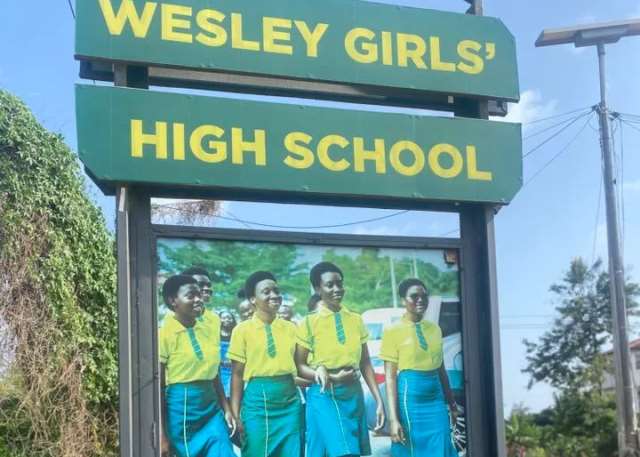
Allegations of religious discrimination at Wesley Girls High School (WGHS) have been vehemently denied by the Methodist Church of Ghana, which maintains that the school’s long-standing customs are legitimate, inclusive, and essential to upholding discipline and unity.
The Church responded to allegations of a Supreme Court case, Shafic Osman v. The Board of Governors, Attorney-General & Ghana Education Service, in a statement issued on Friday, November 28.
The Church stated that it is working to acquire official records so that its legal staff can react appropriately, even though it has not yet received formal notification.
The Church emphasized that allegations that WGHS engages in discriminatory activities as a “public school” are baseless. Harriet Wrigley founded the school in 1836 with the goal of helping girls develop their “Head, Heart, and Hand,” regardless of their origin, ethnicity, religion, or faith.
The Church highlighted that many of its almost 200-year history of educating students from a wide range of religious backgrounds—including Muslims, Adventists, Catholics, Jehovah’s Witnesses, Eckists, Buddhists, Hindus, atheists, and agnostics—have gone on to contribute positively to society.
It claimed that Methodist doctrine that discrimination is incompatible with Christian ideals is reflected in this.
The Church further explained that WGHS’s Methodist identity was unaffected by government assistance provided to faith-based institutions in the early 1960s.
Through its motto, “Live Pure, Speak True, Right Wrong, Follow the King,” and school hymn, which proclaims a dedication to Christian and moral training, the school has consistently publicly declared its Christian background.
Only adherence to a framework intended to foster uniformity, discipline, order, and shared experience, as well as respect for the school’s traditions, are expected of admitted students.
The Church contended that in order for all students to live, study, worship, and engage together, a cohesive framework must be maintained as enrollment and diversity grow.
The Church argued that establishing parallel systems, such as distinct eating, sleeping, worship, or study habits, would result in segregation and undermine the school’s social culture, even while it acknowledged students’ constitutional right to exercise their faith.
The National Peace Council sponsored the signing of the Memorandum of Understanding by the Conference of Managers of Education Units (COMEU) on April 15, 2024, which the Church cited.
The MOU offers a framework for harmony in mission schools, which WGHS continues to preserve. It is supported by significant Christian organizations and Muslim leadership, such as the Office of the National Chief Imam and the Ahmadiyya Mission.
Lastly, the Methodist Church thanked the Christian Council of Ghana, the Anglican Church, the Ghana Catholic Bishops’ Conference, and other ecumenical organizations for their public support through declarations of solidarity.
Source: newsthemegh.com