
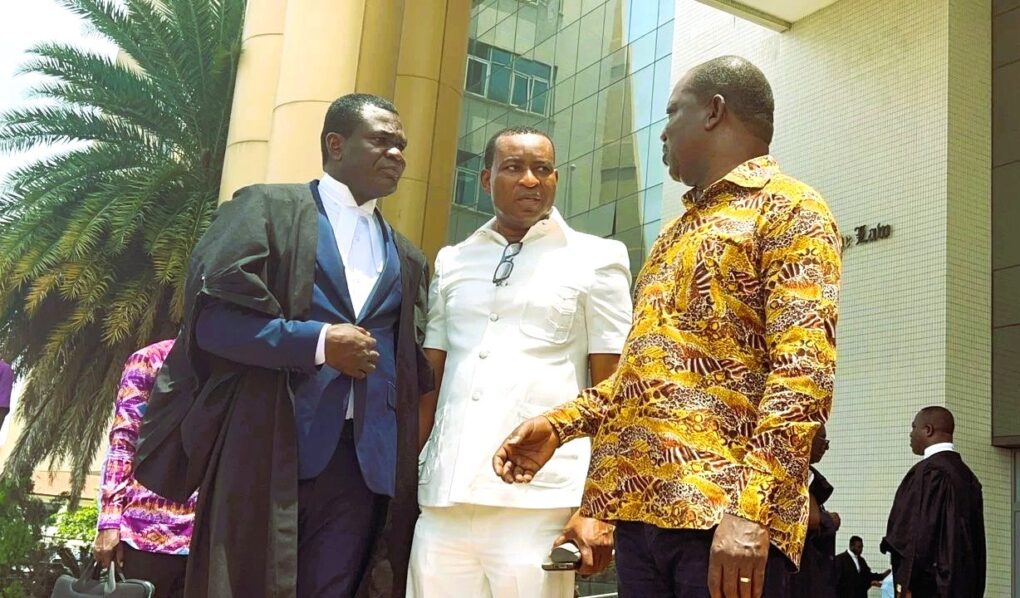
Bernard Antwi Boasiako, also known as Chairman Wontumi, the Ashanti Regional Chairman of the New Patriotic Party (NPP), has adamantly denied giving prosecution witness Henry Okum (PW2) permission to mine on Akonta Mining’s concession.
He maintained that their agreement was just for the planting of coconuts and the restoration of land.
On Thursday, May 21, Wontumi testified in his own defence at the High Court in Accra, claiming that PW2 was only allowed onto the concession to restore degraded areas of the land by planting coconut trees. He refuted claims that he assigned mineral rights or knowingly enabled illicit mining operations.
After the prosecution completed its case, Wontumi, who is on trial alongside Akonta Mining on charges including transferring mineral rights without ministerial authority, began his defence.
Prior to his testimony, the defence had called two witnesses: former Deputy Lands Minister George Mireku Duker and mining expert Wisdom Gomashie.
Wontumi acknowledged that he gave PW2 access to the concession during cross-examination by Deputy Attorney General Dr. Justice Srem Sai, but he insisted that the goal was reclamation rather than mining.
He told the judge, “I didn’t give him permission to mine.”
“He came to reclaim the land and plant coconut trees so that when the coconuts mature, we would share.”
In addition, he testified that, in contrast to the prosecution’s allegations, he never helped PW2 purchase excavators or other earth-moving equipment.
“That is not true. I do not know what work he did. He only planted trees and carried out reclamation. I did not assist him in purchasing any earth-moving equipment,” he claimed.
However, the prosecution maintained that Wontumi consciously allowed mining operations on the concession and purposefully kept his distance from the site in order to avoid being directly connected to the operations.
Wontumi was informed by Justice Srem Sai that he let PW2 to use the concession for mining even though he was aware that he was a small-scale miner.
Wontumi, however, denied the claim, stating that PW2 identified himself as a “service support miner” rather than someone looking to engage in illicit mining.
Additionally, according to the prosecution, Wontumi’s business strategy entailed obtaining mining leases and permitting others to engage in illegal mining in return for a portion of the profits, a practice known as “goodwill” or “percentage” in the illegal mining community.
Wontumi refuted the accusation, calling it a “blatant falsehood.”
The testimony of PW2 Henry Okum, who earlier informed the court that Wontumi consented to allow him to mine parts of the concession while using the mining profits to pay reclamation projects, is crucial to the prosecution’s case.
Justice Audrey Kocuvie-Tay referenced parts of PW2’s evidence and Wontumi’s own warning to the police in a previous decision ordering Wontumi to begin his defence.
The judge ruled, “The evidence on record shows that A1 did permit PW2 to enter the concession.”
Wontumi’s warning statement, in which he acknowledged granting PW2 access to the concession “only to plant coconut trees to reclaim the mined portion of the concession,” was cited in the decision.
The judge did, however, also draw attention to elements of PW2’s testimony that the court deemed important in assessing whether a prima facie case had been established.
PW2 indicated that: “A1 agreed that I mine on the unmined portions of the concession… A1 did not give me any money to do the reclamation works as I was expected to use a portion of the proceeds from my mining activities… to defray the cost of reclamation.”
Justice Kocuvie-Tay stated that the lack of direct funding for reclamation boosted PW2’s case.
“Essential to the credibility of PW2’s testimony is the fact that A1 did not provide funding for the reclamation exercise, which A1 admits to enabling PW2 to carry out under his concession. “How else did A1 expect PW2 to fund the reclamation exercise?” the judge said in his ruling.
However, Wontumi admitted during the proceedings on Thursday that he did not have a formal contract with PW2 that detailed the reclamation arrangement.
He told the court, “I have no documentation with PW2 apart from the instruction to reclaim the land and plant trees, which he has done, and when it matures, we will share.”
Additionally, he acknowledged that he never went to the location after granting PW2 access to the concession, despite the fact that he claimed PW2 showed him films demonstrating restoration efforts and the planting of roughly 18,000 coconut palms.
Source: newsthemegh.com