

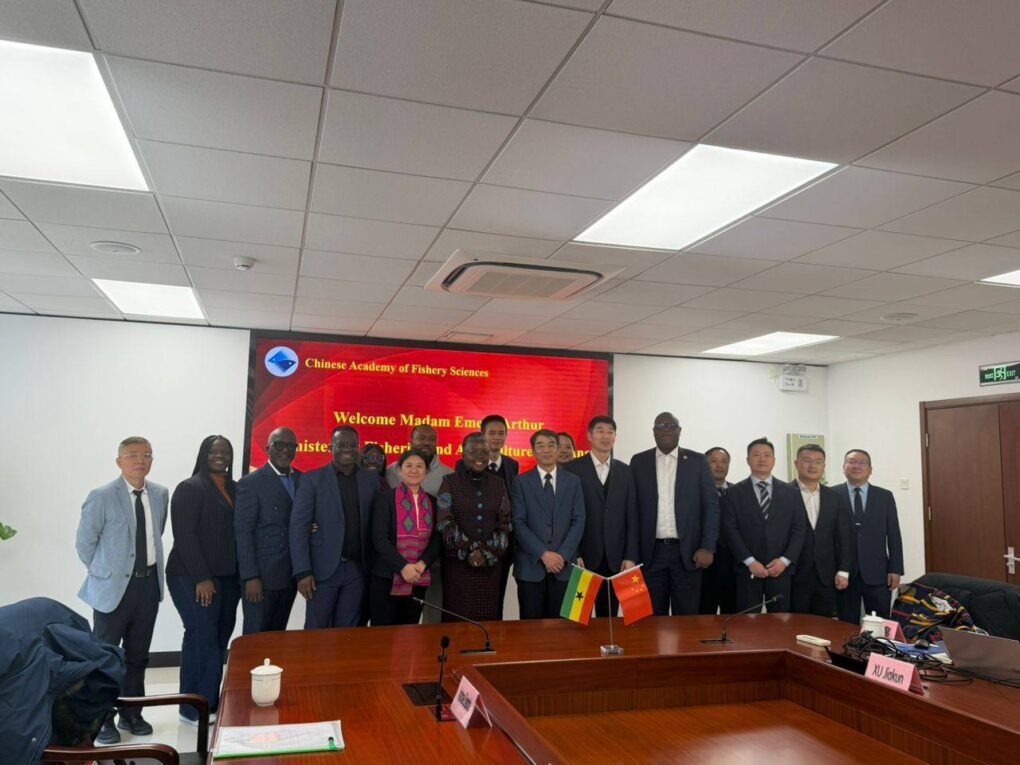
After high-level strategic talks with China’s top national fisheries research organisation, the Chinese Academy of Fishery Sciences (CAFS), the Ministry of Fisheries and Aquaculture (MoFA) has made significant progress in reforming Ghana’s fisheries and aquaculture sector.
The Minister for Fisheries and Aquaculture, Hon., led the engagement. Emelia Arthur (MP) is a member of the Ghanaian government’s 24-Hour Economy and Accelerated Export Development Programme (24H+), which aims to improve industrial competitiveness through strategic international alliances, increase food security, create jobs, and increase exports.
Senior representatives from the Ministry, the 24H+ Secretariat, and important Ghanaian economic institutions joined CAFS’s technical directors and leadership for the meeting, which took place at the organization’s Beijing headquarters.
Fisheries and Aquaculture as a National Development Priority

Speaking during the meeting, Hon. Emelia Arthur reiterated that fisheries and aquaculture continue to be important pillars of Ghana’s development plan, making substantial contributions to employment, export revenue, food and nutrition security, and the long-term growth of the Blue Economy.
She described the government’s goal of creating a fisheries and aquaculture industry that is resilient, well-run, and driven by science, with the help of robust institutions, cutting-edge technology, and data-driven decision-making.
“The Ministry is deliberately pursuing research-led partnerships that will strengthen Ghana’s capacity across aquaculture expansion, fisheries resource management, disease control, value addition and human capital development,” the Minister stated.
Deepening the 66-Year Ghana–China Partnership
With fisheries and aquaculture designated as a priority area for long-term cooperation, the engagement expands upon Ghana and China’s 66-year Comprehensive Strategic Partnership.
The Ministry of Agriculture and Rural Affairs of China oversees CAFS, which demonstrated its vast institutional and technical capabilities, including:
14 specialised fisheries and aquaculture research institutes
Nearly 5,000 scientists and technical experts
Advanced research vessels, laboratories and field stations
Active cooperation programmes in more than 40 countries, including across Africa
Key Areas of Cooperation Discussed
1. Aquaculture and Mariculture Development
The Ministry expressed strong interest in collaboration to expand Ghana’s aquaculture production and close the national fish supply gap through:
Marine fish farming (mariculture) systems
Species diversification beyond tilapia
Inland and coastal cage farming
Scaled production for domestic and export markets
2. Capture Fisheries and Resource Management
Discussions covered:
Joint fish stock assessments and marine surveys
Research vessel collaboration
Strengthening fisheries data systems
Combating Illegal, Unreported and Unregulated (IUU) fishing
Addressing climate change impacts on marine ecosystems
3. Fish Disease Control and Biosecurity
MoFA highlighted existing national gaps in biosecurity and disease surveillance. CAFS expressed readiness to support Ghana through:
Development of national biosecurity frameworks
Strengthening diagnostic and laboratory systems
Capacity building for fisheries officers and researchers
4. Capacity Building and Human Capital Development
Both sides explored structured cooperation including:
Scholarships and postgraduate training programmes
Technical exchanges and expert deployments
Partnerships with Ghanaian universities and research institutions
Strengthening national fisheries research infrastructure
5. Fisheries Infrastructure and Value Chain Development


Priority areas identified included:
Fish processing and cold-chain infrastructure
Feed production systems
Aquaculture demonstration parks
Support for Phase II development of the Fisheries College
Next Steps
The Ministry of Fisheries and Aquaculture will lead the next phase of engagement, which will include:
Drafting a Framework Memorandum of Understanding (MoU) with CAFS
Identifying priority joint research programmes
Planning CAFS technical missions to Ghana
Establishing structured training and scholarship pipelines
Exploring infrastructure collaboration and investment models
A joint working group involving MoFA, CAFS and the 24H+ Secretariat is expected to be established by February 2026, with pilot projects targeted for rollout by mid-2026.
Strategic Impact
The engagement positions fisheries and aquaculture as a strategic anchor of Ghana–China cooperation, aligned with:
National food security goals
Export expansion under the AfCFTA framework
Research-driven policy and governance
Sustainable Blue Economy growth
Long-term skills and institutional development
The Ministry reiterated its dedication to making sure that foreign collaborations result in real advantages for Ghanaian coastal communities, fishermen, fish producers, and processors.
Source: newsthemegh.com