
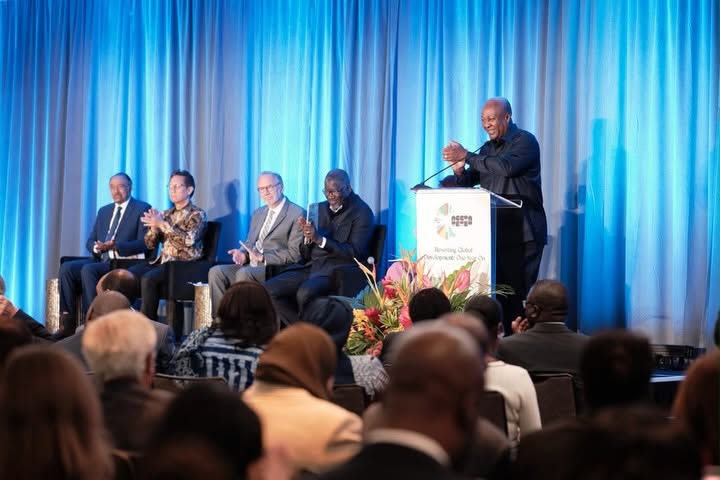
President John Dramani Mahama has called for greater control by countries in the Global South over global health, trade and development financing, arguing that true ownership of development programmes must be matched by the ability to make and implement decisions.
President Mahama made the remarks during a high-level Accra Reset side event held in New York on the sidelines of the 81st United Nations General Assembly (UNGA 81). He also launched a major report titled “A Sovereign Future for Health,” which sets out recommendations for reshaping global health governance.
Mahama: No Ownership Without Control
Addressing global leaders and development partners, President Mahama said many countries in the Global South achieved political independence decades ago, but significant influence over international systems governing trade, finance, health and development remained outside their control.
He referenced the 1955 Bandung Conference, where 29 nations called for a greater voice in international affairs.
According to Mahama, political independence resulted in national sovereignty, but developing countries continued to operate within international systems where key economic and development decisions were often made elsewhere.
He also pointed to the international development principle of country ownership, saying that ownership cannot be meaningful when countries are responsible for development outcomes without having sufficient control over the systems and resources involved.
“There can be no ownership without control,” President Mahama said.
Accountability Must Accompany Sovereignty
While advocating greater control for developing countries, Mahama said increased authority must come with strong domestic accountability.
He argued that transferring decision-making power from international institutions to national governments would not automatically guarantee genuine sovereignty.
According to the President, Ghana’s development strategy therefore places emphasis on fiscal discipline, accountability, anti-corruption measures and responsible management of public funds.
He summarised the principle as “no ownership without control, but no control without absolute accountability to our people.”
The Presidency says the Accra Reset seeks to connect authority with responsibility, productive capacity and accountability among development partners.
Accra Reset Launches ‘A Sovereign Future for Health’ Report
A major highlight of the New York event was the launch of the “A Sovereign Future for Health” report.
The report provides a roadmap for moving from policy discussions to implementation and focuses on strengthening the ability of countries in the Global South to develop and finance their own health systems.
Among its areas of emphasis are domestic industrial capacity, pharmaceutical manufacturing and secure medicine supply chains. The initiative also promotes stronger partnerships among countries in Africa, Asia and other parts of the Global South.
The Accra Reset was established as a Ghana-led initiative aimed at rethinking global development financing, international cooperation and health governance.
The initiative is built around three principles: sovereignty, workability and shared value. Health has been selected as an entry point and practical test of the broader framework.
Ghana Pushes for Health Sovereignty
President Mahama said the Accra Reset is intended to reduce excessive dependence on external donors and strengthen domestic capacity in areas including healthcare, pharmaceutical production, research, regulation and medical supply chains.
He stressed that the initiative does not seek to isolate developing countries from international partners.
Instead, he described the approach as “pragmatic interdependence”, based on partnerships in which countries engage one another on more equal terms.
The Presidency said the report proposes building domestic industrial capability and expanding local pharmaceutical manufacturing, alongside mechanisms to support reliable medicine supply chains across Africa and Asia.
Maternal and Child Health Identified as Key Test
Health has been identified as the first major area through which the Accra Reset will demonstrate its approach.
President Mahama highlighted maternal and child health as an important test of efforts to strengthen health sovereignty in developing countries.
The initiative builds on the Africa Health Sovereignty Summit held in Accra in August 2025, which also focused on strengthening African capacity in healthcare and reducing dependence on external systems.
The President also referenced initiatives involving maternal and child health as potential models for testing new approaches to international health cooperation.
Ghana to Advance Accra Reset at African Union
President Mahama said Ghana intends to continue promoting the Accra Reset at the continental level when the country assumes the African Union chairmanship in 2027.
He said Ghana would work with governments, global health organisations, development finance institutions, philanthropic organisations and private-sector partners to translate the recommendations into practical country-level agreements.
The Presidency has also said the initiative is intended to strengthen Africa’s capacity to finance its own development priorities while expanding cooperation with international partners.
Accra Reset and the Future of Global Development
The Accra Reset comes amid wider discussions about reforming global health governance, development financing and international cooperation.
The initiative’s focus on health sovereignty is also relevant to ongoing global efforts to strengthen pandemic preparedness, health systems and international cooperation. The United Nations is scheduled to hold a high-level meeting on pandemic prevention, preparedness and response during the 81st General Assembly.
President Mahama’s latest remarks therefore place Ghana’s Accra Reset agenda, African health sovereignty and Global South development financing at the centre of his government’s engagement at the 81st UN General Assembly.
The initiative’s next phase will focus on turning its recommendations into practical programmes involving governments, financial institutions, research organisations, manufacturers and other development partners.
Source: newsthemegh.com