

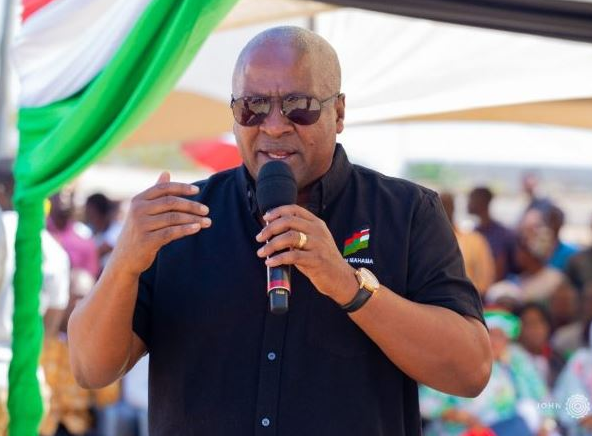
Most Ghanaians still approve of President John Mahama’s job performance, but popular satisfaction has dropped, according to a nationwide poll released today, Wednesday, June 10, 2026, by the Institute of Economic Affairs (IEA).
Mahama’s job approval rating is 58.9%, down from 68% in December 2025, according to the poll, which was conducted in May 2026 throughout all sixteen regions of Ghana and included over 1,000 respondents. 12.8% of respondents had no opinion, while 28.4% disapproved of his performance.
Even while the reduction suggests that the public is becoming more anticipatory, the IEA claims that the more than 30 percentage point difference between approval and disapproval shows that positive evaluations of the President’s performance continue to be far higher than critical ones.
The economics is the primary motivator for those who support it. The government’s management of the economy is praised by nearly three out of four approvers (73.5%), followed by road infrastructure (16.0%) and energy and power (2.7%).
The results show that during the Mahama administration, there was a significant macroeconomic improvement. The cedi has gained 26% versus major currencies since January 2025, inflation has decreased from 23.5% to about 3.4%, and the Bank of Ghana’s policy rate has been lowered from 27% to 14%.
Ghana’s debt-to-GDP ratio decreased from 61.8% at the end of 2024 to 45.3% by the end of 2025, while average commercial bank lending rates decreased from roughly 32% to about 20%.
Due to these improvements, Ghana’s sovereign credit rating has been upgraded by Fitch, Moody’s, and S&P, which is the first triple upgrade in many years, according to the IEA.
The economy continues to rank highest among those who disapprove (30.9%), although the IEA warns that this does not necessarily indicate a disapproval of the macroeconomic record of the administration.
According to the institute, it might instead highlight the real-world experiences of Ghanaians for whom declining inflation and a stronger cedi haven’t yet resulted in reduced living expenses, better employment opportunities, or increased household incomes.
A temporary power supply limitation in May 2026 that caused regular outages to homes and businesses nationwide was specifically linked by the IEA to the 29.9% of disapprovers who mentioned electricity supply.
19.1% of those who disapproved brought up corruption, indicating, according to the IEA, that a sizable section of the public has not yet been persuaded by the government’s anti-corruption rhetoric.
The general image, according to the IEA, is one of widespread public support tempered by growing expectations. “The findings suggest that Ghanaians are broadly supportive of the President’s leadership but are expectant that the progress recorded at the macro level will increasingly be felt in their daily lives,” the institute said.
The poll is the most recent in the IEA’s ongoing series that monitors presidential job performance.
Source: newsthemegh.com