
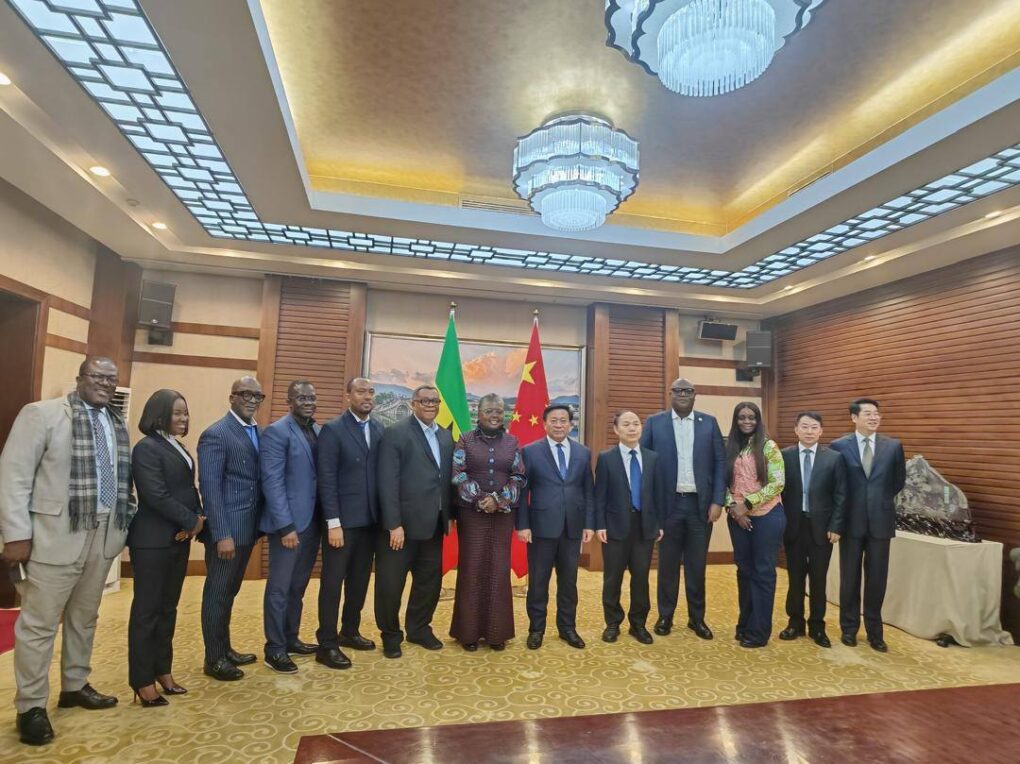
The Minister of Fisheries and Aquaculture, Hon. Emelia Arthur (MP) has led a high-level engagement between the Ghanaian and Chinese governments aiming at strengthening bilateral collaboration in fisheries and aquaculture to improve food security, job development, and long-term blue economy growth.
The engagement took place in Beijing during a meeting between Hon. Emelia Arthur and Mr. Han Jun, Secretary of the Communist Party of China’s Leadership Group and Minister of the Ministry of Agriculture and Rural Affairs (MARA), which oversees fisheries and aquaculture.
The meeting provided Ghana with a strategic platform to present a comprehensive Ghana-China Fisheries Partnership Framework, which outlined the country’s vision for a sustainable, resilient, and investment-ready fisheries and aquaculture sector that supports national development while protecting aquatic ecosystems.

Minister Emelia Arthur leads Ghana’s Fisheries Transformation Agenda.
Addressing the audience, Hon. Emelia Arthur emphasised the importance of fisheries and aquaculture in Ghana’s food security and economic transformation agendas, noting that fish accounts for more than 60% of the country’s animal protein intake and supports millions of livelihoods along the value chain.
She emphasised the government’s commitment to repositioning the sector through science-based management, aquaculture expansion, value creation, and strategic international alliances.
“The future of Ghana’s fish supply lies in responsible aquaculture development supported by technology, investment, and strong institutional collaboration,” the Minister noted, adding that Ghana is eager to work with China to unlock large-scale growth across the fisheries value chain.
Ghana is positioned as China’s gateway to African fisheries markets.
During the presentation, Ghana’s Ministry of Fisheries and Aquaculture (MoFA) highlighted the country’s strategic advantage as a gateway to African fisheries markets, highlighting its stable democracy, strong rule of law, investor-friendly environment, and 100% foreign ownership.
Ghana, through the African Continental Free Trade Area (AfCFTA) Secretariat headquartered in Accra, has access to a 1.3 billion-consumer African market valued at US$3.4 trillion, as well as the 370 million-consumer ECOWAS market.
The Ministry also emphasised Ghana’s abundant natural resources, such as the 8,502 km² Lake Volta, the largest artificial lake in the world, which is currently used at a rate of less than 5%. This presents significant opportunities for the growth of aquaculture, especially tilapia production under favourable year-round water temperatures.
Closing a US$800 Million Fish Supply Gap
According to MoFA data provided at the meeting, Ghana’s yearly fish demand is 1.28 million metric tonnes, but domestic production is only about 684,000 metric tonnes. This results in a supply deficit of roughly 590,000 metric tonnes, which is worth between US$600 and US$800 million.
The Ministry emphasised that aquaculture must drive future growth, with a national output target of 177,000 metric tonnes by 2027, given that important marine species, such as sardinella, have been reduced to 13.8% of sustainable levels.

Investment Opportunities Across the Value Chain
The Ministry highlighted a number of high-impact investment possibilities for Chinese businesses, such as the production of fish feed, SPF hatcheries, cold chain infrastructure, and contemporary fish processing facilities.
With no large-scale fillet or surimi processing capability in the nation, post-harvest losses now range from 25 to 50 percent in inland fisheries and 10 to 20 percent in marine fisheries. Deep processing is still below 10 percent.
Flexible investment structures, such as joint ventures, totally owned businesses, public-private partnerships (PPPs), and technology licensing, were guaranteed to prospective investors. These models were backed by Free Zone incentives like tax holidays, duty exemptions, and unlimited profit repatriation.
Strategic Fishing Ports and Flagship Projects
Additionally, MoFA submitted finished feasibility studies for six priority fishing ports across the country, with Shama in the Western Region designated as a flagship project that could generate over 10,000 employment and require an estimated US$25–40 million investment.
Ghana also offered an instant collaboration opportunity for the US$12 million Ghana National Aquaculture Centre, a fully completed facility looking for a Chinese partner to support operations, research, training, and technology demonstration for Ghana and the larger West African subregion.
Biosecurity and Human Capital at the Core

Hon. Emelia Arthur emphasised the critical need to improve aquatic animal health systems, especially with regard to the Infectious Spleen and Kidney Necrosis Virus (ISKNV), which has impacted over 80% of aquaculture operations.
Acknowledging China’s worldwide leadership in aquaculture biosecurity, Ghana is looking to work with China on vaccine development, laboratory twinning, disease surveillance systems, and SPF hatchery technologies.
The Ministry also suggested a structured human capital development program that would target up to 1,200 professionals over a five-year period and include scholarships and technical training in biosecurity, disease management, processing technologies, and fisheries policy in order to assure sustainability.
Strong Chinese Leadership Encouraging Collaboration
Mr. Han Jun, a renowned agricultural economist and seasoned public administrator with more than 30 years of experience in China’s “Three Rural Issues” sector, led the interaction.
With a doctorate in agricultural economic management from Northwest A&F University, Mr. Han Jun has worked at important national organisations such as the State Council’s Development Research Centre and the Chinese Academy of Social Sciences.
He has also held high leadership positions in the province, fusing his knowledge of policy with real-world experience in government.
He has supported international agricultural and fisheries cooperation based on mutual benefit, technology transfer, capacity building, and sustainable resource management since taking office as Minister of Agriculture and Rural Affairs in 2024. These principles are highly compatible with Ghana’s fisheries transformation agenda.

Building a Partnership for Generations
As the engagement came to an end, Hon. Emelia Arthur advocated for the creation of a formal Memorandum of Understanding (MoU) for Ghana-China Fisheries Cooperation, backed by cooperative investment roadmaps, knowledge transfer systems, and scholarship initiatives.
She explained that the cooperation, which combines Ghana’s natural resources, geographical location, and access to African markets with China’s cutting-edge aquaculture skills, is intended to benefit both countries for generations.
In close cooperation with key international partners, the Ministry of Fisheries and Aquaculture Development reaffirmed its commitment to spearheading a science-driven, investment-ready, and inclusive transformation of Ghana’s fisheries and aquaculture sector.
Source: newsthemegh.com