
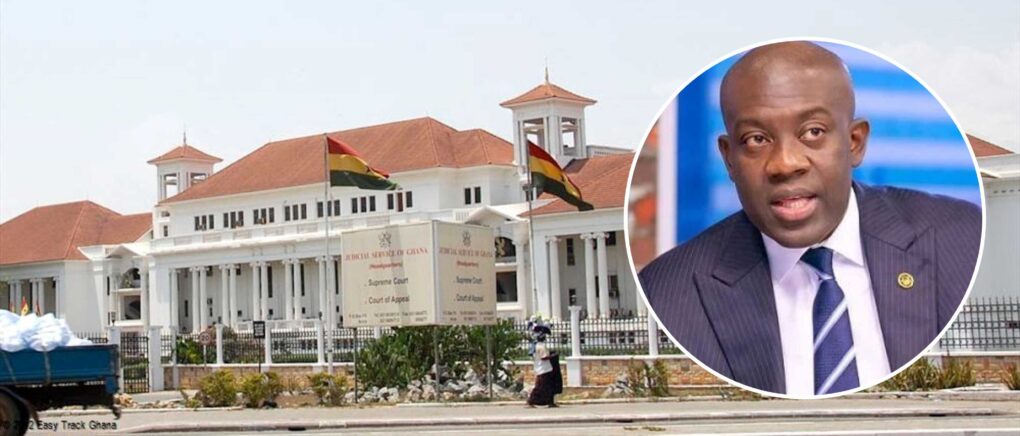
The Supreme Court of Ghana is expected to deliver its ruling today on an application seeking to prevent the High Court from conducting selected criminal trials during the ongoing legal vacation.
The case is before Justice Gabriel Scott Pwamang, who is sitting as a sole judge of the Supreme Court. He heard arguments from both sides on an interlocutory injunction filed by Ofoase-Ayirebi MP Kojo Oppong Nkrumah.
Kojo Oppong Nkrumah Challenges Chief Justice’s Warrants
Oppong Nkrumah is challenging the constitutionality of administrative warrants issued by the Chief Justice, which direct selected High Court judges to sit and hear criminal cases during the legal vacation.
The plaintiff has asked the Supreme Court to determine whether the Chief Justice has the constitutional authority to issue the administrative directives that allow the selected High Court judges to conduct criminal trials during the vacation period.
The Attorney-General has been joined as the second respondent in the case.
Counsel for Oppong Nkrumah, Frank Davies, argued that because the Chief Justice had been named personally as a defendant, he should have independent legal representation rather than being represented by the Attorney-General.
Separation of Powers Argument
Davies argued that allowing the Attorney-General, who represents the Executive, to represent the head of the Judiciary could raise constitutional concerns regarding the separation of powers.
He stressed that the Judiciary, Legislature and Executive are constitutionally recognised as independent arms of government.
The lawyer relied on an affidavit filed on August 14, 2026, together with a supplementary affidavit submitted on the day of the hearing.
He further argued that the traditional practice during legal vacation had been for courts to deal mainly with urgent and non-contentious applications. According to him, criminal trials were generally scheduled when judges and lawyers agreed on dates and the necessary vacation warrant was obtained from the Chief Justice.
Attorney-General Defends Chief Justice’s Representation
However, Deputy Attorney-General and Minister of Justice Dr Edem Srem-Sai rejected the argument that the Chief Justice’s representation by the Attorney-General created a conflict of interest.
He told the Supreme Court that no actual conflict had been established and maintained that the Chief Justice, as the administrative head of the Judiciary, could properly be represented by the Attorney-General.
Dr Srem-Sai also argued that the Attorney-General’s representation of the Chief Justice did not affect the Attorney-General’s independent position as a defendant in the case.
Legal Test for Interlocutory Injunction
The Deputy Attorney-General urged the court to apply the established legal principles governing applications for interlocutory injunctions.
He said the Supreme Court must determine whether the applicant had raised a serious question to be tried, whether refusing the injunction could result in irreparable harm, and where the balance of convenience lay.
Dr Srem-Sai further argued that the applicant had misunderstood the difference between the Chief Justice’s administrative authority to issue vacation warrants and the judicial discretion exercised by individual High Court judges in managing their cases.
Justice Gabriel Scott Pwamang is expected to deliver the Supreme Court’s ruling today, a decision that could have significant implications for the conduct of criminal trials during Ghana’s legal vacation and the constitutional powers of the Chief Justice.
Source: newsthemegh.com