
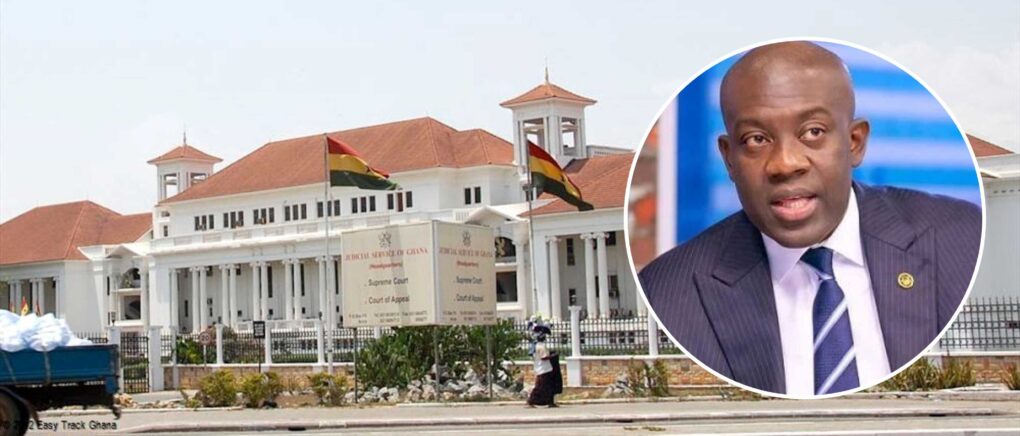
The Supreme Court has dismissed an injunction application filed by Ofoase Ayeribi Member of Parliament Kojo Oppong Nkrumah, seeking to suspend proceedings in a case challenging the constitutionality of warrants issued by the Chief Justice for selected High Court judges to hear criminal cases during the legal vacation.
The Supreme Court, presided over by Justice Gabriel Scott Pwamang, ruled that the applicant had not demonstrated a sufficiently strong legal basis to justify an injunction against the Chief Justice’s constitutional and administrative powers.
Supreme Court Upholds Attorney-General’s Representation
In its ruling, the Court also addressed concerns over the Attorney-General representing the Chief Justice in the proceedings.
The Supreme Court relied on its earlier decision in Republic vrs Tsatsu Tsikata, which established that the Chief Justice, as a public official, may be represented by the Attorney-General in legal proceedings brought against him.
The Court therefore found no impropriety in the Attorney-General appearing on behalf of the Chief Justice in the matter.
Court Rejects Discrimination Argument
A central argument presented by Kojo Oppong Nkrumah was that assigning criminal cases to judges during the legal vacation amounted to a violation of Article 17 of the 1992 Constitution, which guarantees equality before the law and protection against discrimination.
The Supreme Court rejected the argument, stating that there was no evidence that the Chief Justice had instructed judges to apply the law differently to individuals appearing before the courts.
Justice Pwamang noted that the applicant had himself recognised that the Chief Justice has the discretion to issue warrants assigning judges to hear cases.
The Court further held that the warrants clearly indicated that the judges were expected to handle cases pending before their respective courts.
Legal Vacation Trials Intended to Speed Up Criminal Cases
According to the Supreme Court, there was no allegation that the Chief Justice’s decision was based on prohibited grounds such as race, gender, religion or any other constitutionally protected characteristic of accused persons or witnesses.
The Court explained that the warrants were part of efforts to create additional opportunities for criminal cases to be heard and determined without unnecessary delays.
It stressed that although certain criminal proceedings are not normally heard during the legal vacation, this does not prevent the judiciary from taking steps to advance the administration of justice during the period.
Justice Gabriel Scott Pwamang, sitting as a sole judge, consequently dismissed the injunction application.
The substantive case challenging the constitutionality of the Chief Justice’s warrants will continue separately, meaning the Supreme Court is yet to make a final determination on the broader constitutional challenge.
Source: newsthemegh.com